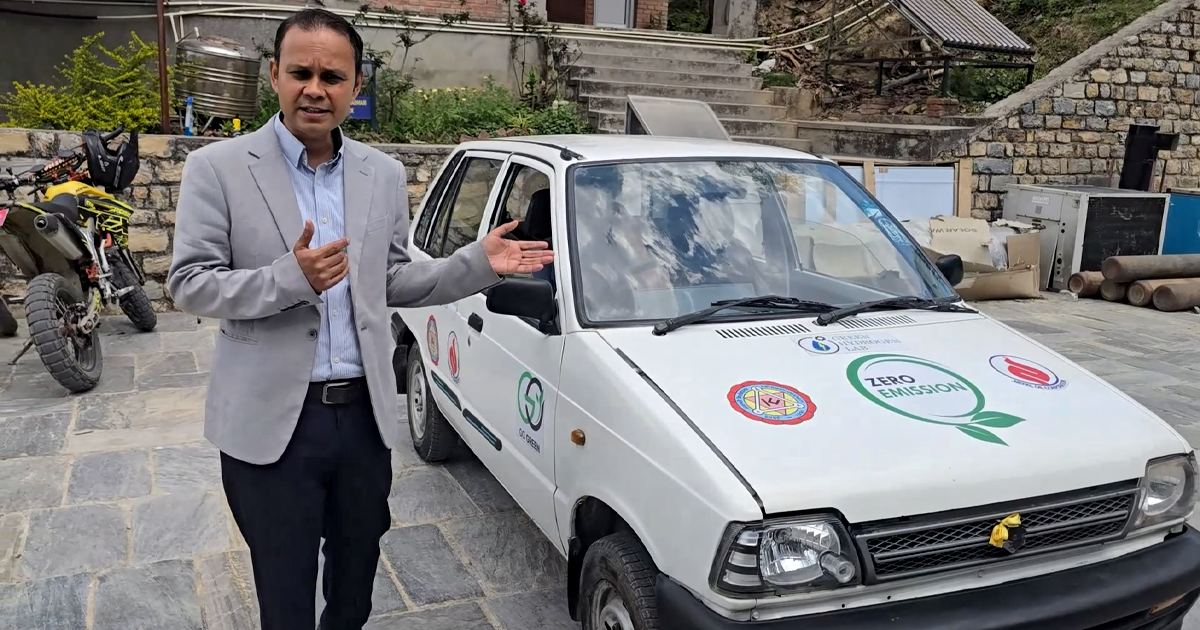

Kathmandu: Kathmandu University has demonstrated that even two-decade-old vehicles can be converted into electric ones, offering a practical and affordable path toward cleaner transportation.
According to Associate Professor Biraj Singh Thapa, converting a 20-year-old diesel car into an electric vehicle can now be done for around Rs 700,000, significantly lower than the initial experimental cost.
The university’s engineering team successfully converted a roughly 25-year-old diesel Maruti 800, one of the institution’s earliest vehicles, into an electric car. Early trials cost nearly Rs 1.5 million due to trial-and-error, sourcing challenges, and a lack of prior experience. With refined design and tested conversion kits, the team now estimates the process can be completed at less than half that cost.
The conversion involves removing the internal combustion engine and installing an electric motor, controller, and lithium-ion battery pack. Interestingly, instead of removing the gearbox, the team fixed it in second gear to maintain sufficient torque and performance. The converted car can travel around 100 kilometres on a full charge and reach speeds of up to 50 km/h, making it suitable for urban use.
Thapa believes this solution is especially viable for ageing taxis in Kathmandu Valley, many of which are 15–20 years old and contribute heavily to pollution. With a conversion cost between Rs 500,000 and Rs 700,000, such vehicles could be transformed into eco-friendly alternatives capable of meeting typical daily travel needs.
While the initial prototype took six months to complete, the team now says a conversion can be done within a week if all components are ready. Thapa even suggests a cost-sharing model in which the government subsidises half the cost, making it easier for vehicle owners to adopt the technology. A pilot program targeting around 100–200 high-polluting taxis—such as those operating at airports—could be launched with relatively modest public investment.
The university is also moving to patent the technology and has expressed a willingness to provide training and technical transfer at no cost to those interested in scaling the solution commercially. However, Thapa stresses that Nepal still lacks clear regulatory guidelines for EV conversion, including standards for parts, safety, testing, and road permits. Without such frameworks, large-scale deployment remains difficult.
Beyond small vehicles, the university has also experimented with converting larger diesel vehicles. In collaboration with public transport operators, a 14-year-old diesel bus has already been successfully converted and tested as an electric bus, showing broader potential for public transportation reform.
Looking ahead, Thapa notes that while battery-based solutions work well for smaller vehicles, long-distance and heavy-duty diesel vehicles may require alternative technologies such as green hydrogen. The university has already tested Nepal’s first hydrogen-powered car and refuelling station, suggesting a future where domestic electricity could replace imported fossil fuels across the transport sector.
Private sector players are also entering the space. Sundar Yatayat Pvt Ltd has been running electric public transport and says converting motorcycles into electric vehicles can cost as little as Rs 150,000. These converted bikes can travel about 80 kilometres on a single charge, costing only Rs 30–40 in electricity, far cheaper than petrol-powered alternatives.
Despite the technical feasibility, both experts and operators emphasize the urgent need for clear policies, safety standards, and training programs. With proper regulation, workforce upskilling, and government support, Nepal could not only reduce pollution and fuel imports but also build a sustainable, locally driven EV ecosystem.

Comment Here