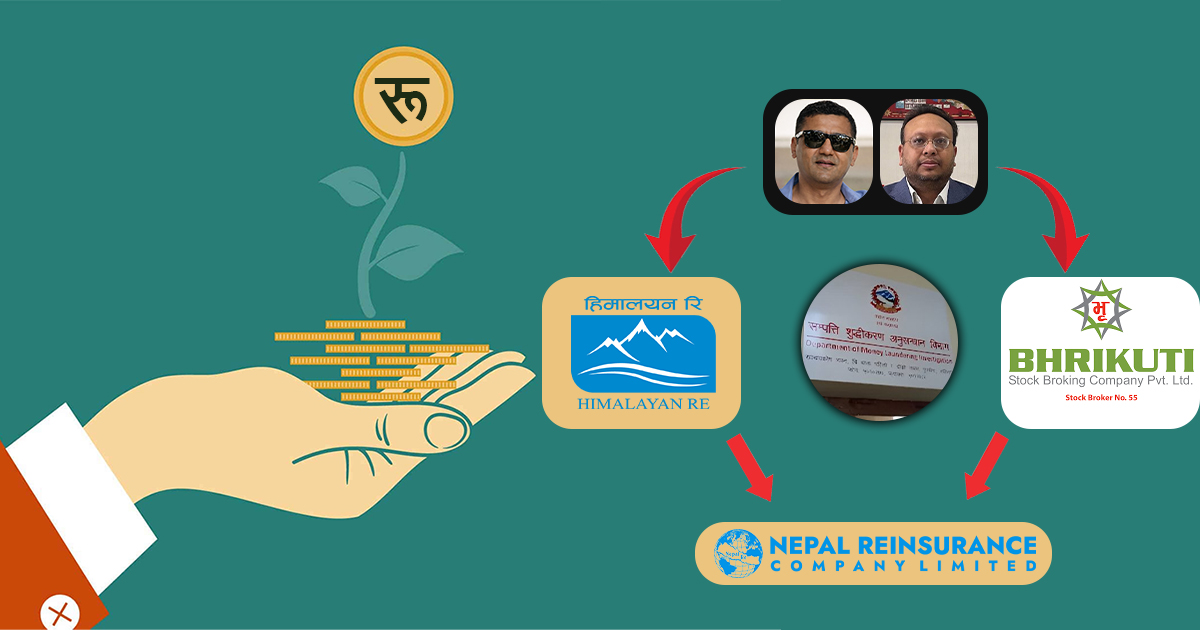

Kathmandu: Controversial businessman Deepak Bhatta, long known for his political clout, only entered Nepal’s secondary stock market this fiscal year. His very first investment has now drawn him into a sweeping money laundering investigation.
Bhatta’s initial purchase was shares of Nepal Reinsurance Company, a move he says was made at the urging of his close associate and business partner, Sulabh Agrawal. That decision has since spiralled into legal trouble, with Bhatta now in custody after being arrested by Nepal Police’s Central Investigation Bureau and handed over to the Department of Money Laundering Investigation, which is probing the case while he remains detained in Lalitpur.
Once a figure who wielded influence across governments led by the Nepali Congress, UML, and Maoists, Bhatta’s fortunes have sharply declined following recent political shifts and election outcomes. The man once believed capable of influencing power equations now finds himself in a dramatically weakened position. He is detained and under scrutiny, largely due to a stock deal he claims to have entered into on trust.
In his statement to investigators, Bhatta has alleged that he was set up by Agrawal and a stockbroker, a claim that has sent shockwaves through Nepal’s corporate circles and prompted authorities to widen the investigation. Agrawal has since been arrested, though details of his statement remain undisclosed.
According to Bhatt’s testimony, the scheme involved pooling Rs 2.5 billion from five individuals to create a fund that would be channelled through a brokerage firm to purchase shares of Nepal Reinsurance in their names. The plan hinged on anticipating a price surge following a rights issue, with additional gains expected from buying unsubscribed government shares at lower rates.
Bhatta claims he was told only Rs 300–400 million worth of shares would be bought in his name, but later discovered that purchases had ballooned to nearly Rs 2.9 billion. He insists he had handed over his trading credentials to Agrawal and was unaware of the scale of transactions being conducted.
Investigators, however, are sceptical. They point out that transaction alerts would have been sent to Bhatta’s registered mobile number and email, making it difficult to argue complete ignorance. Officials also question how a broker could execute such massive trades on credit without collateral, raising concerns not just about legality but also intent.
Financial records show large receivables tied to Bhatta and significant payables linked to other entities, suggesting a complex web of transactions that authorities believe may indicate coordinated activity.
The origins of the plan reportedly date back months, when Agrawal pitched Bhatta on what he described as a low-risk, high-return opportunity involving a pooled fund and strategic stock purchases. Several prominent business figures were allegedly involved, though shares could not be bought in some of their names due to regulatory constraints, leading to the use of Bhatta and others as fronts. Bhatta maintains that he trusted Agrawal completely, even ignoring warnings from close associates about his partner’s past conduct.
As the investigation deepens, more details have emerged about internal disputes and attempts to reverse transactions. At one point, Bhatt confronted Agrawal over the scale of the purchases, to which Agrawal reportedly admitted wrongdoing and promised to rectify the situation. The fallout has since led to resignations within associated companies and drawn regulatory action against the brokerage firm involved.
Authorities are also examining digital footprints, including login data from Bhatta’s trading account, to determine who actually executed the trades. While Bhatt denies any misuse of funds from companies he is linked to and claims he received no direct financial benefit, investigators suspect coordinated manipulation involving multiple actors. The case has exposed potential loopholes in brokerage practices and raised serious questions about governance and oversight in Nepal’s financial system.
Bhatt has told the court he is a victim of fraud and deception by individuals he trusted, insisting that all transactions were conducted under a credit arrangement with the broker and without any unlawful intent. Meanwhile, his once-close relationship with Agrawal has completely broken down, with both sides now blaming each other. What began as a high-stakes investment strategy has turned into a high-profile legal battle, and the final determination of truth now rests with investigators and the courts.

Comment Here