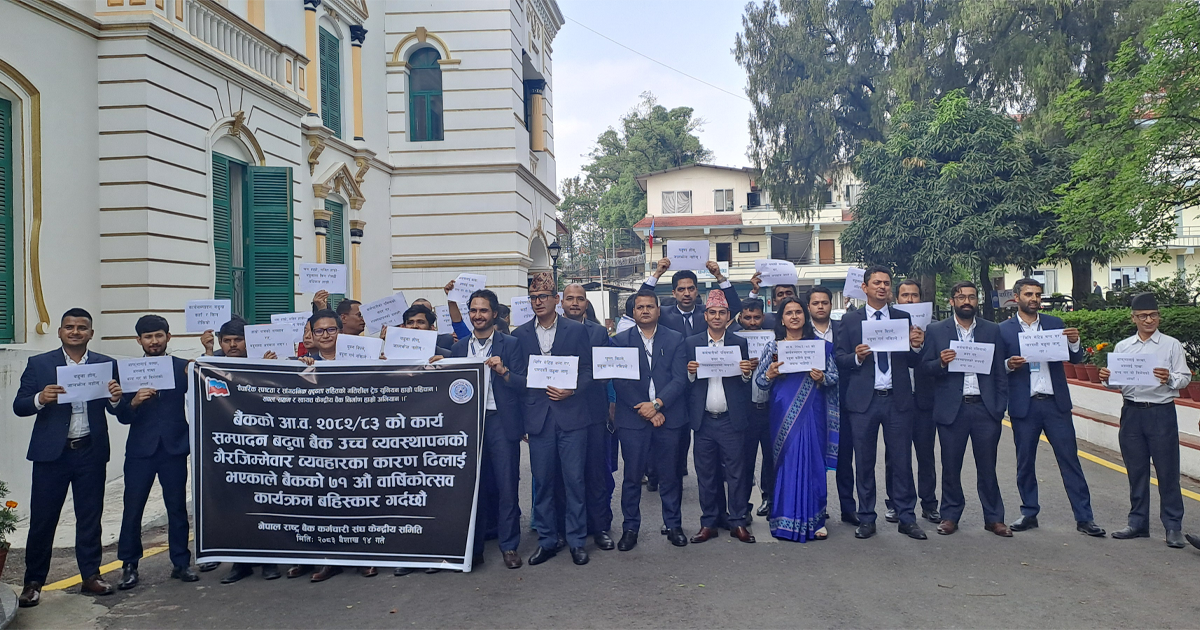

Kathmandu: Employees of Nepal Rastra Bank (NRB) boycotted the central bank’s 71st anniversary celebration on Monday and staged a protest inside the premises, accusing senior management of repeatedly delaying long-overdue performance-based promotions and running the institution in a non-transparent manner.
Under the banner of the Nepal Rastra Bank Employees’ Association Central Committee, staff demonstrated against what they called “irresponsible behaviour” by the bank’s top leadership in failing to complete the promotion process for fiscal year 2025/26.
Protesters carried placards reading “Stop favouritism in promotions,” “Where and why was performance-based promotion halted?” “Foreign trips are possible, but promotions are not?”, and “End internal setting, implement transparent promotion.” The central bank’s anniversary, established on 26 April 1956, was marked this year amid visible internal dissent rather than ceremonial unity.
According to former union president Gita Pokharel Lamsal, both internal competitive promotions and promotions based on performance evaluation should have begun as early as last October, but the process has remained stalled for months. She said employees had formally submitted a memorandum before the anniversary event, warning that they would boycott the ceremony if management failed to address the issue. With no response forthcoming, staff chose to skip the official celebration and launch a coordinated demonstration.
Union leaders have alleged that senior officials showed little urgency in resolving the matter, while frequent foreign visits by the high-level management further deepened employee dissatisfaction. The delay initially began after the appointment of Governor Dr Biswo Nath Poudel, and was later prolonged due to the vacancy in the deputy governor position and what employees describe as indecision at the executive level. Nepal Rastra Bank only recently filled one deputy governor position in early April, after months of administrative vacuum.
The protest comes at a sensitive time for the central bank, which is already under pressure to manage excess liquidity, weak private-sector credit demand and broader financial-sector confidence issues. Just days ago, the bank was forced to absorb Rs 40 billion from commercial banks through a deposit collection instrument as surplus liquidity continued to pile up in the system, underscoring the policy challenges facing the institution.
Adding to the controversy, Nepal Rastra Bank this year barred private media outlets from covering its anniversary function, a move described by several observers as unprecedented for a public institution of national importance. While the central bank has traditionally invited a wide range of stakeholders and journalists to its annual review and commemorative program, this time only state-owned media organizations were reportedly allowed entry under a special instruction from the governor’s office.
The exclusion of private journalists from an event where the country’s monetary authority presents annual assessments and institutional messaging has raised concerns over transparency and the public’s right to information. Critics argue that at a time when the central bank is facing both internal staff unrest and mounting external scrutiny over financial governance, restricting independent media access sends the wrong institutional signal.

Comment Here