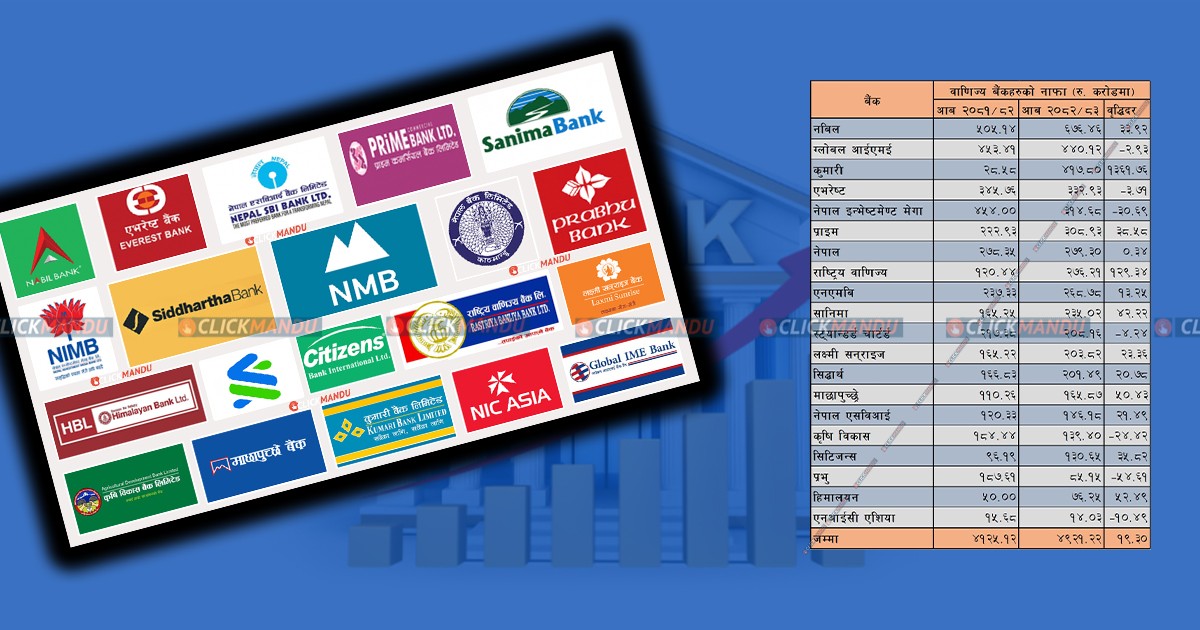

Kathmandu: Nepal’s commercial banking sector delivered a robust earnings rebound in the first nine months of the current fiscal year 2025/26, with aggregate net profit rising by an encouraging 19.3 per cent compared to the same period last year.
According to the third-quarter financial statements published by the country’s 20 operating commercial banks, the sector collectively earned Rs 49.21 billion in net profit by mid-April, up from Rs 41.25 billion recorded in the corresponding period of the previous fiscal year.
Among all lenders, Nabil Bank retained its position as the most profitable bank in the country, posting a net profit of Rs 6.76 billion during the review period. This marks a strong 33.92 per cent year-on-year increase, underlining the bank’s continued earnings dominance. Following Nabil, Global IME Bank emerged as the second-highest profit earner with Rs 4.40 billion in net earnings, although its profit slipped 2.93 per cent from the same period last year.
One of the most dramatic turnarounds came from Kumari Bank, which posted Rs 4.17 billion in profit by the third quarter. The figure represents an extraordinary surge from just Rs 285.8 million earned during the same period last year, making Kumari the fastest-growing bank in terms of bottom-line expansion.
At the lower end of the profitability table, NIC Asia Bank reported the weakest earnings among all commercial banks, generating only Rs 140.3 million in net profit, down 10.49 per cent year-on-year. Himalayan Bank followed with Rs 762.5 million in profit, though its earnings still improved by 52.49 per cent compared to last year. Prabhu Bank posted Rs 851.5 million in profit, but suffered the steepest decline among all banks, with net earnings plunging 54.61 per cent.
In terms of annual profit growth, Kumari Bank led the industry by a wide margin. It was followed by Rastriya Banijya Bank, whose net profit jumped 129.34 per cent to Rs 2.76 billion. Himalayan Bank also ranked among the strongest gainers. Machhapuchchhre Bank recorded a 50.43 per cent rise in profit to Rs 1.65 billion, while Sanima Bank posted a 42.22 per cent increase to Rs 2.35 billion. Citizens Bank International also showed notable improvement, with earnings rising 35.82 per cent to Rs 1.30 billion.
Similarly, Prime Commercial Bank reported a 38.58 per cent increase in profit to Rs 3.08 billion, while Nabil Bank’s already industry-leading earnings expanded by another 33.92 per cent. Laxmi Sunrise Bank posted a 23.36 per cent rise to Rs 2.03 billion, Nepal SBI Bank saw profit grow 21.49 per cent to Rs 1.46 billion, and Siddhartha Bank recorded a 20.78 per cent increase to Rs 2.01 billion. NMB Bank earned Rs 2.68 billion, up 13.25 per cent, while Nepal Bank posted a marginal 0.34 per cent growth to Rs 2.79 billion.
Despite the sector-wide improvement, seven banks still reported declining profits. Besides Prabhu Bank’s sharp contraction, Nepal Investment Mega Bank saw profit fall 30.69 per cent to Rs 3.14 billion. Agricultural Development Bank also reported a 24.42 per cent decline, with earnings dropping to Rs 1.39 billion. NIC Asia, Standard Chartered Bank Nepal, Everest Bank and Global IME Bank also posted moderate profit declines.
The overall earnings expansion suggests that Nepal’s banking industry is gradually regaining momentum alongside a slowly improving economy. However, the pressure on some major lenders indicates that business challenges remain unresolved. Notably, 19 out of 20 banks reported a decline in their weighted average spread rate, the difference between deposit and lending rates, yet overall income continued to rise. Net interest income across the commercial banking sector increased by only 2.09 per cent, indicating that profit growth was not driven primarily by core lending margins.
Banks continue to face heavy excess liquidity and have been steadily lowering deposit rates to reduce the cost of funds. Meanwhile, Nepal Rastra Bank has been mopping up surplus liquidity at an interest rate of 2.75 per cent. Although funding costs have eased and the central bank’s liquidity absorption measures remain in place, the impact on net interest income has been limited, with only a handful of banks posting meaningful expansion in core banking earnings.
A more significant boost has come from non-interest revenue, particularly fee and commission income, which improved sharply across most banks. According to Nepal Bankers’ Association President and Machhapuchchhre Bank Chief Executive Officer Santosh Koirala, four major drivers have contributed to the surge in commission earnings. He noted that letters of credit transactions have risen substantially in recent months, while income from guarantees, remittance services and digital payment transactions has also expanded. These businesses have collectively provided banks with a much-needed alternative revenue stream at a time when lending spreads remain compressed.
Even so, seven banks reported declines in net interest income, including NIC Asia and Standard Chartered Nepal, both of which saw weaker business expansion. Nepal Investment Mega Bank, Laxmi Sunrise, Himalayan, Global IME and Citizens Bank also recorded softer core interest earnings. Still, Koirala said the third-quarter statements indicate an improvement in loan recovery trends and asset quality, suggesting that the banking sector could post an even stronger performance by the end of the fiscal year in mid-July.

Comment Here