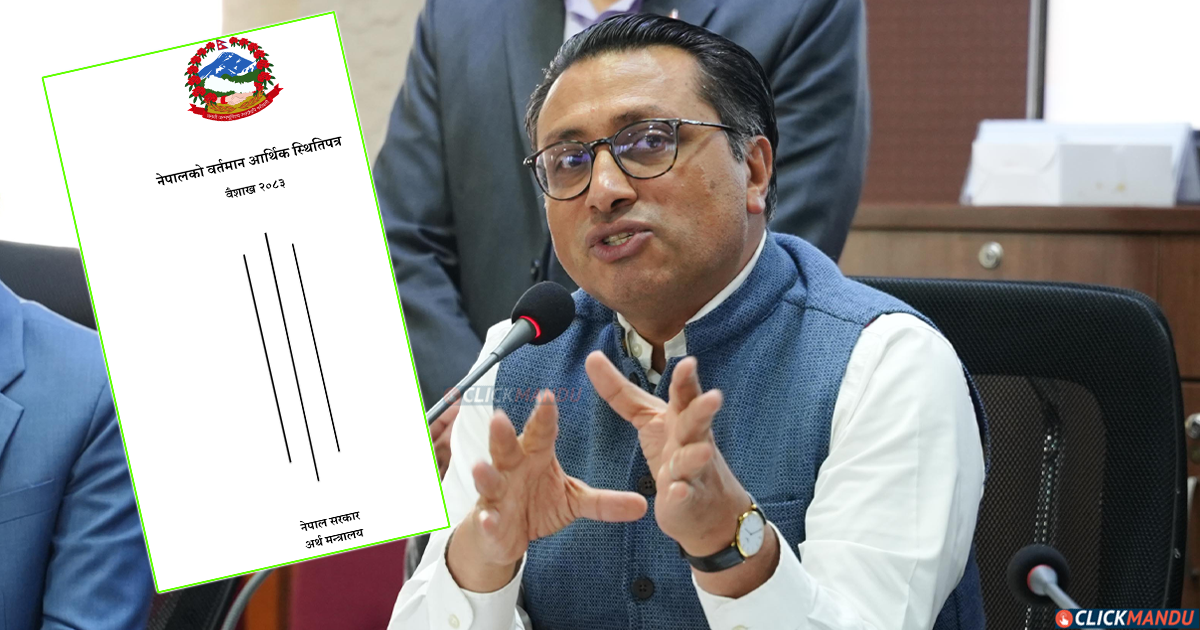

Kathmandu: One month after assuming office, Finance Minister Dr Swarnim Wagle unveiled a 30-page, 76-point assessment of Nepal’s economic condition, offering what is arguably one of the most measured official diagnoses of the country’s economy in recent years.
Unlike the combative white papers released by several of his predecessors, documents often designed more to indict former governments than to objectively explain economic weakness, Wagle’s report avoids political blame games. Instead, it presents a relatively sober picture of Nepal’s economic trajectory over the past decade, acknowledging both incremental progress and deep-rooted structural failures.
Previous finance ministers frequently used such documents to selectively manipulate statistics to paint the previous administration as solely responsible for economic decline. Most notably, former minister Yubaraj Khatiwada in 2017 was widely criticized for cherry-picking data to dramatize an economic crisis.
Similar tendencies were visible in reports issued during the tenures of Janardan Sharma and others, where political accusation overshadowed economic diagnosis. Wagle, by contrast, has taken a more mature route. Drawing on ten years of data, he recognizes that some progress has indeed been made, though nowhere near what Nepal requires. This gives the document a degree of credibility and seriousness often absent in previous government-issued assessments.
Yet while the report is commendable in tone, it appears less convincing in substance. Wagle identifies a long list of economic distortions, but offers only a surface-level explanation of why these problems emerged and remains vague about how his government intends to fix them.
That absence is striking, particularly because this administration holds a comfortable five-year mandate and therefore cannot easily claim policy uncertainty or political fragility as an excuse. The fact that the report diagnoses the illness without prescribing a treatment raises two possibilities: either the government itself is still searching for a coherent economic strategy, or the document was prepared in haste as an introductory political statement rather than a roadmap for reform.
Wagle is at his sharpest when he describes Nepal’s deeper political economy. He argues that the country’s crisis is rooted not merely in resource shortages, but in a “distorted incentive structure” shaped by expensive elections, opaque fundraising, bloated party systems, policy corruption, transactional politics, and crony capitalism.
According to him, the economy gradually shifted away from entrepreneurship, competition, and innovation, and toward a system where licenses, contracts, and regulatory favours became the main source of wealth accumulation.
This access-based model, he notes, discouraged capable entrepreneurs and blocked new market entrants. It is one of the bluntest acknowledgements by a sitting finance minister that Nepal’s state-market relationship has become captured by rent-seeking networks rather than productive capitalism.
He also offers a candid critique of the country’s long-standing ideological confusion over the role of the state and the market. Nepal, he suggests, has oscillated between two extremes: on one hand, the illusion of an all-powerful state, and on the other, an excessive faith in self-regulating markets.
This policy inconsistency weakened competition law, consumer protection, environmental regulation, and social security institutions. At the same time, distrust toward the private sector and a populist obsession with distribution prevented the country from prioritizing production, investment, and productivity growth. As a result, neither the market became dynamic nor the state became responsive.
Wagle further argues that the private sector never received a stable and predictable environment in which to operate. Weak enforcement of contracts, fragile property rights, and chronic regulatory uncertainty undermined investor confidence. The problem, he insists, is not a lack of entrepreneurial talent among Nepalis, but rather a policy framework that effectively punishes enterprise.
This is a crucial admission because it shifts the debate away from the simplistic claim that Nepal suffers from a shortage of capital alone; instead, it suggests that flawed institutions and inconsistent execution are equally responsible for suppressing growth.
The report also outlines how political instability, structural dependence on foreign employment, and failure to utilize Nepal’s demographic dividend have gradually worsened the economy. Rather than creating productive domestic employment, Nepal increasingly became dependent on labour migration and remittance inflows, allowing a consumption-heavy economy to survive without a robust productive base. Wagle identifies this as one of the defining weaknesses of the present economic model.
Despite these diagnoses, the minister stops short of spelling out what exactly his government will do differently. He hints at a broad agenda of structural reform, greater competition, technological adaptation, easier entry for new entrepreneurs, and a shift away from rent-seeking toward employment-led sustainable growth. He also promises higher standards of transparency, better public service delivery, and improved governance.
But these remain declarations of intent, not a practical reform architecture. There is little detail on timelines, institutional restructuring, fiscal priorities, or legislative action. In effect, the report sketches a philosophy, not a policy package.
The final sections of the document identify 11 opportunities for economic transformation and point to agriculture, energy, tourism, and information technology as the key carrier sectors for future growth. However, once again, the report does not explain how these sectors will be activated, financed, or integrated into a broader industrial strategy. Without implementation detail, these sectors risk sounding like familiar policy buzzwords rather than operational priorities.
Economists say this limitation is understandable, but only to a point. Former Nepal Rastra Bank executive director and economist Narbahadur Thapa notes that the paper is not a budget or a formal action plan, but merely a status report meant to portray where the economy stands.
In his view, the real test will come when the upcoming budget reveals whether the government can translate this diagnosis into structural reforms. Thapa considers the document relatively balanced and realistic, particularly in its acknowledgement of declining foreign grants, rising debt, weak revenue mobilization, and poor capital formation. Still, he argues that it would have been more convincing had it included a clearer roadmap.
Thapa also reads an important policy signal in the report: the government appears more inclined to accept the service sector as the primary engine of the economy rather than pushing aggressively for industrial revival. That, he suggests, may indicate a subtle but significant shift in thinking, away from the old production-centric rhetoric and toward managing Nepal as a service-dominant economy. Whether that is a strategic adaptation or a surrender of industrial ambition remains to be seen.
Former vice-chairman of the National Planning Commission and economist Dr Prakash Kumar Shrestha likewise says the report succeeds in portraying reality and identifying major economic concerns, but stops short of outlining concrete remedies. In his assessment, it is a wake-up call rather than a reform manual.
He argues that the burden now shifts to the government’s policy and budget statement, which must respond to the weaknesses identified in this assessment with targeted interventions. One budget alone may not solve every structural problem, he says, but it must at least show a credible direction.
Both economists agree on one central point: Wagle deserves credit for presenting a relatively non-partisan and fact-based portrait of Nepal’s economy. Unlike many politicians before him, he does not deny that previous governments achieved anything, nor does he reduce every failure to partisan blame. But they also agree that diagnosis alone is not enough. The country now needs a detailed corrective blueprint.
Among the key economic weaknesses Wagle identifies are persistently low growth, with Nepal averaging only 4.2 percent annual expansion over the past decade; a premature shift from agriculture to services without sufficient industrialization; weakening capital formation; chronic underperformance in revenue collection; unrealistic budgeting with large expenditure promises but poor execution; an oversized share of recurrent expenditure; rising public debt and increasing debt servicing obligations; weak spending capacity at provincial and local governments; poor returns from growing state investment in public enterprises; the continued depreciation of the Nepali rupee against the US dollar; sluggish bank lending; rising non-performing loans; and weak regulation of savings and credit cooperatives.
In short, Wagle’s paper holds up a mirror to Nepal’s economy and, in many ways, it is the clearest mirror the government has offered in years. But a mirror only shows the damage; it does not repair it. Whether this unusually candid diagnosis becomes the starting point for a genuine paradigm shift or merely another well-written government document will depend entirely on what follows in the national budget.

Comment Here