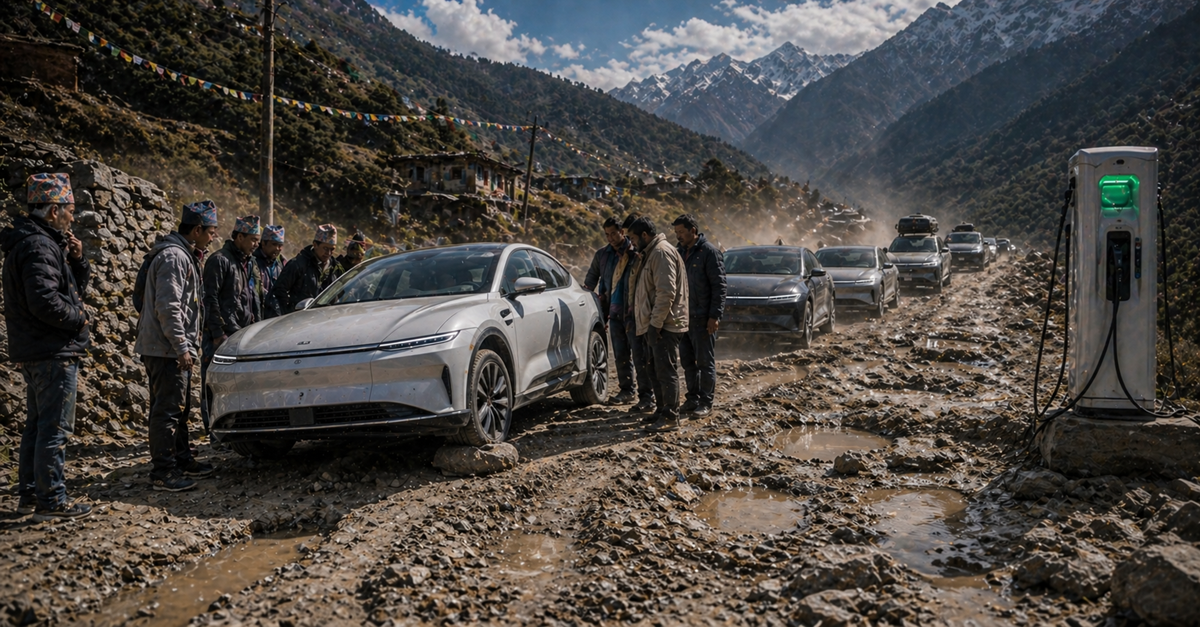

Kathmandu: Nepal’s existing road network has been found largely unsuitable and unsafe for the growing number of electric vehicles entering the country, particularly low-ground-clearance models now dominating the market.
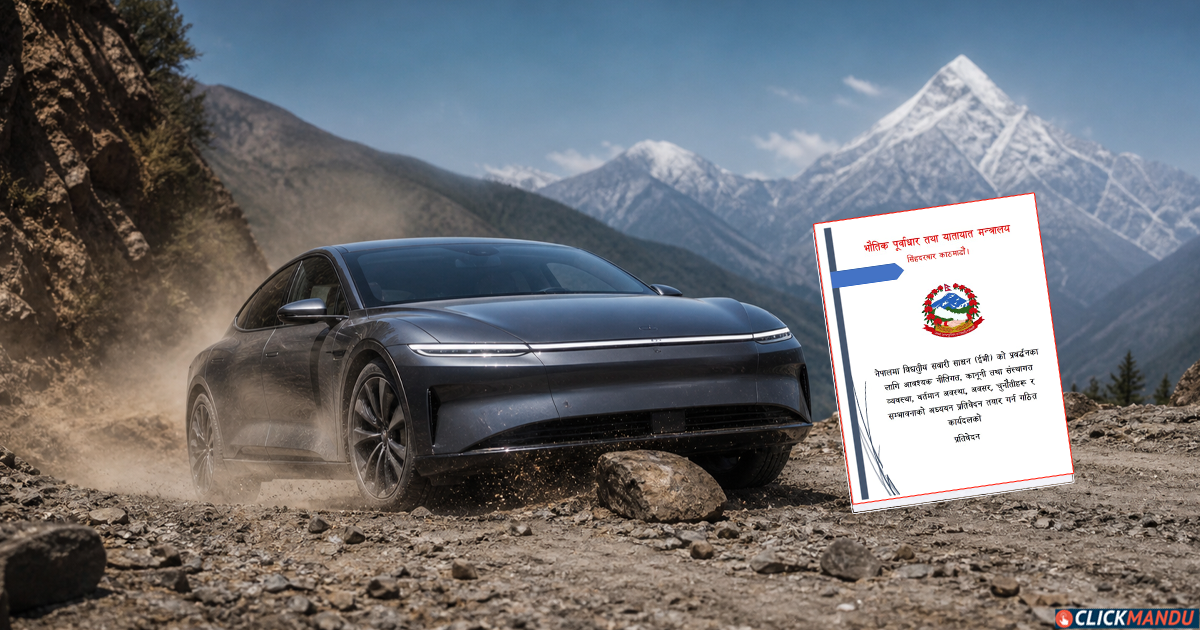
A government-commissioned study has concluded that the country’s physical infrastructure, regulatory preparedness and institutional systems have failed to keep pace with Nepal’s aggressive push toward electric mobility. The report was prepared by a task force led by Joint Secretary Engineer Krishna Raj Panth of the Infrastructure Development and Transport Division, formed during the tenure of former Minister for Physical Infrastructure and Transport Kulman Ghising, to examine EV imports, quality standards, market conditions and policy arrangements.
The ministerial decision to create the task force was taken on September 16 last year with the mandate to assess Nepal’s legal, policy and institutional readiness for electric vehicle promotion, along with opportunities, challenges and long-term prospects. Its findings paint a troubling picture.
Nepal’s roads and vehicle designs are not aligned with EV use, the study says. Nearly 72 per cent of roads in the country are still unpaved, creating a major hazard because EV battery packs are mounted beneath the vehicle floor, making them vulnerable to damage from rocks, scraping and uneven terrain
According to the report, one of the biggest obstacles to EV adoption is Nepal’s road network itself. Although the country has nearly 100,000 kilometres of roads, most roads built by local governments do not comply with standard geometric and engineering specifications. In addition, road surface quality remains poor, with international roughness index measurements reportedly far above acceptable thresholds across much of the network.
The report notes that these conditions are particularly problematic for electric vehicles with low ground clearance, which are increasingly common in Nepal’s market. It recommends that all new road construction and upgrading projects be redesigned with EV compatibility in mind.
Nepal’s roads and vehicle designs are not aligned with EV use, the study says. Nearly 72 per cent of roads in the country are still unpaved, creating a major hazard because EV battery packs are mounted beneath the vehicle floor, making them vulnerable to damage from rocks, scraping and uneven terrain.
This warning comes even though electric vehicles now account for 76 per cent of imported small and medium passenger vehicles in fiscal year 2024/25, largely driven by generous tax exemptions and policy incentives. However, the report argues that ordinary citizens will not fully benefit from the EV transition unless the government gives far stronger support to larger public transport vehicles.
Nepal has set an ambitious national target of making 90 per cent of private vehicles and 70 per cent of public vehicles electric by 2035 as part of its clean energy and sustainable development roadmap. EV promotion is also seen as a critical pillar in achieving the country’s net-zero carbon emission target by 2045.
Yet the study says the country remains far from ready. Nepal’s public transport sector alone represents nearly Rs 1.5 trillion in direct and indirect investment and provides employment to around 1.5 million people, but policy bottlenecks continue to slow electrification.
In Bagmati Province, for example, the report notes that there is still no registration guideline for public vehicles with a seating capacity of 14 to 15 passengers. As a result, even when old vehicles are retired, operators are unable to register replacement units, creating transport shortages on affected routes.
The report also highlights a chronic lack of coordination among government ministries, with overlapping jurisdictions and duplicated work undermining EV promotion. Although the Environment-Friendly Vehicle and Transport Policy introduced in 2014 was envisioned as a broad and forward-looking framework, it has yet to be properly implemented. Nepal’s shift to a federal governance structure in 2015 further complicated questions over which level of government is responsible for execution.
Quality assurance is another major weakness. The task force says Nepal still lacks minimum testing standards for imported, assembled or domestically produced electric vehicles and chargers. This absence is particularly concerning for public transport vehicles, where mandatory technical certification should be non-negotiable.
Without clear import procedures or benchmark standards, the report says virtually any type of EV is entering the Nepali market, raising serious concerns over durability, safety and long-term reliability. It recommends urgent approval of a unified national standard covering vehicles, batteries, chargers and major components, under which only certified imports or production would be allowed.
Battery-related safety risks are also identified as a pressing concern. Lithium-ion batteries used in EVs carry fire hazards due to chemical reactions, yet Nepal currently lacks the specialised firefighting tools and emergency response systems needed to control such incidents.
The task force further warns that Nepal has no Extended Producer Responsibility law governing battery disposal after end-of-life use, creating the potential for a major environmental crisis in the coming years. There is also no battery recycling policy in place, nor any designated site identified within the country for handling hazardous EV waste.
The report says Nepali consumers are also suffering from a growing after-sales service problem because some EV models imported into Nepal are discontinued in their countries of origin within a few years, leaving customers stranded without parts or technical support.
Testing authorities inside Nepal also lack both financial resources and technical capability to conduct full standard certification. As a result, many vehicles are entering service without being evaluated under Nepal-specific operating conditions.
The report states that many imported EVs are not engineered for Nepal’s terrain, road conditions or usage patterns, leading to poor performance, repeated mechanical failures and elevated safety risks. Rapid technological change has also created fear among buyers over battery life, resale value and obsolescence of older models.
Even though EV manufacturing costs are falling rapidly in China because of fierce competition and discounting, the study says Nepali consumers are not seeing those benefits. Informal evidence suggests there is an unusually high profit margin between vehicle landing cost and final showroom price in Nepal.
Battery cost remains another core challenge. While lead-acid batteries are inefficient, lithium-ion batteries offer better performance but account for nearly half of an EV’s total price, making electric vehicles significantly more expensive upfront than conventional internal combustion engine vehicles.
As a result, despite EVs being as much as five times cheaper to operate than ICE vehicles, consumers continue to hesitate because of high initial purchase costs, uncertainty over long-term value, weak after-sales service, maintenance concerns, spare parts shortages and doubts over resale valuation.
The report recommends that the government immediately formulate standards for large EVs used in public transport and freight, legally enable the conversion of existing ICE vehicles into electric models, and create a framework to retrofit ageing fleets before spare parts for conventional engines become unavailable
Charging infrastructure is identified as the third major barrier. Most installed charging stations are concentrated in Kathmandu Valley, Pokhara, Chitwan, Birgunj and a handful of major urban centres, leaving long-distance routes underserved. The report also points to technical shortcomings such as inadequate input power supply, insufficient wiring capacity and poor charging station capability.
The study further notes that technical manpower is in critically short supply. Nepal lacks trained professionals with specialised knowledge in EV operation, diagnostics, charging systems and repair. Since most EV components are fully imported, maintenance costs remain high and spare parts accessibility remains unreliable.
Another overlooked issue is that Nepal’s driver licensing and training system is still designed around conventional internal combustion vehicles. Drivers are not being adequately trained for advanced EV systems, regenerative braking, battery management and digital controls, which the report says has contributed to accidents and slowed market confidence.
The task force also raises concern over the failure to electrify public transport in any meaningful way. Nepal’s EV imports remain overwhelmingly concentrated in private four-wheelers, three-wheelers and two-wheelers, while larger electric buses and trucks — which could deliver the biggest environmental gains — remain negligible in number.
To address this, the report recommends that the government immediately formulate standards for large EVs used in public transport and freight, legally enable the conversion of existing ICE vehicles into electric models, and create a framework to retrofit ageing fleets before spare parts for conventional engines become unavailable.
It also calls for aggressive financial incentives for large electric public vehicles, including deeper customs rebates, vehicle tax waivers, insurance discounts, subsidised bank interest rates and financing models in which banks provide at least 80 per cent of the investment.
Although Nepal already offers EVs customs benefits of up to 200 per cent compared to ICE vehicles, reduces road improvement charges from 9 per cent to 2.5 percent and grants significant annual tax concessions, the report says the presence of electric vehicles in public transportation remains dismal.
At present, government-backed Sajha Yatayat operates 41 electric public buses, while Mahanagar Yatayat runs eight. Sundar Yatayat was the first private company in Nepal to introduce electric buses, but overall deployment remains far below what is needed for a genuine nationwide transition.

Comment Here