
Kathmandu: In 2014, when India accelerated its modern development trajectory, its per capita income stood at around 1,500 US dollars. Nepal finds itself at almost the same point today. This is not merely a coincidence; it is both a signal and an opportunity.
It marks a critical moment to steer the country’s economic ship toward a new direction. The journey is undeniably risky. If the ship is not navigated with competence and discipline, it could sink like the Titanic. But with a carefully calculated and courageous shift, even a massive vessel can be sent toward an entirely different destination. Nepal now needs precisely that kind of strategic redirection.
For decades, despite possessing immense potential, Nepal has remained trapped in underperformance and underutilization. The country has resources, geography, talent and untapped sectors, yet these have not been converted into meaningful economic strength. Against this backdrop, the Nepali people, particularly the younger generation, have delivered an extraordinary mandate for change.
This is not simply a demand for a new government; it is a call for a complete transformation in mindset, governance culture and state systems. Respecting that mandate, the government has committed itself to a five-year mission built on stability, policy predictability and good governance. At the centre of that mission lies one indispensable principle: honesty in public administration.
Nepal’s institutional structure had, over time, become so distorted that even honest individuals were often pushed into compromise by the system itself. As one respected businessman once remarked, the legal and bureaucratic maze was so twisted that even an honest man entered clean and came out corrupt. That observation captures the tragedy of Nepal’s political economy. The promise now is to clean that system from within. This, as the ruling leadership has described it, is the year to pull out the rusted nails. The process may be uncomfortable for some, but it is unavoidable.
The government says it wants private enterprise to flourish, but only on the foundation of integrity. The unhealthy nexus between sections of the business community and corrupt politicians, the capture of policymaking by vested interests, and the entrenched culture of cronyism must come to an end.
Nepal’s economic vision, therefore, is becoming increasingly clear: to overcome the structural disadvantages of being landlocked by building a “weightless and distance-free” economy. The principal vehicle for that transformation is digitalization. Through technology, Nepal can bypass physical barriers and connect directly to global markets.
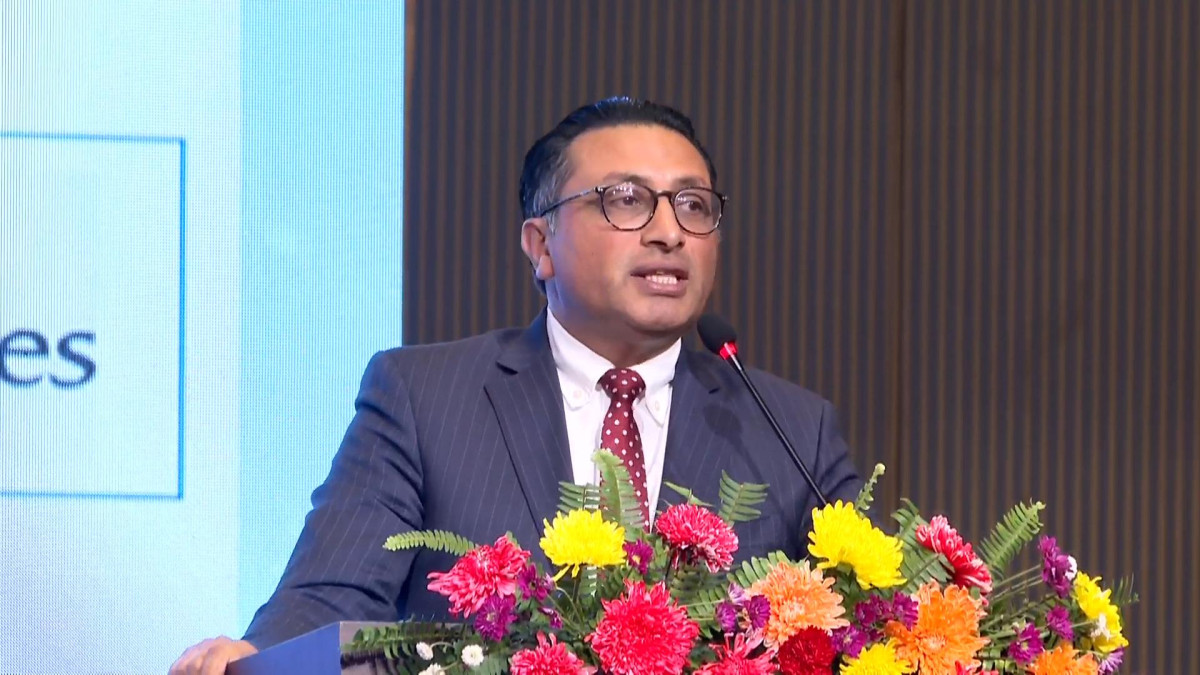
There is also a recognition that past mistakes cannot be hidden or protected. Those who abused public institutions and looted state resources should not be shielded in the name of continuity. Upon assuming office, Finance Minister Dr. Swarnim Wagle said he reviewed reports detailing the scale of misuse, policy capture and organized plunder that had taken place in Nepal, and the findings were deeply disturbing. The extent of what had been done to the Nepali people, he suggested, was enough to shake anyone. That culture, he insists, must stop.
The state’s role, in this new model, is not to crowd out private investment but to create the environment for it. Every rupee of public investment should ideally attract five to six rupees from the private sector. Government does not need to engineer every economic change itself; rather, it must become an enabler of change.
Laws and regulations should function as facilitators, not barriers. This thinking explains why, on his very first day in office, the finance minister moved to scrap 15 outdated and impractical laws and dismantle government agencies that had become synonymous with harassment for the business community.
At the same time, the pursuit of growth cannot come at the expense of social justice. The government rejects the notion that Nepal must first become rich before it can invest in its poor. Even at a lower income level, the country can and should build a social protection system within its means. By investing in education, healthcare, employment and social security, Nepal can create a stronger and more secure middle class, ensuring that the gains of development are not confined to the elite but reach the lower layers of society as well.
Connectivity is another pillar of the development agenda. Energy, roads and digital infrastructure are vital, but so too is aviation. Ironically, sectors that are most crucial for a landlocked country, including aviation, telecommunications and logistics, have historically suffered the worst from political interference and corruption. Rent-seeking in these sectors has held national development hostage. The government’s task now is to make these sectors corruption-free, competitive and efficient enough to serve as the backbone of economic growth.
At the centre of this broader transformation lies Nepal’s soft power. The country’s natural beauty, cultural wealth, tourism appeal and human capital remain its greatest assets. Nepal’s position between two giant economies, India and China, should be seen not as a vulnerability but as a strategic opportunity.
By attracting high-value tourism, foreign direct investment and export-oriented business, Nepal can turn geography into leverage. Nepalis living abroad are also increasingly ready to participate in this transition, and the diaspora must be treated as a genuine partner in the country’s economic future.
India’s recent experience offers particularly relevant lessons. Through digital public infrastructure and nationwide identity-linked systems, India was able to bring direct and measurable change to the daily lives of ordinary citizens. If a country of 1.4 billion people can execute such reforms at scale, there is no reason a country of 30 million cannot do so in a more agile and targeted manner. Nepal does not need giant, unwieldy reforms; it needs smart, practical reforms implemented effectively.
Even Nepal’s size, often perceived as a weakness, can be turned into an advantage. The country appears small only because it is overshadowed by its vast neighbours. In reality, a smaller state can often move faster, reform faster and implement faster. Likewise, Nepal’s extraordinary diversity, with more than 125 ethnic communities and languages, must be treated as a democratic strength whose aspirations are reflected in governance.
This new journey, however, demands a few non-negotiable principles. Reforms must be bold, government must be predictable, and implementation must be relentless. There can be no emotional hesitation or political compromise in enforcing the law. Honest businesses have nothing to fear, but those built on fraud and manipulation will be brought under legal scrutiny.
Prime Minister Balendra Shah, according to the minister, is fully committed to good governance, and the changes witnessed in Kathmandu under his leadership are being presented as early evidence of that resolve.
Still, this transformation cannot be delivered by the government alone. It requires a shared national effort involving the state, the private sector, civil society and the Nepali diaspora. The government says it will stand firmly with entrepreneurs who want to do business honestly, create jobs and contribute to the national treasury. Learning from past mistakes, punishing the exploiters and rewarding the honest, Nepal intends to move forward on a new footing.
The ambition is to double Nepal’s per capita income to 3,000 dollars within the next five to seven years. If every institution and citizen performs their role with sincerity and determination, that target is achievable. This is not simply an agenda for higher growth; it is a campaign to rebuild the country’s dignity, confidence and future. The commitments made in the government’s manifesto, the minister says, will not remain election slogans; they will be translated into action.

Comment Here