
Biratnagar: A conflict of interest between the Prime Minister and the Finance Minister over the mandatory implementation of Maximum Retail Price (MRP) labelling at customs points has brought customs clearance of imported commercial goods from India and third countries to a standstill for the past week, according to traders and importers.
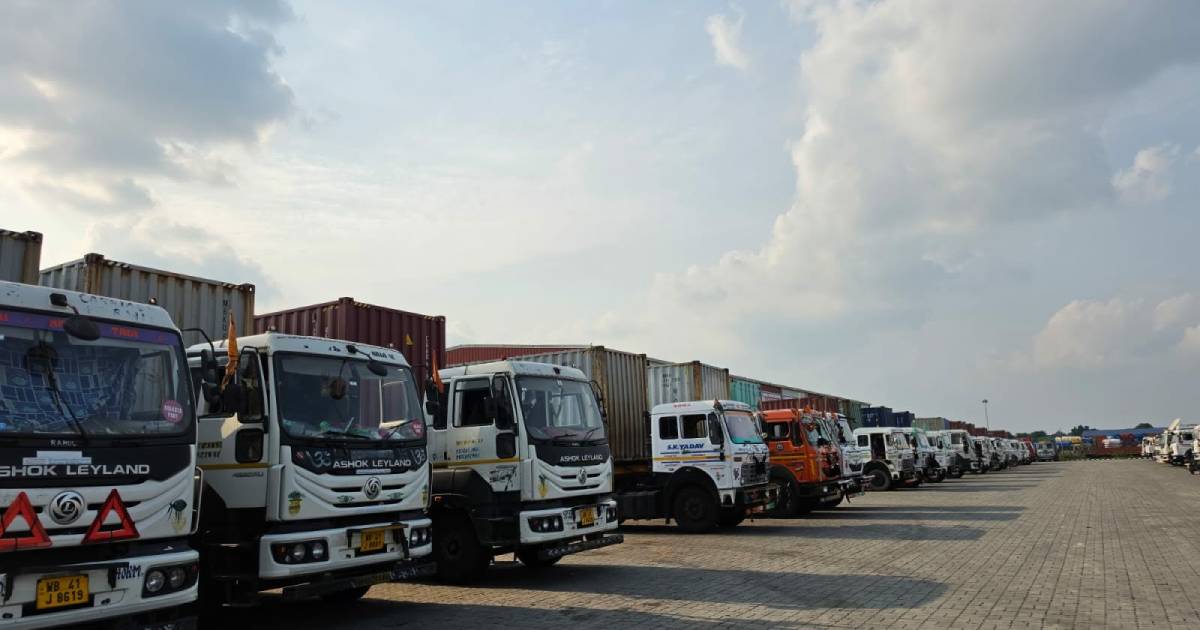
The deadlock has not only disrupted government customs revenue collection but has also left hundreds of cargo trucks and containers stranded at customs yards and along Indian highways, raising the risk of goods being damaged, spoiled, or stolen.
The crisis began after the government, in line with its 100-day action plan, enforced a provision from April 28 requiring all commercial imports to carry clearly stated MRP labels before they can be cleared through customs. Following the implementation of this rule, customs clearance of imported market goods across the country has effectively halted.
The federal government had formally announced the decision on April 12, giving importers 15 days to prepare for mandatory MRP compliance at customs entry points. However, business communities had urged the government to suspend the provision, arguing that affixing MRP labels before import was neither practical nor scientifically justified, and had called for a more workable alternative.
After customs offices refused to release imported goods lacking MRP labels for three consecutive days, the Ministry of Finance and the Department of Customs began working on a facilitative mechanism to address the practical difficulties faced by importers. Customs officials proposed a middle-ground solution that would allow importers of industrial and perishable goods to self-declare MRP values at customs and attach labels only before goods are sold in the domestic market.
Under the proposed compromise prepared by the Finance Ministry and the Customs Department, traders importing goods from India and third countries would declare the MRP at the customs point, while the physical labelling requirement would be fulfilled after the goods enter Nepal and before retail distribution. But according to stakeholders, the Prime Minister’s Office refused to approve this flexible arrangement, deepening the crisis.
As a result, customs clearance of imported commercial goods has remained blocked for a week, leaving goods worth billions of rupees stranded in customs compounds and on Indian roads.
At the Jogbani customs checkpoint alone, not a single consignment of commercial merchandise has been cleared during the past seven days because of the mandatory MRP rule. Devaki Sharma, president of the Biratnagar Customs Agents Association, said the impasse has directly affected government customs revenue while exposing immobilized goods to deterioration and theft.
According to Sharma, around 200 trucks and containers are currently stuck inside the Biratnagar customs yard, another 100 remain parked at the Indian customs yard, and more than 150 cargo vehicles are lined up on Indian roads waiting for clearance.
“The government introduced mandatory MRP implementation, but when the policy proved impractical, the Finance Ministry and Customs Department searched for a middle path that would satisfy both compliance and business convenience,” Sharma said. “However, the Prime Minister’s Office did not agree, and that has complicated the situation further.”
One importer said the situation clearly reflects a policy clash between the Prime Minister and the Finance Minister. “This government came to power promising to dismantle long-standing distortions created by traditional political parties, but even before completing its first 100 days, conflicting interests between the Prime Minister and his own line minister have become visible,” he said.
Jogbani customs revenue largely depends on industrial raw material imports. Chief Customs Officer Umesh Shrestha said the week-long suspension of commercial goods clearance has reduced revenue collection at Biratnagar Customs by nearly 25 per cent.
He said the office normally targets daily customs revenue of around Rs 120 million to Rs 130 million and usually collects Rs 90 million to Rs 100 million. But with only industrial raw materials being cleared over the past week, average daily revenue has dropped to just Rs 70 million to Rs 80 million.
A similar situation has emerged at Mechi Customs, where commercial goods lacking MRP labels have also not been cleared for the past seven days. Customs spokesperson Ishwar Humagain said the checkpoint primarily handles imports of coal and clinker, which are exempt from MRP concerns because such industrial bulk commodities do not require retail labelling. However, other market goods without MRP labels remain stuck.
Business leaders have strongly objected to the blanket enforcement of MRP labelling on all imported products, insisting that such labelling cannot realistically be done before import in every case.
Anupam Rathi, president of the Morang Trade and Industry Association, said the government should suspend the current provision and immediately seek a practical alternative. He argued that traders are willing to calculate their final costs and affix MRP labels once goods reach their warehouses, but requiring labelling before customs clearance is neither scientific nor business-friendly.
“This policy is not investment-friendly at all,” Rathi said. “Importers can only determine a realistic retail price after transportation, duties, handling costs and distribution expenses are finalized.”
Nandkishore Rathi, president of Industry Organization Morang, said the issue is even more complicated because products imported through Biratnagar are distributed to different cities, where the final retail prices vary by destination.
“In that case, on what basis can traders print one fixed MRP before the goods even enter the country?” he asked.
He warned that while the government remains locked in this policy dispute and customs clearance stays frozen, smuggling of commercial goods through border routes has already started to increase, creating another serious challenge for both legitimate trade and state revenue.

Comment Here