
Kathmandu: The government has introduced a new structural and operational mechanism aimed at strengthening industrial and business security while boosting investor confidence across the country.
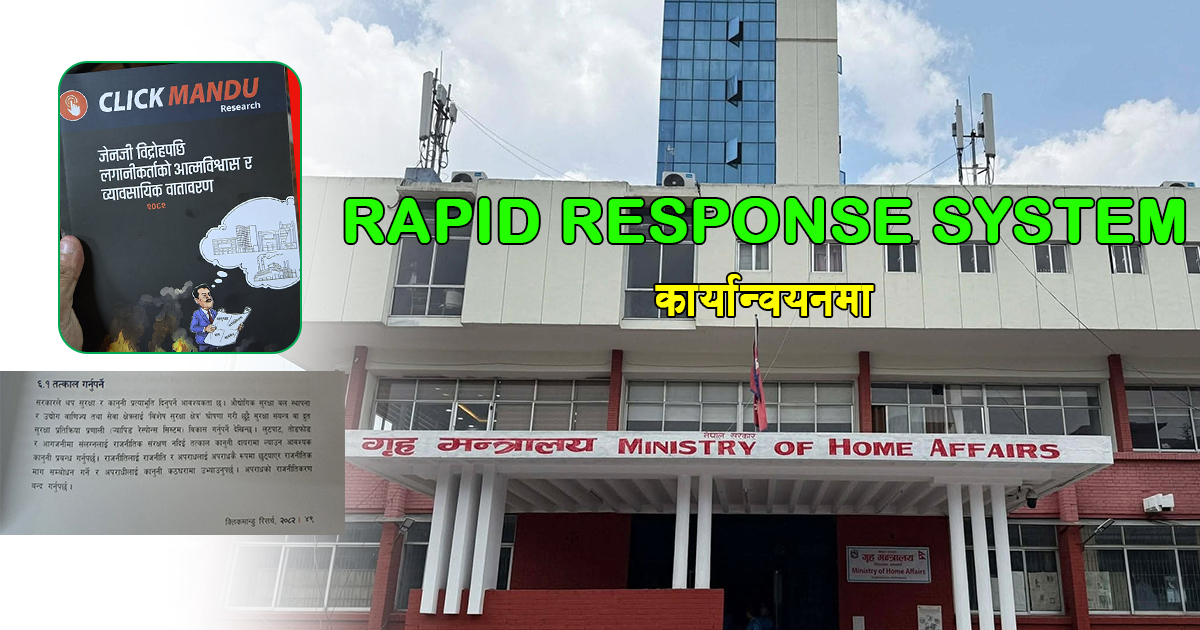
The Ministry of Home Affairs has approved and implemented a new framework titled “Structure and Rapid Response Mechanism for Strengthening Industrial and Commercial Security.”
The new arrangement was introduced following a decision made by the Ministry on April 27, 2026, based on the Cabinet’s 100-point governance reform agenda approved on March 26, 2026. The primary objective is to guarantee security for private sector enterprises and businesses.
Under the new system, a “District Industrial and Commercial Security Coordination Committee” will be formed in every district under the leadership of the Chief District Officer (CDO). The committee will include local heads of the Nepal Army, Nepal Police, Armed Police Force, and National Investigation Department.
To ensure private sector participation, presidents or representatives of district-level business organizations will also be included, while the Assistant Chief District Officer will serve as member secretary.
The committee will be responsible for analyzing the industrial security situation within the district and preparing and implementing special action plans.
As part of efforts to modernize industrial security, the government will encourage businesses to install 24-hour surveillance systems, including CCTV monitoring and other modern technologies.
In addition, the hotline operated through District Emergency Operation Centres in each district will now function round-the-clock as an “Industrial Security Hotline.”
Security agencies will also keep rapid response teams on standby to immediately address potential incidents in industrial areas. A dedicated “security contact person” will be assigned at the nearest security unit for industries and businesses.
To ensure uninterrupted supply of goods and services, security agencies will conduct regular patrols along highways and strategic routes. The concept paper also mentions special search operations to recover goods looted from industrial establishments during protests or unrest.
The Ministry of Home Affairs stated that records will be maintained regarding the distance and response time between industrial zones and security agencies.
The government has also pledged immediate registration of complaints related to criminal incidents targeting industries and businesses, along with strict legal action against those involved.
The committee is required to meet at least once every month, although emergency meetings can be held whenever necessary.
The government believes the initiative will significantly improve investment security and create a more positive industrial environment. Major private sector umbrella organizations, including the Federation of Nepalese Chambers of Commerce and Industry and Confederation of Nepalese Industries, had long been demanding such a mechanism.
The new system also follows recommendations made in a study report published by Clickmandu
after the “Gen Z movement,” which examined investor confidence and the business climate in Nepal.
According to the report, business morale had weakened significantly after the protests. It found that 98 per cent of investors experienced some level of decline in confidence, while 97 per cent of businesspeople felt the investment environment had deteriorated.
The report further stated that physical attacks and unrest had pushed around 70 per cent of businesses into a “wait-and-see” mode regarding further investment, while recent crackdowns by the new government had worsened uncertainty.
This situation, the report warned, risks slowing new industrial investment and job creation.
Although political parties continue to describe the private sector as the “engine of the economy,” many businesspeople still feel psychologically insecure in practice.
The report argued that unless the state immediately restores law and order and guarantees security under the rule of law, Nepal risks a continued outflow of intellectual and financial capital.
In response to these concerns, Clickmandu had recommended stronger security guarantees and legal protection for businesses, including the establishment of an industrial security force and the declaration of industrial, commercial, and service sectors as “special security zones” with dedicated rapid response mechanisms.
The report also recommended ensuring that individuals involved in looting, vandalism, and arson are brought under legal action without political protection.
Following the formation of the government led by Balen Shah on March 26, the Cabinet’s first meeting had introduced the 100-point governance reform agenda, which included the establishment of a rapid response mechanism for industrial and commercial security.
The Ministry of Home Affairs has now moved forward with implementation of that Cabinet decision, which also reflected recommendations made by Clickmandu.

Comment Here