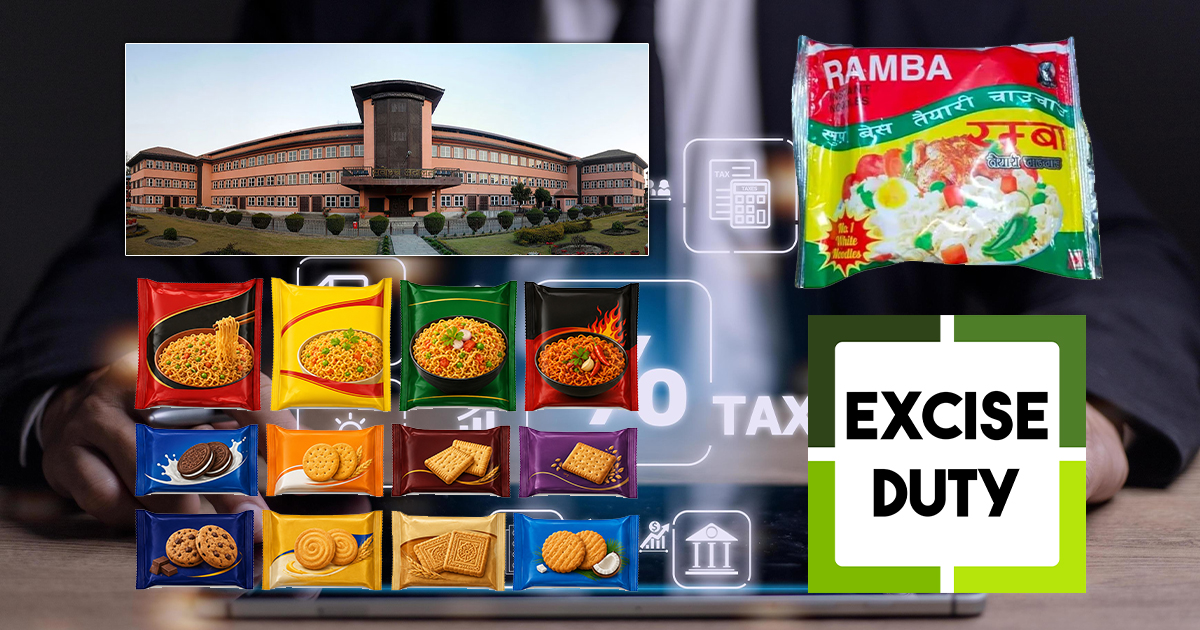

Kathmandu: Nepal’s Supreme Court has ruled that packaging materials used in industrial production qualify as raw materials, allowing manufacturers to claim excise duty credits on such inputs. In a landmark verdict, the court’s full bench interpreted packaging wrappers as an integral part of the production process and held that excise tax paid on them can be adjusted against the excise duty levied on finished products.
The ruling came in a case filed by Pokhara Noodles — the producer of popular noodle brands such as Ramba, Jojo, Maggi, and currently Rara — against the Inland Revenue Department and the Large Taxpayers Office. The recently published full text of the judgment clarified whether excise duty paid on wrappers and packaging materials could be deducted under Section 3A(3) of the Excise Duty Act, 2002, and whether such materials should legally be considered raw materials.
The dispute between Pokhara Noodles and the Large Taxpayers Office had continued for years and originated from an excise assessment for the fiscal year 2011/12. The company argued that the excise duty it paid while purchasing plastic wrappers used to package noodles should be credited against the excise duty payable when the finished noodles were released into the market.
Tax authorities, however, maintained that packaging materials were not raw materials but merely auxiliary items used after production. Based on that interpretation, the Large Taxpayers Office imposed around Rs 3.65 million in excise duty, penalties, and late fees on the company. Pokhara Noodles challenged the decision before the Inland Revenue Department, but the department upheld the tax office’s position.
The company then appealed to the Revenue Tribunal, where the three-member bench was divided. Two members sided with the tax authorities, while one ruled in favour of the company. After the majority decision rejected the manufacturer’s claim, the case reached the Supreme Court.
As previous rulings by different Supreme Court benches had conflicted on similar issues, the matter was referred to a full bench for a final interpretation. A full bench comprising Justices Binod Sharma, Abdul Aziz Musalman, and Meghraj Pokharel delivered the verdict on January 7, 2025 (Poush 24, 2081 BS), ruling that packaging materials are indeed raw materials and therefore eligible for excise duty adjustment.
In its judgment, the Supreme Court analyzed the concept of the “production process,” stating that merely producing an item is not enough — the product must also be marketable. In the case of food products such as noodles, the court said, packaging is legally and commercially indispensable because the product cannot be sold or distributed without proper wrapping.
The court outlined three key tests for determining whether packaging materials qualify as raw materials: the marketability test, the integral component test, and the essential characteristics test.
Under the marketability test, the court noted that noodle wrappers are necessary to protect the product from air, moisture, and contamination and to preserve quality, making unpackaged noodles unfit for sale. Under the integral component test, the court stated that packaging is a stage in the manufacturing process without which the final product remains incomplete.
Referring to the essential characteristics test, the court observed that food safety and consumer protection laws make labelling and packaging mandatory, meaning wrappers cannot be treated merely as decorative or luxury items. The judgment also cited precedents from the Supreme Court of India, emphasizing that since packaging costs form part of the final product’s value, denying tax credit on excise already paid would be unfair.
During the course of the dispute, Nepal amended the Excise Duty Act through the Finance Act 2015. The amendment explicitly stated that excise duty paid on packaging materials could no longer be credited. Tax authorities and the tribunal had relied heavily on this amendment to argue that packaging materials were never intended to be treated as raw materials.
The Supreme Court, however, rejected that interpretation. The judgment stated that the very fact that Parliament introduced a specific restriction only in 2015 indicates that such credits had been permissible before the amendment. The court further invoked the legal principle prohibiting retrospective application of tax laws, making it clear that the 2015 amendment could not be applied to transactions from 2011/12 unless the law explicitly stated otherwise.
The ruling also highlighted the risk of double taxation. The court noted that if manufacturers are required to pay excise duty while purchasing wrappers and then again on the same value when selling the finished noodles — without being allowed to offset the earlier tax — the same item effectively gets taxed multiple times. Such a system, the court said, unnecessarily raises production costs and ultimately burdens consumers.
“The right to adjust tax paid on raw materials against the excise duty payable on finished products is a legal right of industrial producers,” the judgment stated. “Interpreting tax laws narrowly solely for revenue collection, in a way that increases industrial costs, does not serve the broader interests of industrial development.”
The verdict has now provided important legal clarity on the meaning of “raw material” under Section 3(3) of the Excise Duty Act and on the impact of the 2015 amendment. The decision is expected to benefit other industries that use excise-taxed packaging materials, including biscuit, edible oil, and soap manufacturers. The precedent will apply particularly to disputes arising from periods before the 2015 amendment came into effect.
Currently, taxpayers in Nepal are allowed to deduct input VAT already paid before remitting the final value-added tax liability. The Supreme Court’s ruling effectively opens the door for a similar adjustment mechanism in excise taxation as well.
By overturning the decisions of both the Inland Revenue Department and the majority ruling of the Revenue Tribunal, the Supreme Court has granted Pokhara Noodles the excise adjustment it had sought. As a result, the company will no longer be required to pay the additional taxes, penalties, and interest assessed for fiscal year 2011/12. If any amount has already been paid, the ruling also creates a pathway for refunds or future tax adjustments.

Comment Here