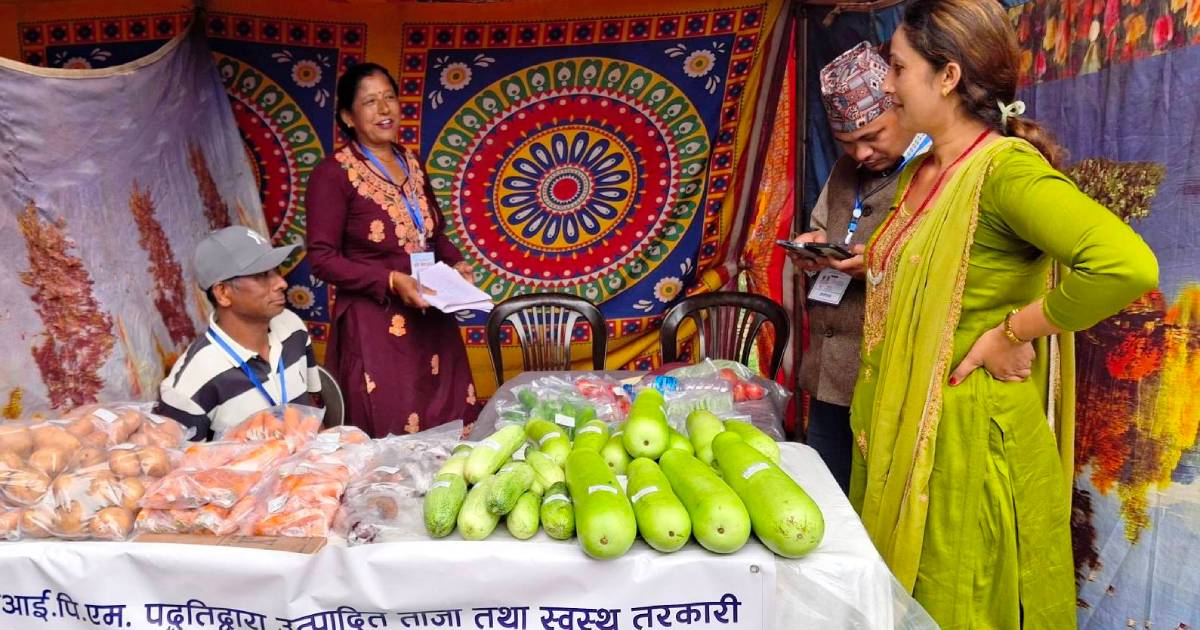

Kavrepalanchok: Panchkhal Municipality has organized a two-day agricultural fair aimed at promoting local farm products and reinforcing its identity as Nepal’s “Agriculture City.” Municipal officials said around 20,000 people visited the event, which was jointly organized by the municipality and Lovegreen Nepal.
The fair was designed to encourage innovation in agriculture and highlight safer farming practices. Activities included exhibitions and sales of produce grown through Integrated Pest Management (IPM) techniques, crop clinics, and competitive showcases of agricultural products. The event was inaugurated on Friday by Mayor Mahesh Kharel.
Speaking at the opening ceremony, Mayor Kharel said Panchkhal’s vegetables now contain significantly lower pesticide residues than in the past. He acknowledged that the area had once faced criticism over excessive pesticide use, but argued that local farming has gradually shifted toward semi-organic production in recent years.
“There has long been a perception that Panchkhal vegetables contain excessive pesticides, but we have been working to break that misconception by promoting organic-oriented farming practices,” he said.
Kharel added that more than 1,200 farmers in Panchkhal have received training in Integrated Pest Management under a partnership with Lovegreen Nepal. According to him, the adoption of IPM technology has helped move vegetable farming toward more sustainable and organic methods.
Farmers in the municipality have also been urging local authorities to launch a weekly agricultural market managed directly by producers. Responding to the demand, Mayor Kharel said the municipality is prepared to support the initiative.
Lovegreen Nepal has been providing IPM training to farmers for the past nine years. The organization’s Executive Director, Narayan Gyawali, said the program has played an important role in promoting healthy and safe agricultural production, protecting public health, increasing yields, and improving farmers’ incomes.
The agricultural fair featured crop clinics, exhibitions and sales of indigenous products, competitions among farm produce, direct interactions between farmers and farmer groups, and displays of vegetables cultivated using IPM techniques. Visitors were also able to explore and purchase dishes and products made from potatoes and other crops produced in Panchkhal.

Comment Here