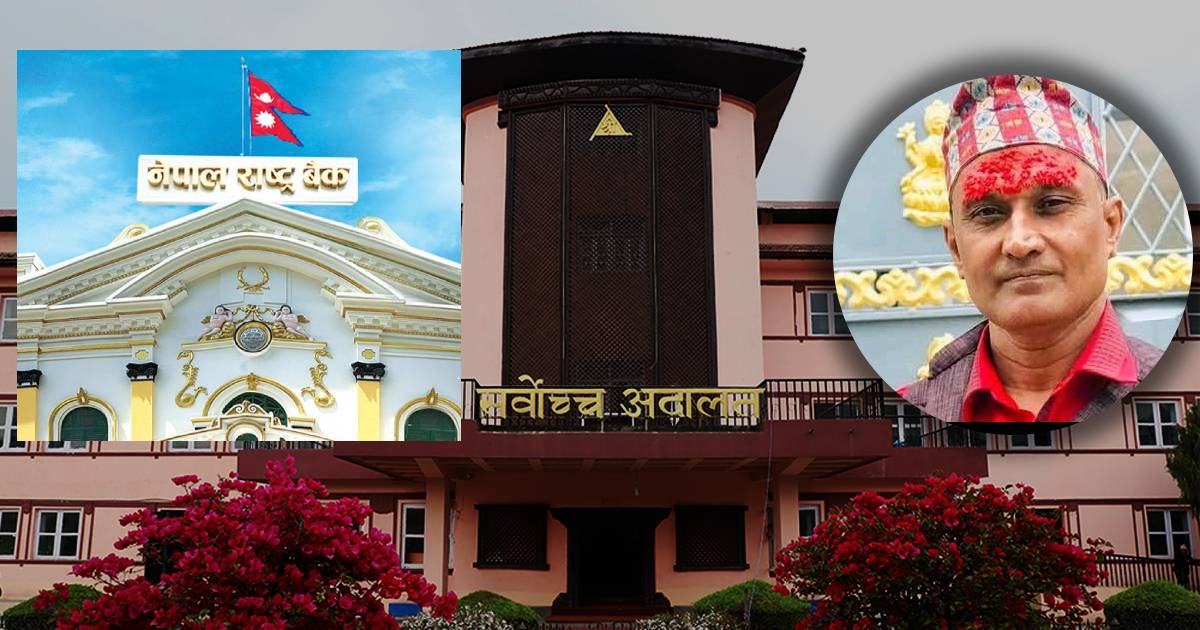

Kathmandu: Nepal’s Supreme Court has ruled that the activities carried out by a group calling itself the “Microfinance Victims Struggle Committee” have posed a serious threat to the country’s financial system and rural economy, ordering the government to take strict legal action against unlawful acts targeting microfinance institutions.
The court said the group had obstructed the operations of financial institutions, physically attacked employees, and encouraged borrowers not to repay loans. Issuing a mandamus order to the government, the court directed authorities to control such “anarchic activities” and ensure the uninterrupted functioning of the financial sector.
The ruling was delivered by a joint bench of Justices Hari Prasad Phuyal and Bal Krishna Dhakal in response to a writ petition filed by advocates including Subash Pathak, Dipesh Dhakal, and Sadin Karki. The court emphasized the importance of protecting the financial sector and upholding the rule of law.
Microfinance institutions have long operated across all 77 districts of Nepal, primarily serving low-income rural women and communities without access to formal banking services. In recent years, however, several groups operating under the banner of the “Microfinance Victims Struggle Committee” have campaigned for loan waivers and organized protests against microfinance institutions.
According to the ruling, individuals associated with the movement have engaged in vandalism at banks and financial institutions, smeared black soot on employees, issued threats, and pressured borrowers to stop repaying instalments.
The group had demanded the abolition of what it described as “neo-feudal” microfinance institutions, cancellation of group loans issued by microfinance companies, free loans for poor farmers, employment and wages based on need and ability, and the establishment of a socialist economic system.
The movement reportedly began after a man named Maniram Gyawali from Gulmi formed an organization opposing microfinance institutions. Since then, the group has been accused of threatening microfinance workers, discouraging financial service users, and attempting to destabilize the entire microfinance system by mobilizing borrowers with promises of debt forgiveness. Demonstrations eventually spread from villages to Kathmandu’s Maitighar protest zone.
The court noted that members of the group not only incited abuse against microfinance employees but also directly harassed workers during loan recovery operations.
Several violent incidents were highlighted in the judgment. In September 2024, branch offices of Abhiyan Laghubitta Bittiya Sanstha in Kanepokhari-2 Daleli and National Laghubitta Bittiya Sanstha in Belbari-6 Bahuni were attacked, vandalized, and set on fire. On the same day alone, protests and acts of vandalism reportedly occurred at 25 different microfinance locations.
Earlier, in February 2023, employees of Jeevan Bikas Laghubitta were assaulted in Morang. In another incident on February 28, 2023, employees of NIC Asia Laghubitta Bittiya Sanstha were smeared with black soot while collecting monthly installments in Bheri Municipality, Jajarkot, and a bag containing collected cash was looted. Likewise, staff members of Deprosc Laghubitta Bittiya Sanstha were assaulted in Gramthan Rural Municipality of Morang in January 2023.
The petition before the Supreme Court argued that such activities had placed billions of rupees invested in microfinance institutions at risk and threatened the savings of more than 5.8 million members, around 97 percent of whom are women.
Although the petitioners requested a ban on the struggle committee itself, the court said the question of whether an organization should be formally registered or prohibited falls under legislative authority. However, it concluded that the group’s actions were clearly illegal.
The judgment stated that the government must immediately initiate legal action against anyone involved in physical attacks on microfinance offices, destruction of property, intimidation or assault of employees, and spreading false assurances of loan waivers to mislead the public.
The court also directed authorities to discourage activities aimed at pressuring borrowers not to repay legally obtained loans or obstructing financial institutions from protecting collateral.
The Supreme Court issued the mandamus order against the Office of the Prime Minister and Council of Ministers, the Ministry of Home Affairs, and Nepal Police Headquarters, directing them to prevent any unlawful disruption to the operations of microfinance and financial institutions.
The court further instructed authorities to ensure adequate security arrangements for offices and employees.
“If gatherings, protests, conferences, or boycott programs conducted in the name of the struggle committee affect the financial system, immediate legal action should be initiated under prevailing laws,” the judgment stated. It also ordered the government to stop the spread of false promises, such as blanket loan forgiveness and to raise public awareness about lawful financial conduct.
The Supreme Court additionally ordered authorities to identify individuals or groups involved in assault, vandalism, and destruction of property and prosecute them under criminal law.
At the same time, the court acknowledged concerns raised against some microfinance institutions themselves. The judgment noted complaints that certain institutions had focused excessively on profit, extended loans beyond borrowers’ repayment capacity, and engaged in abusive recovery practices.
In that context, the court directed Nepal Rastra Bank to strictly monitor whether microfinance institutions are complying with regulatory directives. It also stated that any institution found charging excessive interest rates or exploiting borrowers should face immediate action, while broader policy reforms should be introduced to ensure greater discipline and accountability in the sector.
The court emphasized that the microfinance sector remains a crucial pillar of Nepal’s poverty reduction and women’s empowerment efforts. “Microfinance institutions serve more than 5.8 million members and have mobilized loans exceeding Rs 389 billion,” the judgment noted. “Any physical or psychological attack on such a vast financial network can destabilize the country’s overall economy.”
The ruling also reminded authorities that banking services are classified as “essential services” under the Essential Services Operation Act, 1957, making strikes or disruptions targeting such services unlawful.
The court instructed the Ministry of Home Affairs and Nepal Police not to act only after incidents occur, but to proactively identify potential risks and provide preventive security measures. “In sensitive sectors such as banking and finance, the state must not remain merely reactive but should actively identify risks and implement preventive mechanisms,” the judgment said, adding that ensuring a safe environment for employees and service users is one of the government’s primary responsibilities.

Comment Here