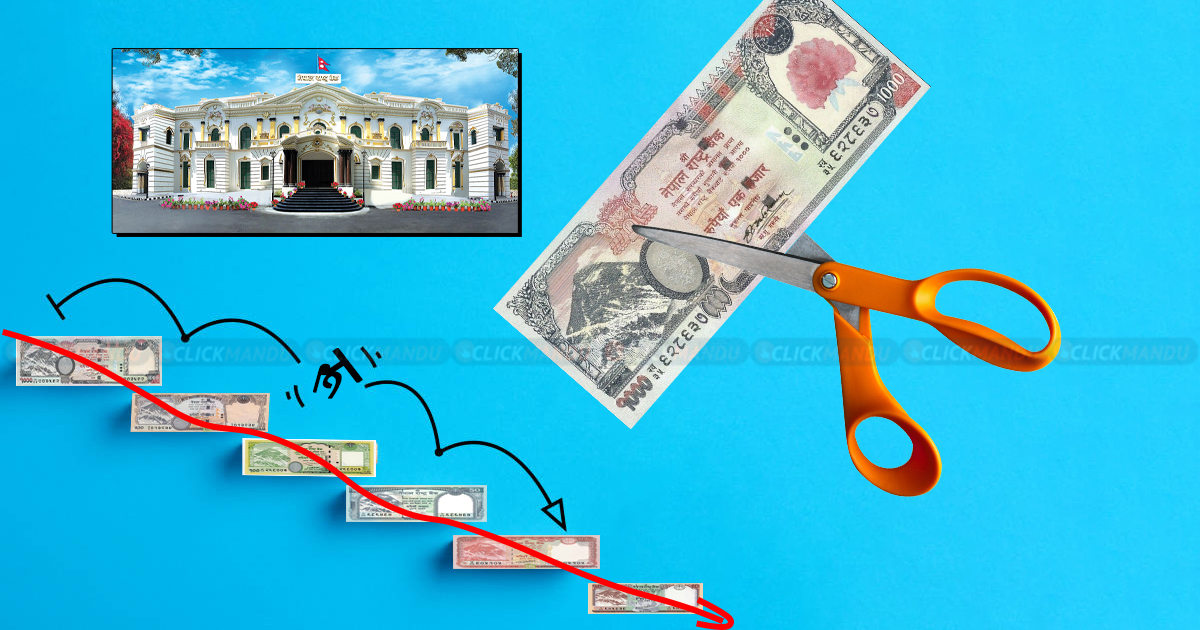

Kathmandu: The real interest rate offered by banks on deposits in Nepal has turned negative, meaning savers are now earning less on their bank deposits than the rate at which prices are rising in the economy. As inflation continues to outpace deposit returns, the actual value of money held by the public in banks is gradually eroding.
According to the latest macroeconomic and financial report published by the central bank, Nepal’s inflation rate stood at 4.47 percent by mid-April, while the weighted average interest rate offered by commercial banks on deposits was only 3.40 percent during the same period. In practical terms, this means the real value of savings deposited in banks is shrinking by 1.07 percent.
Recent data show that real interest rates have remained negative for the past two months, crossing the negative one percent mark in April. Instead of preserving wealth, bank savings are now losing purchasing power.
For example, if a depositor keeps Rs 10 million in a bank, the amount would grow to Rs 10.34 million after one year, including interest. However, goods and services that previously cost Rs 10 million would now require Rs 10.447 million due to inflation. Effectively, the depositor loses purchasing power equivalent to Rs 107,000 despite earning interest.
Nepal Rastra Bank has repeatedly pledged through its monetary policy to maintain positive real deposit rates through policy measures. However, the current figures suggest the central bank has failed to achieve that objective.
Data show that real interest rates remained slightly positive for most of the previous fiscal year. The real deposit rate was negative by 0.17 percent in mid-March, but the gap widened sharply to negative 1.07 percent by April.
Economists warn that prolonged negative real interest rates can have serious consequences for the economy. When savings in banks continuously lose value, people become more inclined to move money into informal channels or transfer capital abroad. This could weaken domestic savings significantly and create future shortages of investment capital for large infrastructure projects.
Despite excess liquidity in the banking system, depositors are bearing the cost of poor liquidity management and weak policy transmission.

Comment Here