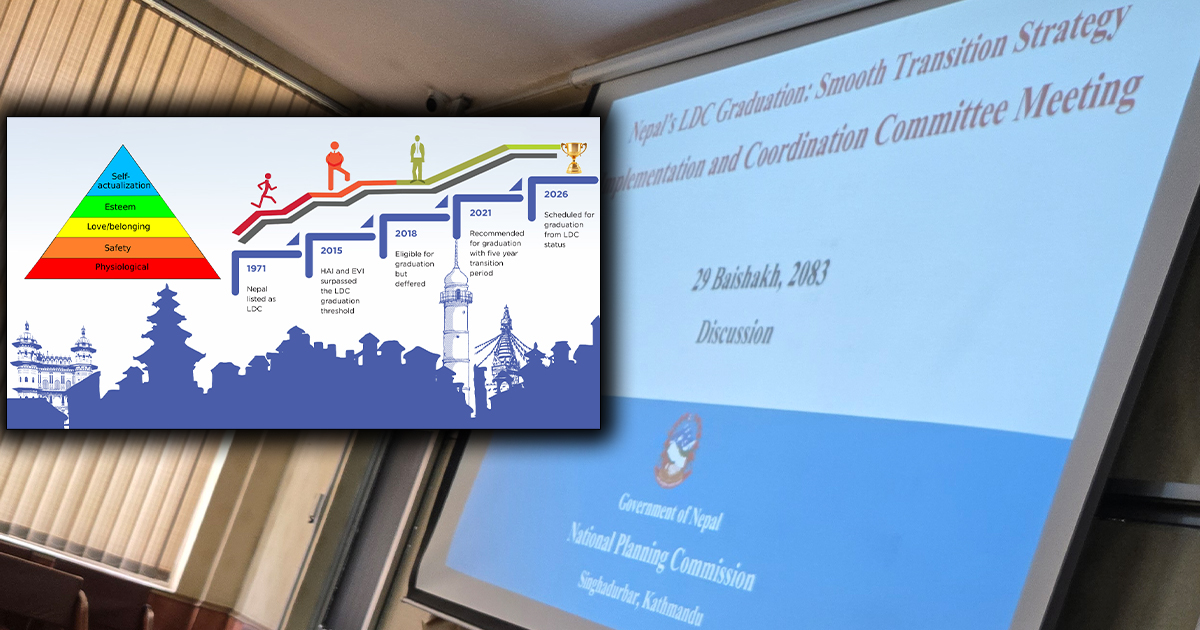

Kathmandu: The government is preparing to ask the United Nations to postpone Nepal’s graduation from the Least Developed Country (LDC) category to developing nation status by three years, pushing the transition from November 2026 to November 2029.
Although Nepal has already fulfilled the criteria required for graduation from the LDC category, the government now believes the country is not fully prepared for the immediate transition and wants additional time to manage the economic and structural consequences.
According to sources at the National Planning Commission, Tuesday’s meeting of the LDC Graduation Implementation and Coordination Committee decided to recommend the postponement request to the United Nations through formal government channels.
The move comes amid concerns that Nepal’s economy remains vulnerable due to a series of recent domestic and global shocks. Officials cited the impact of the Gen Z-led protests in Nepal last year, continuing geopolitical conflicts, including the Russia-Ukraine war and instability in West Asia, as well as the country’s own limited preparedness for the transition. Nepal’s private sector has also been lobbying the government to delay the graduation date, warning that the country could lose important trade privileges and financial concessions.
A member who attended Tuesday’s committee meeting said representatives from various agencies raised concerns about the economic costs Nepal could face if graduation proceeds immediately. The official noted that external shocks from ongoing global conflicts have already strained the economy, making the timing difficult for Nepal to transition into developing-country status.
Following the committee’s decision, the recommendation will now move through the Ministry of Finance and the Office of the Prime Minister and Council of Ministers before being formally submitted to the United Nations.
Once Nepal graduates from the LDC category, it will gradually lose several international benefits currently available to least developed nations. These include grant assistance, preferential trade access, tariff-free export facilities, and special provisions under the World Trade Organization (WTO). Officials fear Nepali exports could become less competitive internationally, potentially shrinking market access for domestic products.
The private sector has repeatedly warned that losing duty-free access and export subsidies could severely hurt Nepal’s manufacturing and export industries. Businesses argue that Nepal’s economic fundamentals remain fragile despite meeting the technical graduation criteria.
Government officials have internally discussed delaying graduation since last year, partly due to concerns that Nepal could suffer economically if it moves too quickly. The administration that came to power following the Gen Z protest movement has also favored postponement.
“Nepal is already eligible for LDC graduation from November 2026,” a committee member said after the meeting. “But the government assesses that the country could face losses if the transition happens immediately. That is why there is now a decision to request the UN to defer it until November 2029.”
Officials say Nepal also needs additional time to rebuild after recent disasters and social unrest, revive economic growth, and accelerate efforts toward achieving the Sustainable Development Goals.
Bangladesh, which is also preparing to graduate from the LDC category alongside Nepal, had already asked the United Nations in September last year to reassess the timing of its own transition.
To qualify for LDC graduation, countries must improve in three areas: the Human Assets Index, the Economic and Environmental Vulnerability Index, and Gross National Income (GNI) per capita. Nepal has already met all three benchmarks, although meeting only two would have been sufficient for graduation eligibility.
Nepal had qualified for graduation earlier as well, but repeatedly sought extensions to allow more preparation time. Most recently, in 2021, Nepal received a five-year transition period, setting the graduation date for November 2026. The government is now preparing to ask for yet another extension.
Nepal, Bangladesh and Laos were all expected to complete their five-year preparation period and graduate from the LDC category in 2026.
Nepal had spent decades trying to move out of the LDC category after being listed by the UN General Assembly on November 18, 1971. The country finally secured eligibility for graduation nearly 50 years later.
Supporters of graduation argue that moving into developing-country status would strengthen Nepal’s international credibility, improve investor confidence, and create a more favourable environment for foreign investment. United Nations assessments in 2015, 2018 and 2021 noted Nepal’s progress in human development and economic resilience indicators.
Nepal recently crossed the income threshold required for graduation. Per capita gross national income has risen from around $1,335 three years ago to approximately $1,496 now. The World Bank classifies countries with per capita income above $1,361 as no longer belonging to the low-income category.
Graduation also signals improved repayment capacity, meaning international lenders may reduce concessional financing and increase borrowing costs. Institutions such as the World Bank and the Japan International Cooperation Agency (JICA) have already raised interest rates on some concessional loans provided to Nepal following the country’s income growth.
Currently, Nepal receives concessional loans from development partners at interest rates averaging below two percent, but those rates are expected to rise further after graduation.
The private sector argues that Nepal’s apparent rise in income does not necessarily reflect a dramatic improvement in real economic strength, noting that global income levels have risen broadly. Business groups say Nepal risks becoming “artificially rich” on paper while remaining economically vulnerable in practice, which is why they have urged the government to follow Bangladesh’s example and seek more time.
At the same time, proponents of graduation maintain that the transition would enhance Nepal’s reputation, strengthen credit ratings, encourage productive investment, and reduce long-term dependence on foreign aid.
Still, concerns remain high over the possible reduction in grants and trade privileges. According to a study by the International Trade Centre (ITC), Nepal’s exports could decline by around four percent after graduation in 2026.
Least developed countries currently enjoy duty-free access for many products in international markets, a benefit Nepal is expected to lose after graduation. The country may also no longer qualify for several special concessions and exemptions provided under WTO rules.

Comment Here