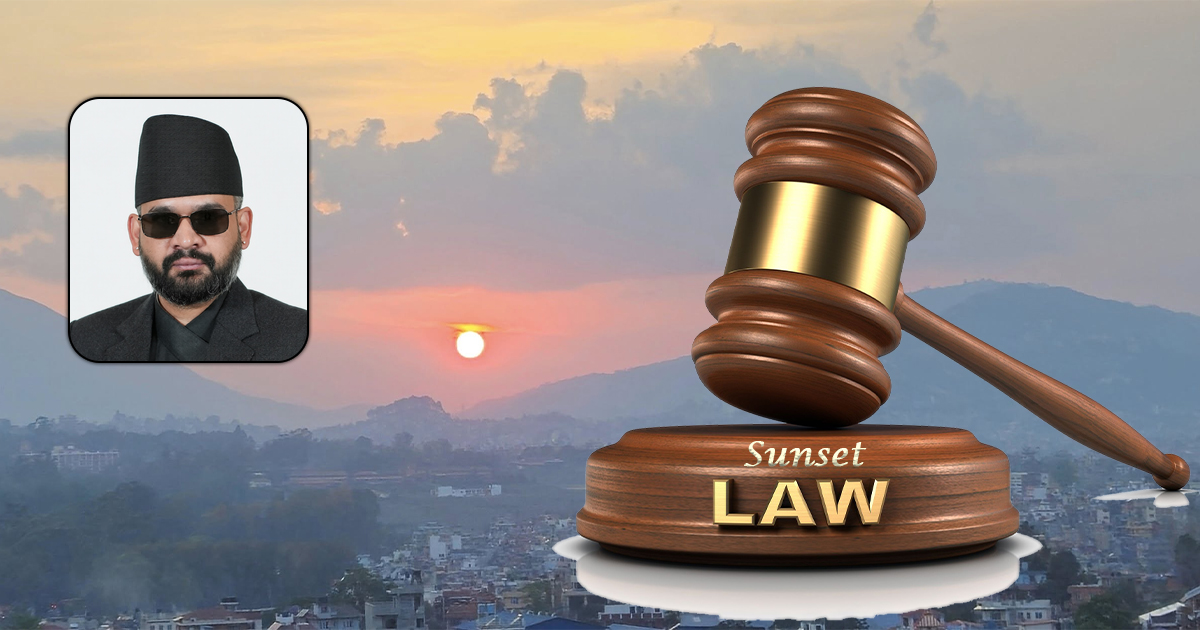

Kathmandu: The government is in the final stages of drafting a special “Sunset Law” aimed at removing long-standing legal and bureaucratic hurdles that have delayed large infrastructure projects across Nepal. The proposed law, being prepared under the direction of Prime Minister Balen Shah, is expected to be submitted to the Prime Minister within days.
Officially titled the “Development Project Management and Implementation Facilitation Act,” the proposed legislation would temporarily suspend or relax several legal provisions related to forests, land acquisition, environmental clearance, and procurement procedures for a period of 10 years. The objective is to accelerate the construction of infrastructure projects, including hydropower plants, transmission lines, roads, cable cars, industrial zones and tourism infrastructure.
The bill to introduce the law in Parliament has been named the “Development Project Management and Implementation Facilitation Bill, 2083.”
The Prime Minister’s Office had earlier sent a 36-page draft of the proposed law to the National Planning Commission on April 27. Following that, a seven-member committee led by National Planning Commission expert member Arjunjung Thapa was formed to refine the proposal. Senior officials from five ministries and the commission are involved in finalizing the legislation, which is now being condensed into a concise six-to-eight-page framework.
The original draft proposed suspending legal provisions that obstruct development projects for a decade and replacing them with a special legal mechanism. However, officials later concluded that the initial version was too lengthy and complicated. The revised effort now focuses on identifying exactly which legal provisions are obstructing development and determining whether they should be amended, overridden or temporarily deactivated.
The government has already amended several laws through a recent ordinance aimed at easing development bottlenecks. But the proposed Sunset Law would function as a separate and more powerful umbrella law specifically designed to facilitate infrastructure construction.
In particular, the law seeks to ease restrictions imposed by the Forest Act, Environment Act, Local Government Operation Act and Public Procurement Act. Some provisions of these laws would either be suspended or modified for 10 years in order to fast-track nationally significant projects.
Committee members say the proposed law will especially benefit hydropower, transmission line and cable car projects, many of which have faced years of delays because of forest clearance requirements and environmental approval procedures.
Carbon-neutral or carbon-negative projects such as hydropower plants and electric cable cars would become eligible for easier access to forest land and faster approval processes
Recently, the government removed a legal requirement forcing public projects using forest land to purchase replacement land and plant five times the number of trees cut down. Instead of nurturing trees for five years, project developers can now deposit compensation funds into a designated government fund. The proposed Sunset Law aims to extend similar provisions to private sector projects as well.
Officials argue that large projects such as the Postal Highway, Kaligandaki Corridor, Mid-Hill Highway, Madan Bhandari Highway, hydropower schemes, transmission lines and cable car projects have all suffered major delays because of complicated forest clearance procedures. Once enacted, the Sunset Law is expected to neutralize many of those barriers for at least a decade.
The draft also proposes preferential treatment and fast-track approval for projects that are carbon-neutral or carbon-negative and cause minimal environmental damage.
A member of the drafting committee said the ordinance reforms currently apply only to government projects, but the new law would allow private sector projects to receive the same facilities. Carbon-neutral or carbon-negative projects such as hydropower plants and electric cable cars would become eligible for easier access to forest land and faster approval processes.
As an example, officials cited the Rs 60 billion Muktinath Cable Car project, which they described as a carbon-negative tourism project that runs on electricity and helps reduce emissions. Despite its environmental benefits, the project has reportedly been stuck in legal disputes for three to four years because it lacks special facilitation mechanisms.
Another major target of the law is Nepal’s notoriously slow Environmental Impact Assessment (EIA) system. At present, obtaining EIA or Initial Environmental Examination (IEE) approvals can take anywhere from two to four years due to the need for clearances from forests, national parks, local governments and multiple ministries.
Under the proposed Sunset Law, if the responsible agency fails to decide on an EIA-related file within three months, the matter would automatically move to a high-level directive committee chaired by the Prime Minister, which would be empowered to resolve the issue immediately.
The draft also seeks to simplify access to construction materials such as stone, gravel and sand. Projects that have already completed EIA approval for extracting construction materials would no longer require separate permission from local governments. Developers would simply pay royalties to local authorities.
The law would also address another recurring obstacle in infrastructure projects: relocating electricity poles. Once the law comes into effect, the Nepal Electricity Authority would be allowed to move utility poles through direct quotation methods instead of following lengthy public procurement procedures.
“One billion-rupee road projects should not be halted just because a one-crore electricity pole relocation process gets stuck,” a committee member said.
After parliamentary approval, the proposed law would override conflicting provisions in several existing laws for a period of 10 years. Officials say the idea is to temporarily supersede impractical legal provisions while allowing time for broader legal reforms in the future.
Arjunjung Thapa, who is leading the drafting process, said the final draft could be submitted to the Prime Minister within a week. While declining to disclose detailed contents, he said the law would be “short, practical and implementation-oriented.”
The push for the Sunset Law follows a directive issued by Prime Minister Balen Shah during a high-level meeting earlier this year, in which he reportedly instructed officials not to allow forests or bureaucratic obstacles to stand in the way of development projects. “Forests should not block development,” he had said.
The term “Sunset Law” refers to legislation that automatically expires after a fixed period unless renewed by Parliament. Unlike ordinary laws that remain in force indefinitely until repealed, sunset laws come with a built-in expiration date — such as two, five or ten years — after which they automatically cease to exist unless lawmakers decide to extend them.
The concept is based on periodic review and accountability. It forces governments and legislatures to evaluate whether a law remains effective and relevant. The practice was formally institutionalized in Colorado, United States, in 1976, though similar concepts existed much earlier in history.
In Nepal, ordinances provide a familiar example of sunset-style legislation. Ordinances issued when Parliament is not in session automatically lapse if they are not endorsed within six weeks after Parliament reconvenes.
Supporters of the proposed law argue that Nepal’s infrastructure sector has long suffered from overlapping approvals, weak coordination, land acquisition disputes, forest clearance delays, procurement complications, lack of skilled manpower and unclear implementation procedures. They say projects funded through loans become increasingly expensive as delays continue and interest costs pile up.
Rather than using forceful measures, the Balen administration now appears to be pursuing legal reform as the primary route to accelerating development
Currently, project developers often spend years moving between ministries, departments, local governments, forest offices, investment agencies, and land revenue offices to seek approvals. The Sunset Law aims to centralize and streamline those procedures.
Officials insist the law is not intended to destroy environmental safeguards but rather to create a balance between conservation and development. They say Nepal’s biggest development bottlenecks today lie in land acquisition and forest clearance procedures, and the proposed law would create extraordinary mechanisms to resolve them quickly.
Prime Minister Balen Shah had previously criticized the country’s slow infrastructure delivery during election campaigns, saying roads that should be completed in two years end up taking two decades. Rather than using forceful measures, his administration now appears to be pursuing legal reform as the primary route to accelerating development.
Calls for such reforms have also come from the private sector and political leaders. Nepali Congress leader Gagan Thapa had earlier argued that at least 41 laws would need to be amended to ensure timely road construction and infrastructure delivery.
Business groups and energy entrepreneurs have similarly demanded the removal of legal barriers that they say discourage investment and delay projects. Ahead of the recent investment summit, the government had already amended multiple laws through omnibus reform legislation. However, private sector leaders continue to push for broader structural reforms — something the proposed Sunset Law now seeks to address.

Comment Here