
How do we know about anything? Is it through observation? Or is it through the sayings of ancient books, parents and priests, experienced and learned people? Or is it the combination of it all?
David Deutsch engagingly challenges these obviously sounding assumptions and shows how wrong they are. Then he goes on to introduce the theory of knowledge, which he attributes to Karl Popper and which underlies all the various seemingly unrelated phenomena in the natural world and the human world. As the dots get connected and as I realised how all the explanations of the different phenomena in the book are somehow related to the same underlying basic principle, it gave me the joy of knowing and the satisfaction of finding.
That basic principle is that all knowledge begins with explanations that are like guesses. We cannot know anything just from observation. In fact, no observation is possible without a theoretical explanation of what is being observed. When I observe that someone not speaking with me is angry with me, I am basing that observation on the theoretical understanding of how humans generally behave when they are angry, the personality of that angry person, what I have done in the past that could have resulted in the present reaction and many more similar theories. So ultimately, all our observations are always colored by theory or explanation.
However, there can be different explanations or theories for the same phenomenon in question. How do we know which is right and which is wrong? Her not speaking with me may be because she has taken a silent vow, or she is angry with someone else and not me, or she is playing a prank with me. I choose between these differing explanations by criticising them. Explanations that fall apart when criticised are bad explanations.
Observation is one of the tools of criticism. If I listen to her talking to others, I can rule out the silent vow as a bad explanation. Her general demeanour, showing sadness, together with my theoretical knowledge of her serious personality, can be a strong criticism of the explanation that she is playing a prank. I would also try to criticise and test the explanation of her being angry with me. Maybe by trying to talk to her and also trying to find other better explanations. When the explanation withstands all possible criticism, I have to accept it as the best explanation for now. And that becomes my current state of knowledge.
This process of conjecture (meaning guess), criticism and testing to arrive at a possible explanation is how knowledge is created and updated in every field, including science, art, philosophy, and our day-to-day life. The obvious implication is that we cannot accept something as knowledge without explanation just because someone in authority says it is. It could be a decent explanation that s/he is an expert in the field and thus does have a good explanation for saying what s/he is saying, even if I do not know the explanation myself. This is the mode we take when we visit a doctor to diagnose our medical condition and suggest the treatment. However, like all explanations, this explanation should also be subject to criticism. That is exactly what we do when taking a second opinion on medical conditions.
Another important implication is that there can be no justified source of knowledge. Since knowledge is derived from explanation and all explanations are subject to criticism, there can be no eternal knowledge. Even the best of explanations may have some fallibility attached to them, which we may not be able to see today.
For thousands of years, humans watched the bright stars in the sky and wondered what they were. Most explained the Earth to be the stationary centre of the universe around which the heavenly objects revolved. Their observation seemed to validate this theory, and since there was little criticism to challenge it, this was the valid knowledge for those thousands of years.
Moving on to the knowledge creation in general, Deutsch identifies two ways known in the universe so far by which it has happened. One is biological evolution, and the other is human learning
Now we know how wrong they all were as scientists came along, criticised their worldview, and found better explanations. Similarly, our best explanation of the present day will surely be challenged by the people of the future as they progress to a better but far from perfect understanding of reality. Just like we cannot take the knowledge on the authority of ancient texts, we cannot take them on the authority of our intuition or initial explanation without criticism. That is the only known way for the progress of any kind.
As a practical implication, how is it relevant for teaching? Effective teaching can start only with a good understanding of how humans, who make up the pupils, learn. Formulating conjectures and criticising them on the way to finding better explanations is the birthright of each human. That is the only way anyone can ever learn. Hence, teaching should be about facilitating the engagement of this process within the students. It is a far cry from the generally prevailing model of teaching where students’ minds are thought to be a kind of bucket in which teachers pour all the knowledge they have acquired (called the bucket theory of mind).
So, the explanation takes centre stage. The goal of the teacher should be to help students recreate the explanation that the teacher has provided. All methodology should be in service of this goal. Maybe it is not the most effective method to give the final explanation to the students at the outset. This would skip over the steps of conjecture and criticism of initial bad explanations. Maybe practising those steps is essential for learning the specific phenomenon being learned, and also the method by which learning in general happens. And of course, students can and do go ahead questioning the erroneous assumptions and explanations of the teacher in the process of elevating the state of knowledge to newer heights.
Moving on to the knowledge creation in general, Deutsch identifies two ways known in the universe so far by which it has happened. One is biological evolution, and the other is human learning. In both cases, the process of conjecture and criticism occurs, but biological evolution is non-explanatory. Random mutation of genes serves as conjecture, which is criticised through the selection process.
Those genes which are best at reproducing copies of themselves relative to the variants of those genes populate the gene pool. Knowledge is being created in the sense that genes are selectively programmed to be most adaptive to the environment. When many such genes operate together to create an organism, there is an appearance of design in the organism, which is the result of knowledge implicit in the genes.
The generic knowledge that genes embody is that of how to get the most copies of itself at the expense of other variants. Thus, the knowledge is different from human knowledge in that it does not care about the underlying truth beyond its own immediate environment. Genes in fish have the knowledge necessary for survival in the water of organisms built out of those genes. That is why so many organisms go extinct when there is a change in the ecosystem.
Human knowledge creation is explanatory and thus holds the power to go beyond the parochial limitations of its environment. That is because explanatory knowledge, unlike knowledge embodied in genes, has reach and universality. For example, explanatory knowledge about gravity allowed humans to predict the movement of planetary bodies far away from our immediate experience.
In a different area, knowledge about human nature and the dynamics of the collection of people living in society helps us identify ever better ways of organising society and politics, even before such organisation is put into practice. That is why good explanations help us get closer to the underlying truths with universal reach and thus solve problems leading to progress.
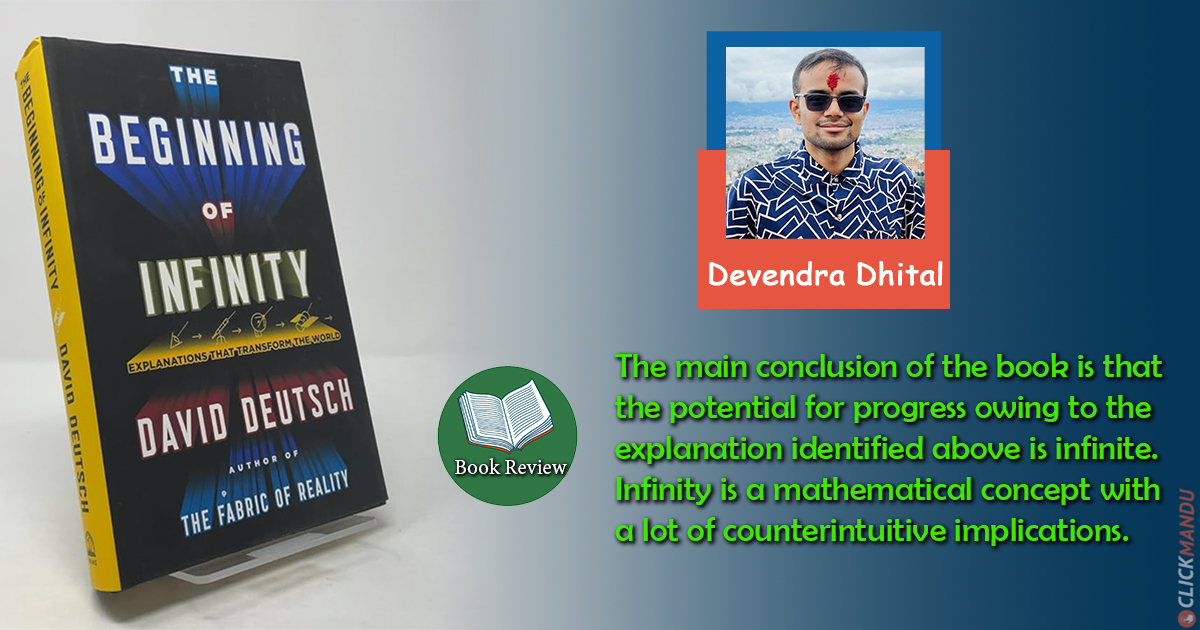
The main conclusion of the book is that the potential for progress owing to the explanation identified above is infinite. Infinity is a mathematical concept with a lot of counterintuitive implications. Deutsch identifies one of such implications in regard to knowledge and progress to be that we are always at the start of infinity. No matter how much progress we make, there is always near infinite progress on the horizon.
When this abstract conception is translated into concrete real-world terms, the implications are both exciting and wonderful. Primarily, the only limit on what can be achieved is the one placed by the law of physics. For example, any transmission of information or any kind of travel at a speed above the speed of light is not permissible since that is the absolute physical limit.
However, that leaves a lot of room for unimaginably sophisticated progress to happen. Deutsch speaks with almost certainty of there being future progress like intergalactic travel, harnessing the energy from the sun and immortality of life. All of these are only technical problems which will be solved since no known law of physics is violated in their solution. From this grand perspective, current problems like resource shortage, climate change, global warming, possible nuclear catastrophe, etc., are easily manageable given the right knowledge.
The Beginning of Infinity is a challenging book. Reading it, I felt to be in the presence of one of the most intelligent people alive
It is not at all to say that there will be no problems. Just like knowledge and its bounds are infinite, so is the problem that new solutions will create. And those problems will not be the ones that we are accustomed to seeing. Today’s problems will long have been solved, and we will be in the presence of entirely new problems, most of which we cannot even imagine today.
Those problems could be like the problem of a computer virus to a person 200 years back, when no computers had been invented. We do not yet have the physical environment or the knowledge background to know or conceptualize those problems. This is one of the limitations of knowledge creation that Deutsch highlights. The content of future knowledge cannot be known in advance because if it were, that would be the present state of knowledge.
As an example, during 1900, nuclear war was not a problem because the knowledge of the extremely powerful energy within microscopic atoms was yet to be known. The discovery of nuclear energy has the potential to solve a big problem of energy shortage, but has created new problems of possible nuclear war in its turn. That problem, too, has a solution, and it can be argued that humanity has dealt with it well enough so far, as it has not engaged in nuclear war for more than 75 years despite there being enough nuclear weapons to destroy our planet.
The Beginning of Infinity is a challenging book. Reading it, I felt to be in the presence of one of the most intelligent people alive. Some of the technical concepts that Deutsch introduces and explains, like different quantum phenomena, the multiverse, Turing’s theory of computation and its implications, are quite complex and require deep concentration to follow through.
But on the whole, a willing reader will be able to understand and enjoy most of the book without much technical background. However, another challenging aspect is that it brings into the open a lot of deeply held assumptions and dismantles them mercilessly.
If you think that an omnipotent god is watching over you or that Earth is a friendly place providing its life with food and motherly sustenance, or conversely that humans are just one of the billions of life forms without much significance, you are in for a great surprise. More dramatically, Deutsch argues with scientific certainty that in some universe you have married your childhood sweetheart and are living happily ever after. To find out how, read The Beginning of Infinity.

Comment Here