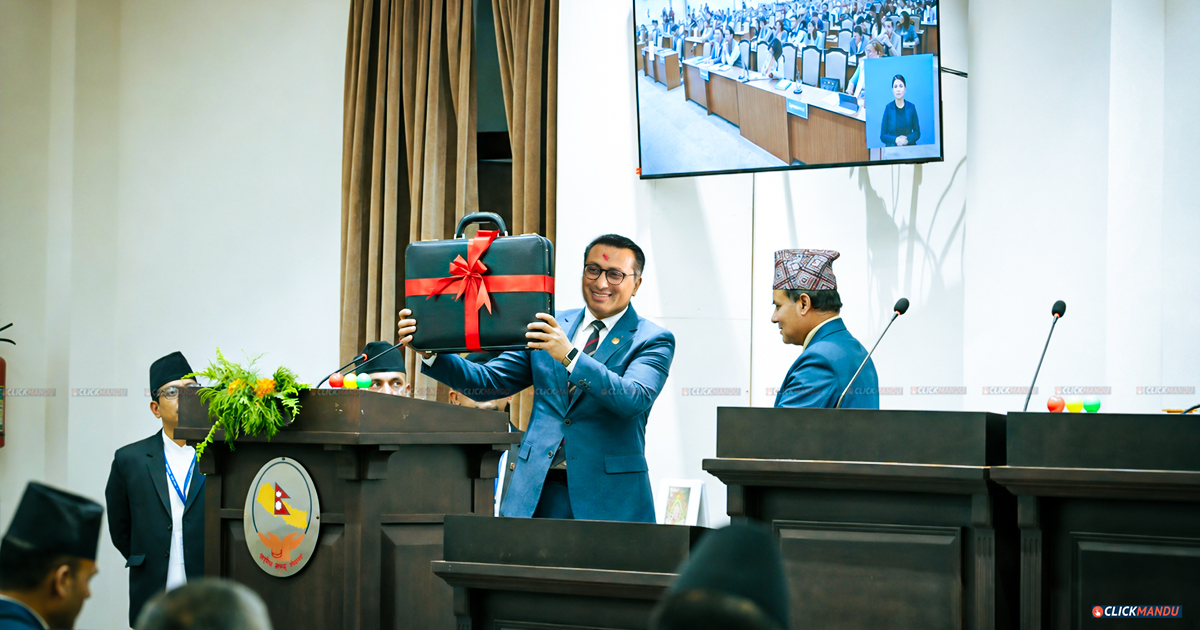

Kathmandu: Finance Minister Dr Swarnim Waglé is set to present the national budget for the fiscal year 2026/27 on Friday, marking his first time leading the country’s annual fiscal announcement.
As the inaugural budget under the administration of Prime Minister Balendra Shah, this presentation has sparked immense curiosity among the general public, the business community, and the younger generation. While the tradition of formal budgeting in Nepal began following the political transition of 1951, economic historians and experts suggest that out of the dozens of budgets presented over the decades, only a handful have truly transformed the nation’s economic landscape, with most serving as mere routine continuations.
The foundation of Nepal’s fiscal planning was laid by Subarna Shumsher Rana in 1951, shortly after the end of the 103-year-old Rana regime. This historic first budget was remarkably focused on social welfare, dedicating a staggering 51 percent of its resources to education and 38 percent to health, signalling a new era of transparency and public service. A decade later, following the political takeover by King Mahendra in 1960, Rishikesh Shah introduced a budget that remains notable for its aggressive focus on cutting public expenditure during a time of significant institutional change.
The later years of the Panchayat era saw a major shift toward economic liberalization, particularly through the policies of Dr Yadav Prasad Pant and Dr Prakash Chandra Lohani. Before this period, the banking sector was exclusively state-owned, but its reforms allowed for the issuance of public shares and the entry of foreign investment. This led to the establishment of the country’s first joint-venture banks, such as the predecessors of Nabil Bank, Nepal Investment Mega Bank, and Standard Chartered Bank Nepal, which fundamentally modernized the domestic financial system.
The most significant paradigm shift in Nepal’s modern economy occurred in 1991, following the restoration of democracy. Presented by Mahesh Acharya with the strategic backing of Dr Ram Sharan Mahat at the National Planning Commission, this budget introduced privatization and prioritized private-sector investment.
This era encouraged the establishment of large-scale industries and resulted in robust economic growth between 1991 and 1994. However, the political landscape shifted again in 1994 when Bharat Mohan Adhikari, representing the first communist government, introduced populist yet enduring programs like the old-age pension and the “Build Your Own Village” campaign, which channelled funds directly to local village committees for the first time.
In the early 2000s, Dr Ram Sharan Mahat, who holds the record for the most budget presentations, delivered a standout fiscal plan for 2002/03. In a rare move for a developing nation, he actually reduced the total budget size by 3 billion rupees to curb unproductive spending while initiating systemic reforms to address bad loans in the banking sector and introducing multi-year funding for “National Pride Projects.”
Later, in 2008, Dr Baburam Bhattarai shifted the focus toward aggressive revenue mobilization. His budget set and achieved ambitious income tax collection targets, marking a record year for domestic revenue. As Dr Wagle prepares to present his maiden budget today, the nation is watching to see if his plan will join these historic milestones by offering a new vision for Nepal’s economic future.

Comment Here