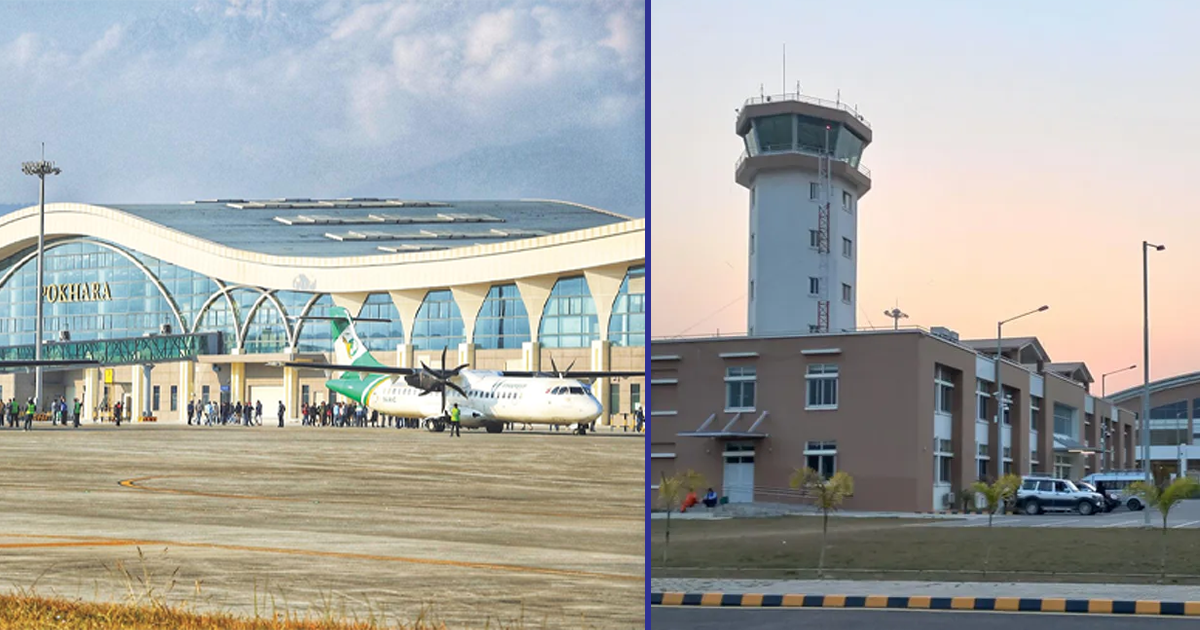

Kathmandu: The Government of Nepal has officially decided to outsource the management and operation of the Gautam Buddha International Airport in Bhairahawa and the Pokhara Regional International Airport to the private sector starting next fiscal year.
Recognizing that the state has struggled to operate these newly constructed facilities effectively, Finance Minister Dr Swarnim Waglé announced through the budget for the fiscal year 2083/84 that the government will partner with private entities to ensure more efficient and commercially viable management. Additionally, the administration has committed to finalizing the construction and investment modality for the long-proposed Nijgadh International Airport within the next six months to move the strategic project forward.
In terms of broader aviation infrastructure, the budget prioritizes the expansion of Bharatpur Airport to facilitate night flight operations, alongside the expansion of Surkhet Airport and the upgrading of airfields in Mugu and Dang. To maintain and improve the nation’s primary gateway, the government has earmarked 1.53 billion rupees specifically for the upgrading of Tribhuvan International Airport in Kathmandu. Overall, the fiscal plan allocates 7.34 billion rupees for the culture and tourism sectors and 2.93 billion rupees for civil aviation, signalling a shift toward public-private partnerships in managing the country’s modern transport hubs.
On the cultural front, the government has allocated 830 million rupees for the comprehensive infrastructure development of the Lumbini region, focusing on sites like Tilaurakot, Devdaha, and Ramgram. A major strategic goal involves branding Janakpur as a premier global wedding destination to capitalize on its religious heritage.
Furthermore, the budget outlines initiatives to secure UNESCO World Heritage status for Tilaurakot, Janakpurdham, and Gokarneshwar. To preserve the country’s ancient high-altitude heritage, a special project will also be launched to conserve Buddhist monasteries that are over two hundred years old in the districts of Mustang and Manang.
To further diversify tourism activities, the government plans to develop new hill stations in various regions and enhance strategic trekking routes such as the Great Himalayan Trail. In a move to boost international marketing, original local names will be assigned to peaks over 6,000 meters that are currently unnamed but open for climbing.
The government is also focusing on social inclusion and local engagement by initiating the construction of bicycle trails in Gandaki Province and launching model homestay programs in Dalit settlements across the Madhesh, Karnali, and Sudurpashchim provinces, ensuring that the economic benefits of tourism reach marginalized communities.

Comment Here