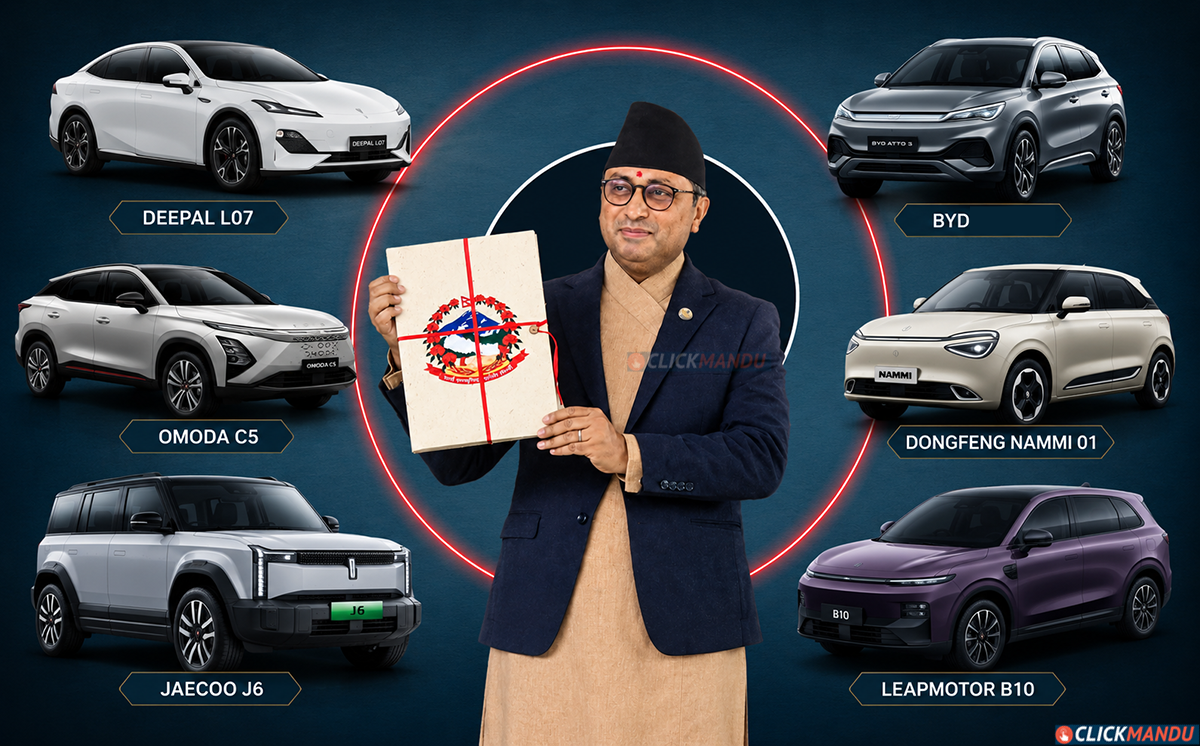

Kathmandu: Finance Minister Dr Swarnim Wagle has come under intense scrutiny for a “grave error” in the tax structure for Electric Vehicles (EVs).
Allegations suggest that by cleverly removing excise duties and introducing a “Clean Infrastructure Investment Fee,” the Minister has manipulated policy to benefit controversial auto traders to the tune of billions of rupees.
By suspiciously omitting a specific tax slab from the documents, Minister Wagle is accused of committing a serious economic offence that favours a handful of powerful businessmen, including Bishnu Agrawal, who have a history of tax evasion through misreported documentation. While the Finance Minister frequently lectures on good governance, he is now accused of bleeding the state treasury to enrich controversial traders, leaving Prime Minister Balen Shah appearing helpless in the face of such deep-rooted cronyism.
Unless an immediate investigation is launched and the Finance Minister is held legally accountable, it will embolden future officials to commit such blatant financial crimes openly.
What did Dr Wagle actually do?
Section 11 of the Finance Bill 2026 introduced the “Clean Infrastructure Investment Fee” for the first time. Under this new rule, EVs are taxed based on their invoice value rather than their motor’s peak power. Before this fee is applied, all EVs attract a 20 percent customs duty and a 5 percent road construction fee.
However, in Schedule 3 of the bill, several sub-headings were abolished, leaving only two categories. The controversy arises in the detailed breakdown of the additional fees:
Category A: EVs with an invoice value up to Rs 2 million incur an additional 2.5 percent fee (Total 22.5 percent).
Category B: EVs valued between Rs 3 million and Rs 4 million incur an additional 15 percent fee (Total 35 percent).
Category C: EVs valued between Rs 4 million and Rs 5 million incur an additional 70 percent fee (Total 90 percent).Category D: EVs valued above Rs 5 million incur an additional 110 percent fee (Total 130 percent).
The “billion-rupee” gap
The “grave error” lies in the missing link between Category A and Category B. While the bill specifies taxes for cars up to Rs 2 million and those starting from Rs 3 million, it is completely silent on EVs with an invoice value between Rs 2 million and Rs 3 million.
In legal and tax terms, if a rate is not specified in the schedule, it effectively means these vehicles are exempt from the Clean Infrastructure Investment Fee. The wording in Clause (B) further complicates this, stating, “Regardless of what is written above, the following shall apply,” effectively isolating the categories and leaving the Rs 2–3 million bracket as a tax-free zone.
Who benefits?
The suspicion of foul play deepens when looking at which brands fall into this “missing” price bracket. Most models from BYD, Deepal, Nami, Omoda, JAECOO, and Leapmotor have invoice values precisely within this Rs 2 to 3 million range.
This is particularly alarming because the Office of the Auditor General has repeatedly flagged these same companies for evading billions in revenue by under-reporting the kilowatt (kW) capacity of their vehicles. According to the Auditor General’s 63rd report, the Rasuwa and Tatopani customs offices alone saw a revenue loss of over Rs 2.5 billion due to such technical misreporting.
Instead of recovering these lost funds, Minister Wagle appears to have “rewarded” these traders with a massive tax loophole.
Price point analysis:
Data obtained by Clickmandu shows the average invoice prices for popular models:
BYD Atto 3: ~2.8 million rupees
BYD Atto 2: ~2.2 million rupees
Deepal: ~2.9 million rupees
Nami: ~2.6 million rupees
Omoda E5: ~2.7 million rupees
JAECOO J5: ~2.6 million rupees
Leapmotor: ~2.4 million rupees
Every single one of these models, previously cited by the Auditor General for tax evasion, now conveniently falls into the tax-exempt “missing slab” created by Dr Wagle. This has led many to believe that the “error” was a deliberate act of policy tailoring to serve specific vested interests.

Comment Here