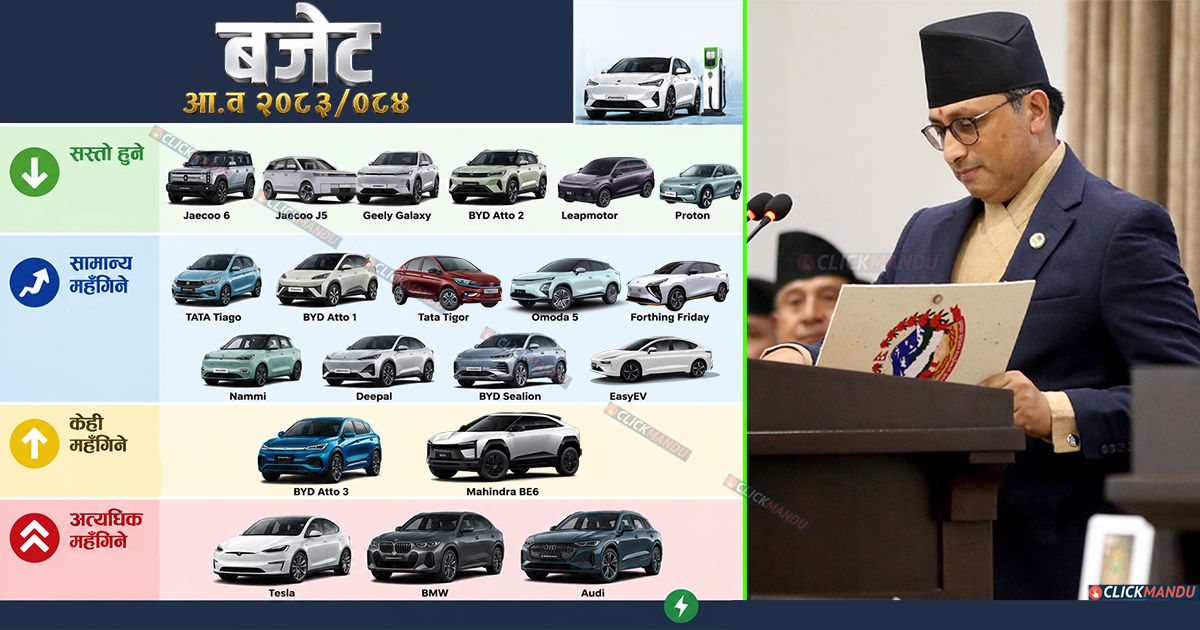

Kathmandu: Nepal government has fundamentally restructured the tax regime for electric vehicles, abandoning the longstanding system based on peak motor power in kilowatts in favour of a value-based model.
This policy shift, announced in the recent budget, aims to stabilize the market for average consumers while drastically increasing the cost of luxury imports. By moving away from motor capacity as the primary metric, the government is attempting to simplify the tax code and align vehicle costs more closely with their actual market value.
Under the previous system, electric vehicles were taxed through a complex mix of customs and excise duties linked to motor strength, which resulted in a total tax burden ranging from 41 percent to 210 percent. The new budget has simplified this by eliminating excise duty and replacing it with a “Clean Infrastructure Investment Fee.”
While the customs duty is now fixed at a flat 20 percent for all electric vehicles, the new infrastructure fee scales aggressively based on the vehicle’s invoice price. Other standard charges, such as the 13 percent Value Added Tax and the 5 percent Road Construction Fee, remain in effect.
The total tax burden under this new regime now spans a wide spectrum, ranging from 44 percent for vehicles with an invoice value under 2 million rupees to a staggering 217 percent for those priced above 5 million rupees. For the middle-tier market, vehicles priced between 2 and 4 million rupees will face tax rates ranging from 68 percent to 88 percent.
However, there has been some early confusion regarding the specific calculations for the 2 to 3 million rupee bracket, as discrepancies have been noted between the Ministry of Finance’s claims and the text of the official Finance Bill.
This policy change is a significant win for high-performance but moderately priced vehicles that were previously penalized for having powerful motors. Models like the Jaecoo 6 and Geely Galaxy, which feature high kilowatt ratings despite being mid-priced, are expected to see their tax burden drop by approximately 13.5 percent. This shift makes powerful electric driving more accessible to the middle class, with other brands such as BYD, Leapmotor, and Proton also expected to see favourable price adjustments or stability in this category.
For the entry-level, low-kilowatt electric vehicles that many average consumers rely on, the impact appears minimal. Popular budget models like the Tata Tiago EV and BYD Atto 1 will see a marginal tax increase of only about 2.5 percent. This slight adjustment is unlikely to cause a significant ripple in the retail market, ensuring that affordable options like the Tata Tigor, Omoda 5, and various smaller Chinese EV models remain within reach for the general public.
Conversely, the luxury segment faces a massive financial blow under the new rules. Because high-end brands like Tesla, BMW, and Audi carry high invoice values, they are now subject to the highest tax brackets regardless of their motor efficiency. A Tesla that previously faced an 81 percent tax burden will now see that figure jump to 163 percent, while some BMW models could see their tax rate nearly triple to 217 percent. This essentially reclassifies premium electric vehicles as high-end luxury goods, significantly increasing the cost of ownership for wealthy buyers.
Ultimately, the government’s new policy signals a strategic attempt to democratize performance-oriented electric mobility while tightening the screws on luxury consumption. By decoupling tax from motor power, the state is encouraging a market filled with capable, high-tech vehicles for the working and middle classes. While entry-level buyers will see little change, the era of relatively affordable luxury electric imports in Nepal has effectively come to an end.

Comment Here