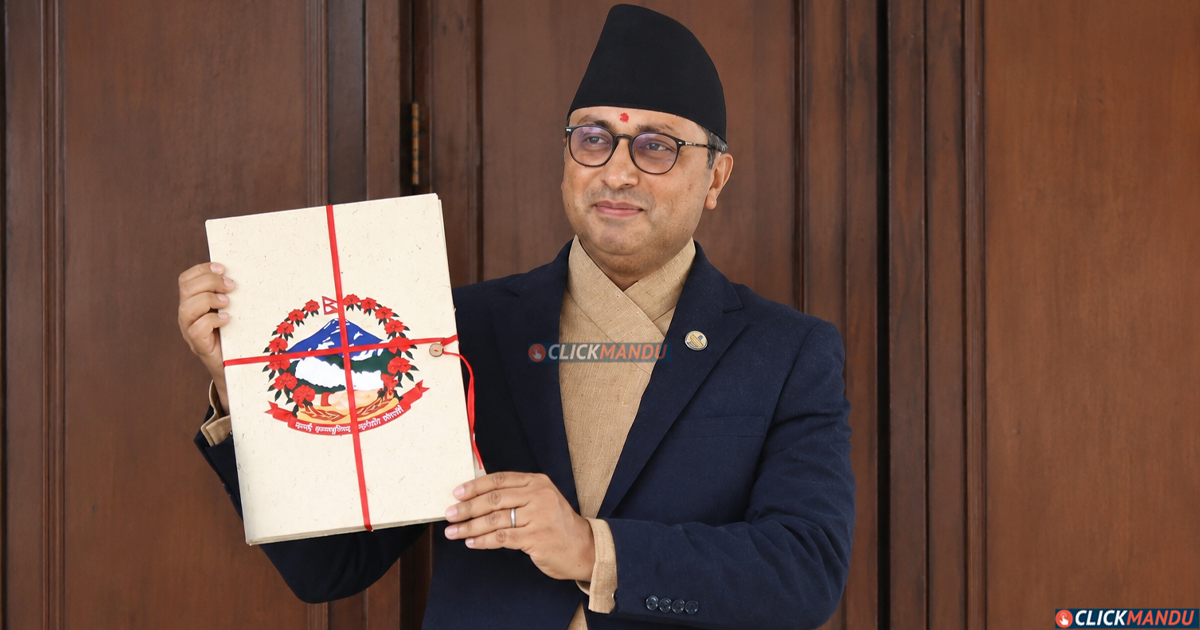

Kathmandu: Finance Minister Dr Swarnim Wagle unveiled a budget designed to breathe new life into the economy through a comprehensive overhaul of the tax system, aiming to provide relief to businesses and expand the middle class.
His opening announcements centred on nine major pillars intended to stimulate growth. Key highlights included raising the income tax exemption threshold to one million rupees, reducing the maximum personal income tax rate by ten percentage points, and lowering customs duties on 273 types of industrial raw materials to ensure they remain cheaper than finished goods.
To simplify the system, the Minister proposed reducing customs tiers from eleven down to seven, abolishing excise duties on 360 items, and consolidating various infrastructure and road maintenance fees into a single “Green Tax.”
The reform package also introduced measures to resolve long-standing tax disputes and modernize the tax administration. The Minister announced that involuntary transfers of ownership due to death or certain corporate restructurings would no longer trigger specific restrictive clauses of the Income Tax Act.
He promised that capital gains tax on listed securities would finally be treated as a final tax. To encourage a formal economy, he introduced a 10 percent VAT rebate for consumers using digital payments at the point of sale and proposed a lottery system to incentivize the issuance of tax invoices.
Furthermore, a high-level committee was slated to study the feasibility of multi-tiered VAT, while a special amnesty scheme was offered to settle pending court cases by paying the principal tax plus a nominal fee in exchange for waiving all penalties and interest.
While these initial pronouncements created a wave of optimism, particularly within the private sector, the subsequent release of the Finance Bill significantly dampened that enthusiasm. Critics argue that the fine print reveals a disconnect between the Minister’s rhetoric and reality. The introduction of VAT on electricity and new “Equity Fees” on education and health services have emerged as major points of contention.
Additionally, while the government claimed to abolish excise duties on many items, it simultaneously introduced a new “Internal Production Promotion and Protection Fee” on over 200 imported products, including footwear, tiles, and furniture. This move is seen by many as a rebranding of taxes rather than true simplification, effectively maintaining the tax burden while adding administrative complexity.
The transition toward a “simpler” tax regime has also faced scrutiny regarding its practical impact on the cost of living. Despite the narrative of a green transition, the government imposed a new “Clean Infrastructure Investment Fee” on electric vehicles. While this replaced the previous excise duty, experts suggest it creates new bureaucratic hurdles rather than genuine relief. Similarly, the decision to impose additional fees on education and health has been questioned at a time when access to quality services is already a challenge for many.
Tax experts argue that instead of creating specialized “Equity Fees,” the government should have integrated these costs into a streamlined VAT system to maintain legal consistency.
Perhaps the most significant blow to the average citizen is the imposition of VAT on electricity. While industrial sectors can claim this back as a tax credit, the burden falls squarely on the shoulders of the general public. Statistics show that roughly 91 percent of the Nepal Electricity Authority’s six million customers are individual households, accounting for nearly half of the utility’s total revenue.
By taxing electricity, the government has directly increased the monthly expenses of over 5.5 million families. When combined with the new fees on healthcare and schooling, the budget appears to place a heavy financial load on the very middle class it claimed to protect.
Discrepancies also emerged regarding the legal implementation of the Minister’s promises. Despite the announcement that capital gains tax would be “final,” the Finance Bill failed to amend the relevant sections of the Income Tax Act to reflect this change. Instead, the bill actually increased capital gains tax rates, raising the short-term rate from 5 to 7.5 percent and the long-term rate from 7.5 to 10 percent.
Furthermore, the new one-million-rupee income tax threshold has created confusion regarding its application to couples. By removing previous provisions that allowed for separate filings, it remains unclear whether a working couple is entitled to a combined two-million-rupee exemption or if they are now capped at a single million, potentially leading to a higher tax bracket for dual-income households.
Ultimately, while Dr Wagle’s budget was framed as a blueprint for economic transformation, it has left many questioning the balance between its ambitious goals and its practical execution. While the strategy to please the middle class and incentivize the private sector was clear in the speech, the Finance Bill tells a more complicated story of new fees and legal ambiguities. As the fiscal year progresses, the true impact of these policies will be measured by whether they actually improve the standard of living or simply increase the financial and administrative pressure on the Nepali people.

Comment Here