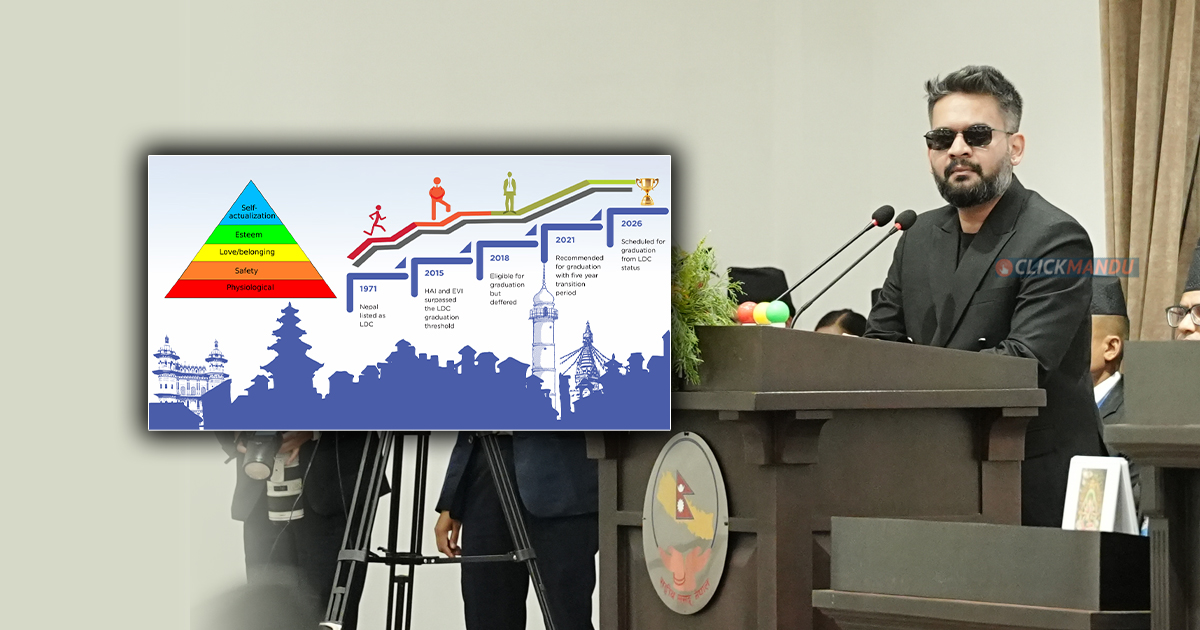

Katjmandu: Prime Minister Balen Shah has defended the government’s decision to postpone Nepal’s graduation from the Least Developed Country (LDC) category, arguing that the nation currently prioritizes economic survival and export viability over international prestige.
Speaking during a parliamentary Q&A session, the Prime Minister emphasized that his administration is thinking strategically rather than emotionally. He noted that immediate graduation would prematurely strip Nepal of vital trade concessions, particularly the duty-free access its products currently enjoy in foreign markets.
Shah remarked that while graduating might provide a boost in national confidence, the country’s current priority is to bolster its financial reserves. He drew a parallel with China, pointing out that even as a global economic powerhouse, China maintained its developing nation status for a long time to protect its interests, suggesting that Nepal should similarly focus on production and capital before accepting a more advanced classification.
On May 8, the government officially initiated the process to stall the graduation, which was originally scheduled for November 24, 2026. Through a formal request to the United Nations, Nepal is now seeking a three-year extension to push the graduation date to November 2029.
Foreign Minister Shishir Khanal addressed a letter to the Chair of the UN Committee for Development Policy (CDP), explaining that the current economic, social, and geopolitical climate makes the 2026 deadline untenable. This move follows an assessment by the National Planning Commission and sustained pressure from the private sector, where entrepreneurs warned that an immediate exit from the LDC list would lead to a collapse in exports and a significant economic downturn.
The government’s appeal to the UN is built on several critical economic vulnerabilities, chief among them being the sharp contraction in economic growth. With the World Bank projecting Nepal’s growth to shrink to 2.3 percent by 2026, the administration believes the country lacks the momentum to thrive as a developing nation. Beyond growth rates, there is a profound fear regarding the loss of “duty-free, quota-free” market access. Officials estimate that the end of these trade preferences could lead to a 35 percent drop in employment within the production sector, as Nepali goods would struggle to remain competitive against international rivals.
Furthermore, the government cited the slow execution of its “Smooth Transition Strategy,” admitting that internal preparations and legal reforms have not kept pace with the original timeline. The economy is also grappling with a sluggish post-pandemic recovery, which has been further complicated by recent geopolitical tensions and climate-driven natural disasters. These factors have placed immense pressure on an already fragile system, making the planned 2026 graduation look increasingly like a risk to the nation’s financial stability.
External shocks have also played a major role in this decision, particularly the uncertainty surrounding remittances, which remain the backbone of Nepal’s foreign exchange reserves. Escalating tensions in the Middle East and global inflation in essential commodities like fuel and fertilizer have hit the national treasury hard.
Nepal is not alone in its hesitation; neighbouring Bangladesh, also scheduled for graduation in 2026, has similarly requested a reassessment of its timeline. After fifty years on the LDC list, Nepal’s leadership has concluded that ensuring the economic security of its citizens requires a few more years of international protection before fully stepping into the global competitive arena.

Comment Here