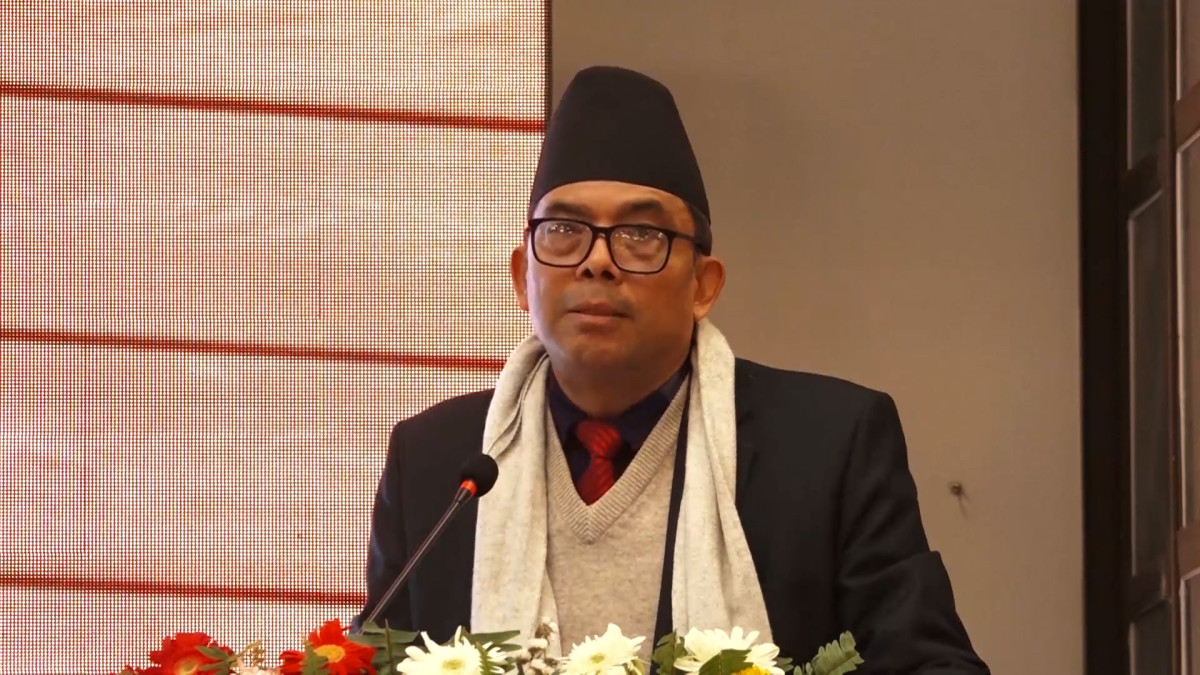

Kathmandu: Dr Prakash Kumar Shrestha, the former Vice-Chairman of the National Planning Commission, has emphasized that the budget for the fiscal year 2026/27 should be viewed as more than just a collection of figures.
Speaking at an event organized by the Nepal Economic Association, he argued that the budget is a composite of politics, policy, people, and national prosperity. During his presentation on “Budget and Prosperity,” he provided a comprehensive analysis of the current economic landscape and highlighted both the strengths and weaknesses of the upcoming fiscal plan.
Dr Shrestha expressed deep concern over the nation’s sluggish economic growth and the downward trend in capital formation. He noted that without encouraging levels of capital formation, achieving the desired economic expansion remains an uphill battle. While he acknowledged that inflation appears somewhat under control for now, he warned that underlying risks continue to threaten price stability.
Turning to the financial sector, he pointed out a paradox where banks are flush with liquidity, yet credit disbursement remains exceptionally low. He criticized the government’s decision to hold approximately 380 billion rupees in the national treasury instead of injecting it into the market, suggesting this move has exerted a contractionary pressure on the economy. Furthermore, he observed that while interest rates have hit historic lows, real interest rates have actually turned negative.
On the external front, the analysis was more positive, with Dr Shrestha citing strong remittance inflows, a surplus in the balance of payments and current account, and an increase in foreign exchange reserves. However, he cautioned that the continuous depreciation of the Nepalese Rupee against the US Dollar remains a significant challenge for the economy.
He raised sharp questions regarding the government’s ability to spend effectively, noting that the average growth rate for both revenue and expenditure has hovered around 12 per cent over the last few years. While the government aims to increase its spending from the usual 25 per cent of GDP to 28 per cent, Dr Shrestha remains sceptical about the feasibility of such an ambitious implementation plan, given the historical context.
The gap between capital expenditure targets and actual performance was highlighted as a major issue. Data presented showed that while the target for capital spending was 21 per cent over the past five years, actual spending reached only 16 per cent. Additionally, foreign loans and grants have consistently fallen short of expectations, leading to a situation where national debt is ballooning at a rate far exceeding economic and revenue growth.
Regarding the upcoming fiscal year, he suggested that an expansionary fiscal policy is necessary to revitalize the stagnant economy. The current budget envisions a 25 per cent increase in total size and sets a target to push capital expenditure up to 71.5 per cent of its allotted goal.
Discussing the budget’s funding sources, Dr Shrestha noted that only 66 per cent will be covered by revenue, leaving a massive reliance on foreign debt, which accounts for 12 per cent or 247 billion rupees. He also questioned the realism of nearly doubling the target for foreign grants, suggesting such projections might be overly optimistic.
He identified roads and bridges as the primary focus of the government, accounting for 38% of the total capital budget. He further revealed that roughly 33 billion rupees have been indirectly allocated to various constituency-level projects favoured by lawmakers, highlighting a continued focus on localized infrastructure.
On a more optimistic note, he praised several policy reforms, such as tax exemptions, an emphasis on technology, adjustments to customs rates, and the introduction of the “Investment Express” to simplify FDI and investment promotion. He also lauded the government’s initial steps toward downsizing the state apparatus and cutting unnecessary administrative costs.
In the agricultural sector, he noted that the 40 per cent subsidy for investments up to 20 million rupees targets the middle class but, unfortunately, bypasses the most impoverished farmers. Regarding social welfare, he described the increase in the child nutrition allowance from 532 to 1,000 rupees as a landmark step for human capital development, though he urged the government to expand the program beyond the current 25 districts to cover the entire country.
Ultimately, he argued that achieving growth targets would depend on the government’s capacity to effectively spend 431 billion rupees on capital projects and the private sector’s ability to increase credit flow. He projected that with a favourable monsoon and successful spending, growth could reach 6-7 per cent; otherwise, it would likely stagnate between 5-6 per cent.
Finally, Dr Shrestha voiced concerns that new taxes on education and health could undermine social welfare. On the other hand, he expressed hope that recent changes to income tax slabs might provide some relief to the public and help stimulate market demand.

Comment Here