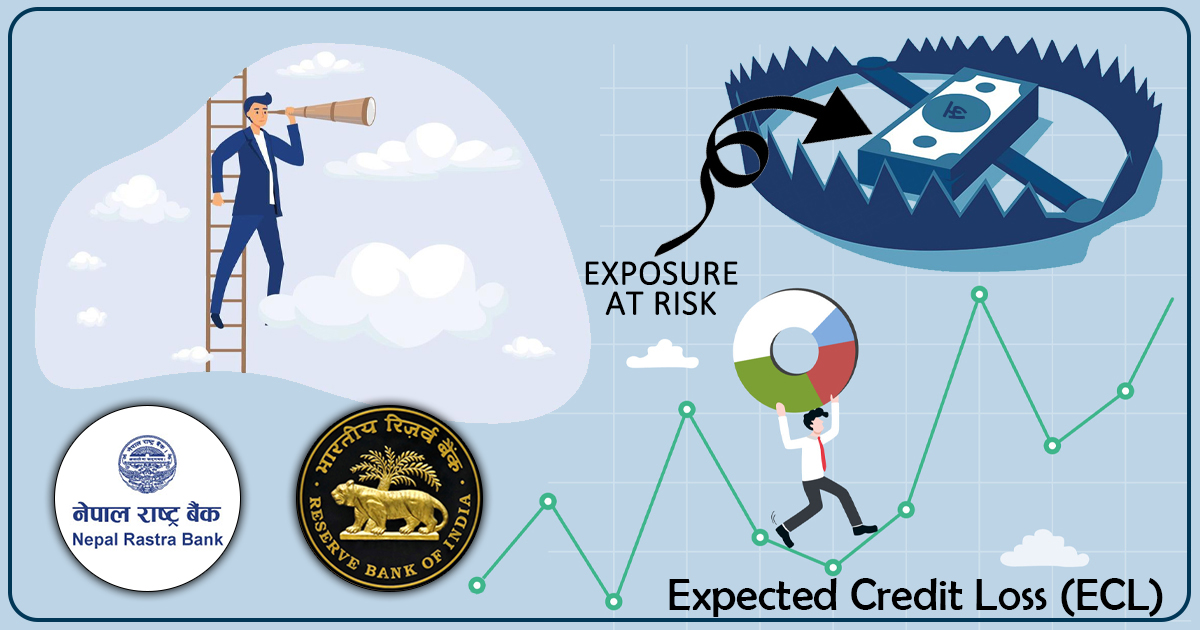

Kathmandu: Approximately two years after Nepal implemented similar measures, India has introduced the Expected Credit Loss (ECL) framework for loan loss provisioning.
The Reserve Bank of India (RBI) recently issued its 2026 Master Direction on Asset Classification, Provisioning, and Income Recognition (IRACP), marking a pivotal shift for the Indian commercial banking sector. This new mandate replaces the traditional “Incurred Loss” model, where provisions were only made after a default occurred, with a forward-looking approach that aligns with international IFRS-9 standards. Although the guidelines are now public, the transition will be gradual, with full implementation scheduled to begin on April 1, 2027.
Under the new regime, Indian banks must move away from the conventional “ageing-based” system and instead base their loan loss provisions on future risk projections. While Nepal adopted the ECL framework two years ago, its implementation has faced practical challenges. Currently, the Nepal Rastra Bank requires its banks to maintain provisions based on whichever is higher: the ECL calculation or the traditional time-based provision. This dual requirement has made it difficult for Nepalese banks to fully transition to a pure ECL-based system.
The RBI defines ECL as a weighted average estimate of potential credit losses throughout the entire duration of a loan. To calculate these figures, banks are required to analyze historical data, current economic conditions, and future macroeconomic variables. This ensures that banks are preparing for potential defaults long before they actually happen.
The framework categorizes financial instruments into three distinct stages based on their risk profile. Stage 1 includes loans with no significant increase in risk, requiring a 12-month ECL provision. Stage 2 covers loans where risk has increased significantly, but default hasn’t occurred, requiring lifetime ECL estimates; any loan more than 30 days past due automatically falls into this category. Stage 3 is reserved for defaulted loans, defined as those more than 90 days past due, which also require lifetime ECL provisioning.
To ensure stability, the RBI has incorporated “prudential floors” that act as a safety net. Regardless of what a bank’s internal model suggests, it cannot provision less than the minimum percentages set by the regulator. For instance, Stage 1 secured retail and corporate loans require a minimum provision of 0.40 percent, while Stage 2 loans require at least 5 percent. For Stage 3 assets, the floor ranges from 10 percent to 100 percent depending on how long the loan has been in default.
Additionally, banks must now recognize income using the Effective Interest Rate (EIR) model, which factors in transaction costs and fees rather than just the contractual interest rate. The RBI has set a deadline of March 31, 2030, for all existing loans to be transitioned to this EIR model.
Recognizing that these new requirements could put significant pressure on bank capital, the RBI has provided a five-year transition period, mirroring the strategy used in Nepal. Banks will be allowed to “add back” a portion of the increased provisioning costs to their Common Equity Tier-1 capital.
This relief starts at 80 percent in the first year and gradually decreases to 20 percent by the fifth year, giving institutions time to bolster their capital reserves. Furthermore, the RBI has emphasized the need for total automation, mandating that credit classification and risk assessment be handled by IT-based systems to minimize human intervention. The bank’s Board of Directors will ultimately be responsible for the integrity and monitoring of this framework.
While the core principles of the ECL model are similar in both India and Nepal, there are notable technical differences. For example, India has set the minimum Probability of Default (PD) floor at just 0.03 percent, which is much lower than Nepal’s 2.5 percent threshold.
In terms of Loss Given Default (LGD), if a bank cannot provide its own reliable model, the RBI mandates a backstop rate of 65 percent for secured loans and 70 percent for unsecured loans. In contrast, Nepal calculates LGD by taking 75 percent of the realizable value of collateral after deducting costs. By establishing these product-specific floors and regulatory backstops, the RBI aims to create a more transparent and resilient banking environment capable of weathering future economic shocks.

Comment Here