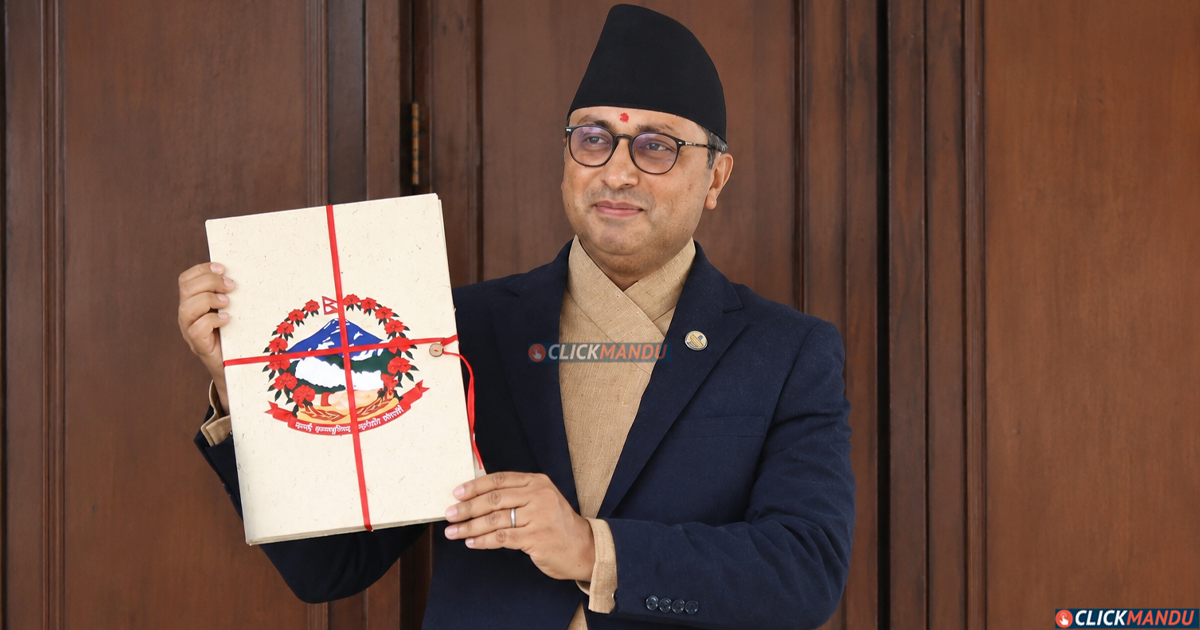

Kathmandu: When Dr Swarnim Wagle, a Harvard-educated economist, took the mantle of Finance Minister, the public harboured immense expectations that his expertise would finally synchronize tax policy with economic momentum for the benefit of all.
Under a government led by Prime Minister Balendra Shah, who rose to power on the promise of representing the marginalized, the “common man” anticipated a revival for farmers and the downtrodden. Disillusioned by traditional parties, the electorate had handed the National Independent Party (RSP) a near two-thirds mandate, dreaming of a solution to their deep-rooted grievances.
However, the first budget for the fiscal year 2026/27 has proven to be a bitter pill; while it sells the dream of “Production and Progress,” its actual policies have offloaded the burden of inflation onto the citizens, making life significantly more arduous for the poor and middle class.
The budget presents a jarring paradox: it tightens the noose on the kitchens, education, and healthcare of low-income families while showing remarkable leniency toward the luxury consumption of the ultra-wealthy. While the government chases the ambitious goal of a “Digital Economy,” it has simultaneously broken the backs of farmers and the working class by introducing new tax rates on necessities.
Specifically, the imposition of new taxes on education, health, and electricity, coupled with significant cuts in the agricultural budget, has jeopardized both the immediate sustenance and the prospects of average Nepali households.
In a move that raises eyebrows, the budget provides tax concessions for trade in precious metals like gold, silver, and diamonds. Although the government justifies this as a measure to curb smuggling, the reality is that it primarily benefits large-scale traders and the affluent.
It is a striking contradiction for a government to remain soft on luxury goods while aggressively taxing electricity and healthcare—the most fundamental needs of the people. Furthermore, through the Financial Ordinance, the government has introduced a provision to automatically waive luxury fees on gold jewellery and Value Added Tax (VAT) on diamonds and precious stones accumulated before September 2025 in cases where the sellers failed to collect it from customers, essentially granting a state-sponsored pardon to the jewellery elite.
To appease the bureaucracy, Minister Wagle increased government salaries and allowances by ten percent each, creating a massive mandatory liability for the state treasury. While he sought to please the middle class by raising the lower income tax threshold and delighted the upper-middle class by reducing the top-tier tax rates, he “gifted” the poor and farmers with rampant inflation by adding VAT and taxes to essential services.
Former Finance Minister Barsaman Pun criticized the budget for being completely detached from the struggles of the “ground-level” citizens, noting that it lacks any concrete plan for labourers, farmers, or unemployed youth. Pun argued that the government has shirked its responsibility for job creation by offloading everything onto the private sector—yet, in reality, it has failed to provide the necessary environment for the private sector to actually generate those jobs.
Analyst Arun Subedi describes the budget as being trapped in a “whirlwind of theoretical deviation,” offering little more than disappointment for both the rich and the poor, despite some minor relief for the middle class. Subedi remarked that the budget lacks a clear identity, failing to foster investment or capital formation.
Without capital formation, job creation remains stagnant, leaving the unemployed and the impoverished without opportunities. He argues that by adding taxes across various sectors, the government has merely dumped the weight of high living costs onto those least able to afford them. Despite the government’s claim that it will keep inflation at six percent, economists warn that the new taxes on education, health, electricity, and fuel will make this target impossible to achieve.
The economic reality for Nepal’s vulnerable remains grim. According to the National Living Standards Survey 2022/23, over 20 percent of the population still lives below the absolute poverty line. The bottom 20 percent of the population spends more than 60 percent of their income on food and basic services.
Any increase in the price of electricity or healthcare effectively pushes these families deeper into poverty. Statistics suggest that nearly 6 million people are currently trapped in poverty, with another 35 percent of the population categorized as “near-poor”—those just one economic shock away from falling back into absolute poverty.
For the average Nepali, 53.1 percent of total expenditure goes toward food. For the poorest households, this figure rises to 70 percent. When 20 percent of their remaining income is consumed by education, health, and fuel, these families are left with less than 10 percent of their earnings for savings or investment.
While the middle class spends a slightly lower percentage on food, they are being crushed by rising house rents and private school fees. Rural poverty stands at nearly 25 percent, meaning any disruption in internal supply or international price hikes hits the rural poor the hardest. Experts warn that when more than half of a household’s income goes toward food, it indicates severe economic insecurity.
The 2026/27 budget introduced a three percent “Equity Fee” on private and community-led health services and higher education. While the constitution labels health and education as fundamental rights, the dilapidated state of government hospitals and schools forces even low-income families to take loans to access private institutions.
Instead of improving the state system, the government is now taxing the parents who are forced to seek private alternatives. A poor family needing an emergency medical procedure costing 100,000 rupees will now have to pay an additional 3,000 rupees to the state as an “Equity Fee”—an amount that covers a month’s worth of basic groceries for a low-income household.
In a move that contradicts the national goal of displacing LP gas with domestic hydropower, the budget added a five percent tax on electricity. While the government aims to reduce the cost of hydropower plants, it has passed the bill on to the consumers. Now, any household consuming more than 50 units of electricity per month must pay VAT.
This directly penalizes urban middle-class families who have transitioned to electric cooking. Additionally, a 15 percent “Green Tax” has been slapped on electrical components like switches, plugs, and optical fibers, increasing the installation costs for clean energy. For a family in the sweltering Terai region, where multiple fans and water pumps are necessities, this five percent hike represents a significant blow to their monthly budget.
The agricultural sector has also been sidelined. Aside from chemical fertilizers, the regular budget for small-scale irrigation and seed programs has been slashed. Conversely, the government announced a 40 percent subsidy for large-scale corporate farms investing over 20 million rupees, reinforcing a policy that favours the wealthy over the 3.4 million small-scale farming families who own less than one hectare of land.
Finally, by integrating various road and infrastructure taxes into a consolidated 10-rupee per litre “Green Tax” on fuel, the government has ensured a ripple effect of price hikes across the economy. Since most goods in Nepal are transported via diesel-powered vehicles, this tax will inevitably inflate the cost of every vegetable, liter of oil, and packet of medicine, hitting those with fixed incomes the hardest. In essence, this “Socialism-oriented” government has delivered a budget that serves the boardroom far better than it serves the kitchen.

Comment Here