
Kathmandu: Nepal’s hydropower sector has undergone a staggering financial transformation over the last five years, but beneath the surface of soaring investment lies a deeply fractured insurance ecosystem that threatens the nation’s energy security.
At first glance, the statistics suggest a thriving market. In the fiscal year 2020/21, total premium collection from the hydropower industry stood at a modest 130.4 million NPR. By the close of the 2024/25 fiscal year, this figure had rocketed to 630.6 million NPR. Similarly, the total sum insured has more than doubled, jumping from Rs 142.04 billion to a massive Rs 322.46 billion.
While these numbers reflect the massive capital being poured into the country’s rivers, they also mask a grim reality: the safety net designed to protect these multi-billion-rupee assets is on the verge of a total breakdown.
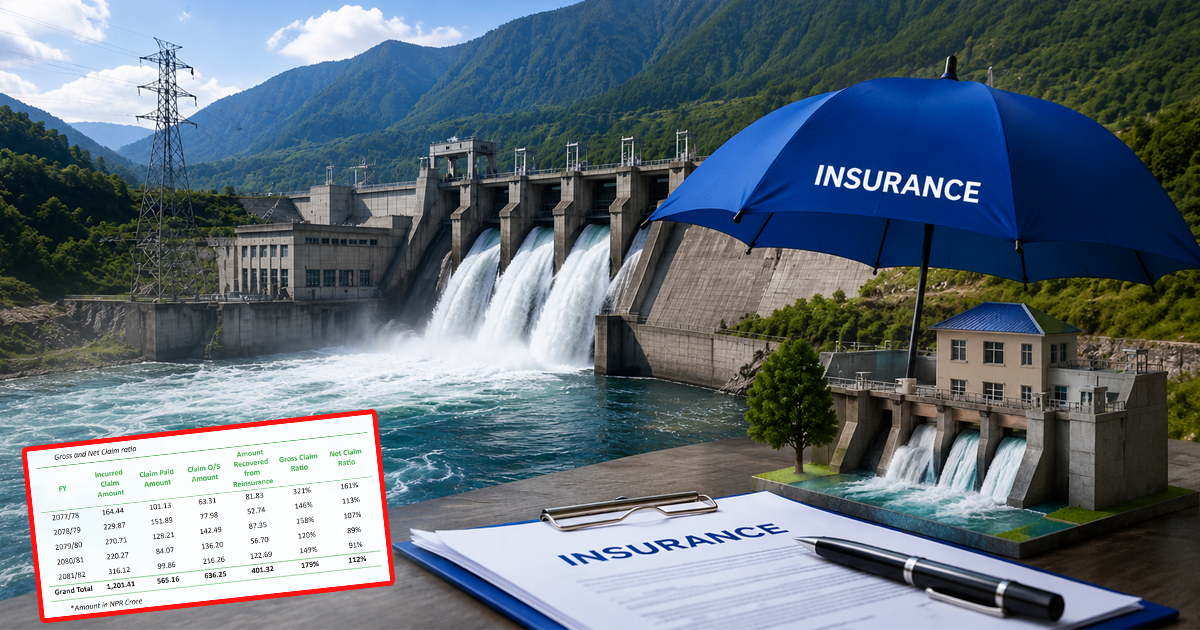
The disparity between the collection of premiums and the actual settlement of claims has reached a critical boiling point. According to recent data from the Nepal Insurance Authority, while the industry is eager to collect premiums, it is increasingly unable or unwilling to settle the resulting claims.
The number of outstanding claims has more than doubled in five years, moving from 57 to 124. More alarmingly, the total value of these unsettled claims has exploded from Rs 633.1 million Rs to over 2.16 billion. This represents a three-and-a-half-fold increase in frozen capital, leaving hydropower developers in a precarious position. The claim settlement ratio, which was a healthy 197.14 percent in 2020/21, has plummeted to a dismal 47.13 percent, suggesting that the industry is settling less than half of the liabilities it incurs annually.
The administrative bottleneck is primarily rooted in a convoluted and inefficient assessment process. On average, it takes 298 days to settle a standard hydropower claim, and in many instances, the process drags on for several years. A comprehensive study by the regulatory authority has identified surveyors as the primary obstacle in this pipeline.
The report reveals that between 62 percent and 75 percent of the total time spent on a claim is consumed during the interval between the appointment of a surveyor and the final submission of the damage assessment report. This chronic delay raises serious questions about the professional efficiency, technical capacity, and perhaps even the underlying motives of the survey teams. Without a timely report, insurance companies have a convenient excuse to withhold payments, leaving hydropower projects damaged and stagnant, which often leads to total operational shutdowns.
This is not merely a localized problem for a few companies but a structural rot pervading the entire market. Technical categories such as “Erection All Risk” and “Business Interruption” insurance are particularly prone to these delays due to their inherent complexity. Nepal lacks a sufficient pool of domestic experts capable of assessing large-scale engineering failures, leading to a heavy and expensive reliance on foreign surveyors.
This dependency further complicates the bureaucratic process. Furthermore, a troubling trend has emerged where domestic insurers refuse to release funds until they receive the corresponding amount from their international reinsurers. This “waiting game” creates a massive liquidity crunch for hydropower developers who still have to service bank loans while their projects remain offline. Consequently, the banks’ massive investments in the energy sector are also being pushed into the high-risk category.
The financial health of the insurance portfolios themselves is equally concerning. The claim ratios for “Contractor All Risk” have surged from 183 percent to a staggering 1700 percent, while loss of profit insurance claims have exceeded the 2000 percent mark.
These astronomical ratios suggest a fundamental flaw in the industry’s pricing model. It appears that in a desperate race to capture market share, insurance companies are accepting massive, high-stakes risks for dangerously low premiums. They seem to be ignoring Nepal’s unique and volatile geographical realities, such as the high frequency of floods, landslides, and seismic activity.
During the construction phases of these projects, technical flaws and environmental vulnerabilities are frequently under-evaluated, leading to massive financial haemorrhaging for the insurers when the inevitable happens. Even smaller portfolios, such as machinery breakdown insurance, are seeing claim ratios over 600 percent, indicating that risk is mismanaged at every level of the project lifecycle.
The regulatory authority’s assessment paints a picture of an industry flirting with a financial meltdown due to weak underwriting practices. By ignoring the real geographical risks, insurers are accepting liabilities that they cannot realistically sustain. The report indicates that for every 100 rupees earned in premiums, insurers are losing an average of 8 rupees after accounting for reinsurance.
The gross combined ratio for the hydropower business stands at approximately 146 percent, which is a clear indicator of an unsustainable business model. If this trajectory continues, the long-term stability of the hydropower insurance market in Nepal is in jeopardy, as international reinsurers may eventually deem the sector “uninsurable” and withdraw their support.
To rectify this, a shift toward a scientific, risk-based pricing model is no longer optional—it is a necessity. Currently, the industry uses a “one size fits all” approach where projects in high-risk zones like Sindhupalchok or Lamjung pay similar rates to those in much safer terrains.
The market must transition toward project-specific risk profiles that factor in historical damage data and specific environmental threats like Glacial Lake Outburst Floods (GLOFs). The Authority has proposed a phased increase in minimum tariff rates over three years and the potential de-regulation of rates for mega-projects to allow for more accurate pricing. Without these changes, insurers will continue to engage in a “price war” that ultimately undermines their own solvency.
Transparency and modernization must also be prioritized to break the current deadlock in settlements. The introduction of a standardized digital claim tracking system would allow developers to see exactly where their claims are stuck, creating accountability for both surveyors and insurers.
There is also a dire need for specialized insurance products that address the unique complexities of modern hydropower engineering, rather than relying on generic property policies. These new products should have clearly defined terms that prevent the kind of legal and administrative disputes that currently paralyze the settlement process.
Finally, the role of the regulator is paramount in ensuring the industry’s survival. The Nepal Insurance Authority must move beyond mere observation and begin enforcing strict timelines for claim settlements and mandatory capital reserves for high-risk portfolios.
Codifying the standards for surveyors and investing in the training of technical manpower will help reduce dependency on foreign experts and speed up assessments. The establishment of an “Integrated Hydropower Insurance Database” is also essential to provide a scientific foundation for future policy-making. If these structural and procedural reforms are not implemented immediately, the widening chasm between collection and settlement will eventually swallow the market, jeopardizing Nepal’s energy independence and its broader economic aspirations.

Comment Here