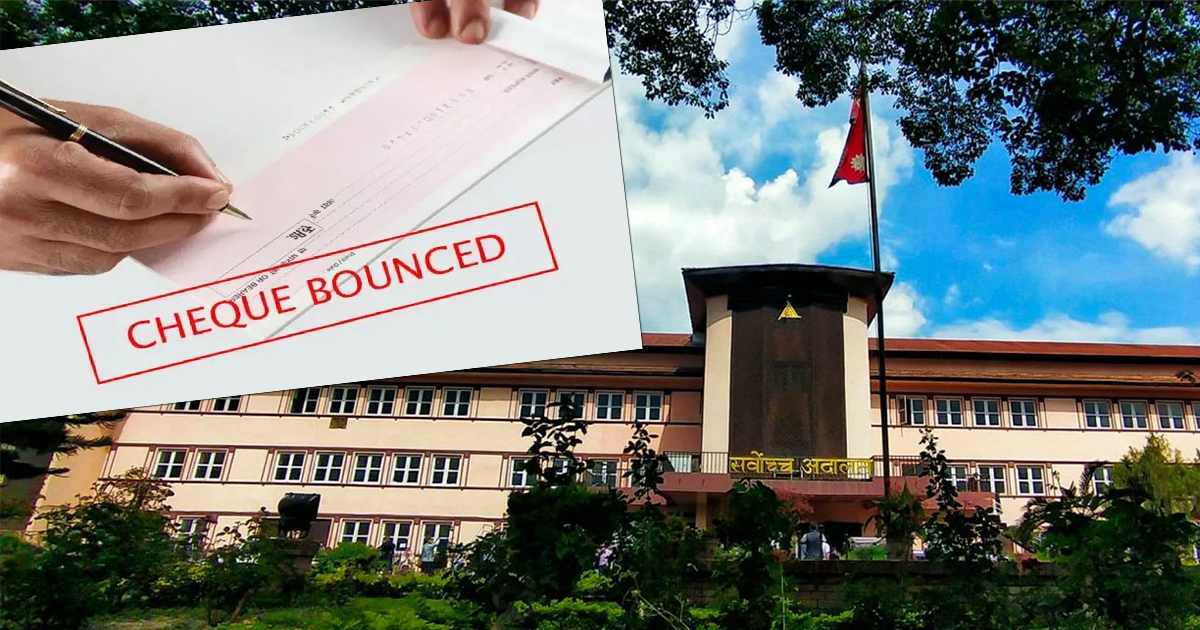

Kathmandu: In a significant legal precedent regarding financial disputes, the Supreme Court of Nepal has issued a landmark verdict ensuring that victims of cheque bounce cases receive both the principal amount and the accrued interest.
A joint bench of Justices Kumar Regmi and Bal Krishna Dhakal ruled that individuals who issue cheques without sufficient bank balance are liable to pay the victim the full amount mentioned in the cheque, along with an annual interest rate of 10 percent.
The Supreme Court anchored its decision on a major legal precedent established in the case of ‘Mahendra Prasad Mahato vs. Dukhani Devi Mahato,’ published in the Nepal Law Journal in 2011. The court interpreted that in disputes arising from written instruments between a creditor and a debtor, the clarity of the document itself must take precedence.
It emphasized that justice cannot be determined based on oral claims or informal domestic dealings when the written evidence—in this case, a signed cheque—clearly outlines the obligations of the parties involved.
The court further clarified that once a cheque is signed and issued, the issuer cannot evade legal responsibility by making unsubstantiated claims of coercion or alleging the funds were part of an informal ‘Dhukuti’ (rotating credit) scheme. According to the ruling, the law prioritizes the written instrument, and without objective evidence to prove otherwise, a signed cheque stands as a definitive acknowledgement of debt and a commitment to pay.
This specific ruling stems from a long-running financial dispute between Shakuntala Khadka of Kathmandu and Sangita Thapa, originally from Gorkha. The conflict began in 2016 when Khadka provided loans totalling 2.4 million rupees to Thapa. To settle a portion of this debt, Thapa issued two cheques in late 2016 totalling 900,000 rupees.
However, when Khadka attempted to cash the cheques at Citizens Bank and the then Infrastructure Development Bank, they were repeatedly returned due to insufficient funds.
Faced with a total loss of her money, Khadka filed a lawsuit under Section 107 (a) of the Negotiable Instruments Act, 1977, seeking the principal, interest, and the maximum legal penalty. In court, Thapa admitted to the transaction but claimed she was forced by “hired goons” to sign blank cheques and documents following a failed ‘Dhukuti’ instalment. She argued that the dates on the cheques were filled in by Khadka and that she was being unfairly prosecuted.
The case saw varying interpretations in lower courts. In 2018, the Kathmandu District Court initially ruled that Thapa must pay both the principal and interest. However, the Patan High Court later modified this decision, ordering only the repayment of the 900,000 rupees principal while denying the interest. The High Court had argued that interest could not be claimed on a cheque bounce case unless there was a separate, formal loan agreement specifically mentioning interest terms.
Khadka subsequently appealed to the Supreme Court, which conducted a thorough analysis of the Negotiable Instruments Act. The apex court noted that the law explicitly states that if a person knowingly issues a cheque without sufficient funds, they must compensate the holder for the amount mentioned plus interest. The court found no objective evidence to support Thapa’s claims of coercion or informal ‘Dhukuti’ dealings.
Ultimately, the Supreme Court overturned the High Court’s decision, declaring it legally flawed. The final verdict mandates that Thapa must pay Khadka the 900,000 rupees principal, along with a 10 percent annual interest calculated from the date the lawsuit was filed until the payment is completed. Additionally, Thapa has been ordered to pay a fine of 1,000 rupees as prescribed by the Act.

Comment Here