
Kathmandu: Most people operate under the assumption that keeping money in a bank is a surefire way to grow wealth safely. While it is true that the principal remains secure and nominal interest is credited, the actual purchasing power of those savings is currently in decline.
Despite the visible increase in the balance on a bank statement, the “real value” of that money is eroding because the interest rates offered by financial institutions have fallen significantly below the rate of inflation. When the real interest rate turns negative, the cost of living rises faster than the wealth accumulated through savings, effectively meaning that depositors are losing value every day.
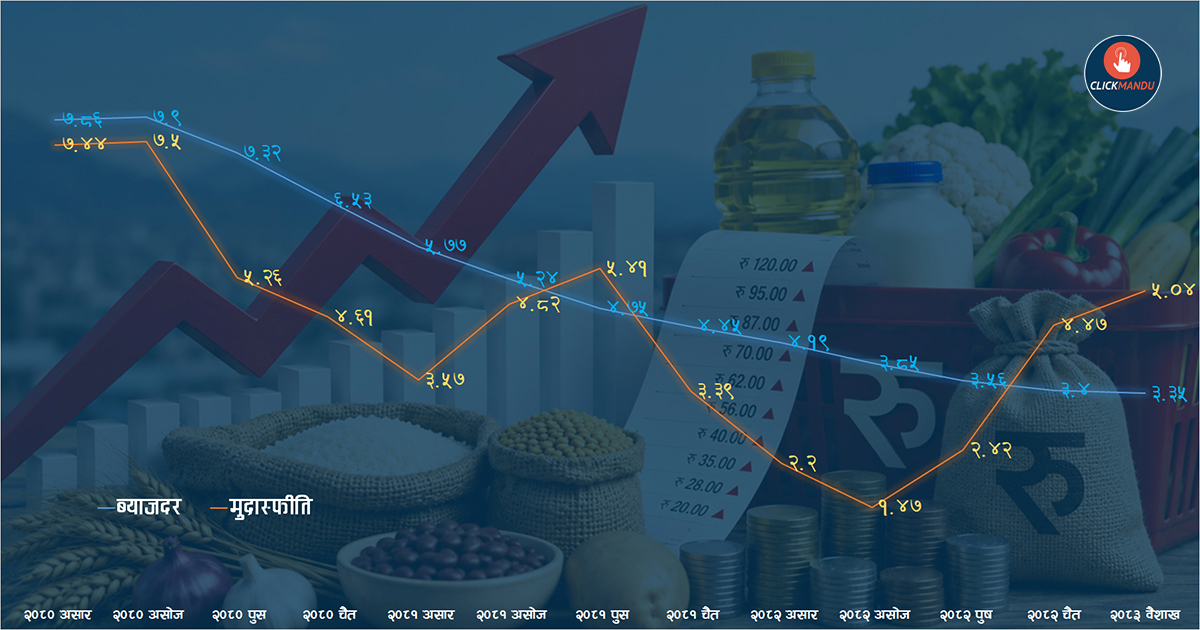
To understand how this loss occurs, one must look at the gap between deposit rates and consumer price inflation. In Baisakh 2081 (mid-May 2024), commercial banks offered an average deposit rate of approximately 3.35 percent, while the annual point-to-point inflation stood at a much higher 5.07 percent.
For instance, if a citizen deposits Rs 100,000 today, they would receive Rs 103,400 after one year at current average rates. However, based on the current inflation rate, a basket of goods that costs Rs 100,000 today would cost roughly Rs 105,700 in a year. Consequently, even after adding the interest earned, the depositor would still fall short of the amount needed to purchase the same goods, illustrating how negative real interest rates weaken the value of money.
This trend has persisted despite the Nepal Rastra Bank’s (NRB) repeated commitments to maintain positive real interest rates in its annual monetary policies. The central bank has traditionally stated that its policy rates are decided based on the gap between projected inflation and foreign exchange reserves, with a focus on ensuring that depositors are not penalized by rising prices.
In the current fiscal year, the NRB even adopted a more flexible monetary policy to stimulate general demand and reduce the government’s internal debt servicing costs. However, critics argue that the central bank has prioritized lowering the cost of borrowing for the government and the private sector over the interests of savers, leading to a practical failure in keeping interest rates above inflation.
The banking system is currently grappling with a massive surplus of liquidity, which has prompted banks to aggressively slash deposit rates. Simultaneously, external factors such as conflicts in the Middle East have driven up global costs, which eventually impact the Nepali kitchen.
Data shows that for several months, the weighted average interest rate on deposits has remained below the annual point-to-point inflation. Even fixed deposit rates, which are typically used as long-term investment tools by common citizens, have fallen. Most banks are now offering maximum individual fixed deposit rates below 5 per cent, while regular savings rates languish between 2.75 per cent and 3 per cent, far below the recorded consumer inflation of over 5 per cent.
Financial experts warn that a prolonged period of negative real interest rates poses a significant risk to the broader economy. For a developing nation like Nepal, which requires massive domestic savings to fund infrastructure projects, a decline in the incentive to save can be devastating.
When the “real” return on savings is negative, there is a heightened risk of capital flight. Since the Nepali Rupee is easily convertible with the Indian Rupee and domestic investment sectors like real estate and the stock market are currently sluggish, individuals with significant capital may seek to move their money to markets where returns are more competitive, further draining the national economy.
Ultimately, the current economic climate is creating a paradox where, despite record-high remittance inflows, capital remains inactive or is losing its value within the formal banking channel. For many citizens, especially those who rely on interest income for their daily livelihoods, the current rates are insufficient to meet the rising costs of necessities. If the central bank does not intervene to align interest rates with the actual cost of living, the erosion of domestic savings will not only affect individual households but could also undermine the long-term stability and investment capacity of the nation.

Comment Here