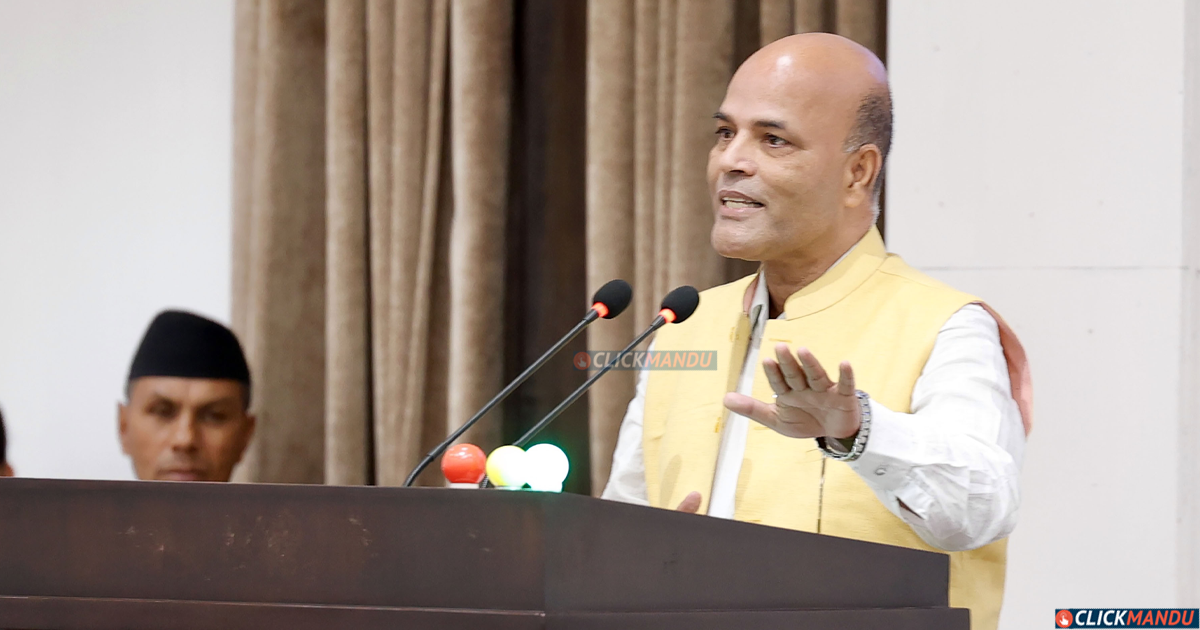

Kathmandu: Member of Parliament Dr Amaresh Kumar Singh has issued a scathing critique of the government’s proposed budget for the upcoming fiscal year, asserting that it is fundamentally unimplementable.
Speaking during a theoretical discussion on the budget in the House of Representatives on Thursday, the lawmaker, identified in the session as representing the ruling Rastriya Swatantra Party, likened the fiscal plan to a heavily inflated balloon.
He warned that such a bloated structure cannot sustain itself for long and predicted that the government would fail to meet its stated targets. Singh argued that the budget’s size, which accounts for roughly 32 to 33 percent of the Gross Domestic Product (GDP), is unprecedented in South Asia and completely detached from economic reality, offering little more than empty hope to ordinary citizens.
A primary point of contention for Dr Singh was the government’s decision to impose taxes on education and health services. He accused the state of violating the spirit of the Constitution, which guarantees these sectors as fundamental rights. According to Singh, levying taxes on private schools and hospitals ultimately transfers the financial burden onto students and patients who are already struggling.
He emphasized that the government should have focused on fortifying public schools and hospitals before imposing such measures. He further expressed disappointment that his expectation for the establishment of high-quality educational institutions, modelled after Budhanilkantha School, in all seven provinces remained unaddressed in the budget.
The lawmaker also highlighted a deepening crisis within the domestic business environment, noting that the private sector is currently paralyzed by a climate of fear. While some may point to the high levels of liquidity in banks as a positive sign, Singh countered that this surplus exists only because no one is willing to take loans or invest in a toxic atmosphere. He cautioned the government that while fear might be a tool for governance, it is never a catalyst for development, and without a secure environment for trade, the country’s economic engine will remain stalled.
Turning his attention to the plight of the agrarian community, Dr Singh criticized the government for failing to manage the massive price disparity between producers and consumers. He pointed out the irony where a farmer is forced to sell vegetables at the farm gate for a mere 5 rupees, yet consumers in the capital must pay 50 rupees for the same produce.
The budget, he claimed, offers no concrete mechanism to bridge this gap or ensure that farmers receive a fair price for their labour. Furthermore, he slammed the fiscal plan for its lack of specific programs for youth self-employment and the IT sector, warning that failing to address the challenges of unemployment and the rise of Artificial Intelligence would lead to a national crisis. He noted that marginalized groups, such as Dalits and the Musahar and Chepang communities, have been entirely overlooked.
In his concluding remarks, Dr Singh compared Nepal’s reliance on debt to a villager trapped in a cycle of high-interest loans. He criticized the trend of borrowing 450 billion rupees internally, only to see 300 billion of that amount immediately funnelled into paying off the interest and principal of old debts.
With capital expenditure hovering at a dismal 20 percent, he remarked that only divine intervention could save the nation’s economy. He dismissed the government’s grand promises of transforming Nepal into a state comparable to Singapore or Japan as mere rhetoric, arguing that the country continues to survive solely on remittances while its productive sectors are left to wither.

Comment Here