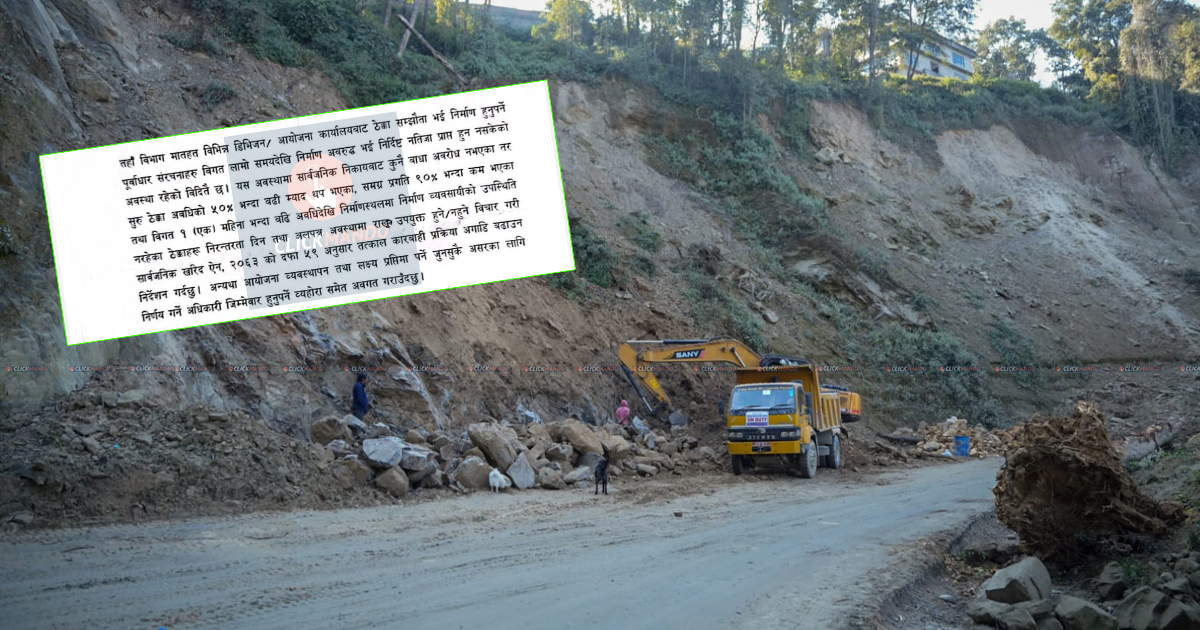

Kathmandu: The Ministry of Infrastructure Development has officially directed the Department of Roads to cancel contracts for development projects that have failed to gain momentum over a prolonged period. Ministry Secretary Gopal Prasad Sigdel issued a “special directive” urging authorities to take a hardline stance against contractors who have shown negligence or abandoned their worksites. The Secretary made it clear that projects failing to show progress despite the absence of government-side obstacles will no longer be granted any further leeway.
According to the Ministry’s new criteria, contracts will be terminated immediately if the project duration has been extended by more than 50 percent of the original timeframe, yet physical progress remains below 90 percent. Furthermore, construction firms that have been absent from their worksites for more than a month are to be prosecuted under Section 59 of the Public Procurement Act, 2063. The Ministry has also issued a stern warning to its own officials, stating that those responsible for failing to implement these termination orders will be held personally accountable for any future financial damages.
While the government moves toward strict enforcement, the Nepal Federation of Construction Entrepreneurs (FCAN) has decried the move as “inhumane” and an attempt to “terrorize entrepreneurs.” The federation argues that the state has abandoned its role as a facilitator and is instead attempting to criminalize the construction sector. Contractors contend that the “sick” status of many projects is actually the result of internal government failures, including frequent design changes, bureaucratic delays in contract extensions, and administrative complications regarding variation orders.
The construction industry further highlights that the sector is currently paralyzed by the skyrocketing costs of raw materials. Business leaders claim that while they expected the national budget to address price adjustments, the lack of implementation has made continuing work financially impossible. Recent geopolitical tensions in West Asia have exacerbated the situation, leading to an unnatural surge in the price of bitumen and a severe shortage in its availability, effectively bringing road paving works across the country to a standstill.
The standoff has been further intensified by aggressive rhetoric from political leadership. During a recent inspection of the Mugling-Nagdhunga road expansion project, Infrastructure Minister Sunil Lamsal expressed extreme frustration over the delay in relocating utility poles. The Minister reportedly issued a controversial order to officials to find the negligent contractors and “break their legs,” a statement that has highlighted the deepening animosity between the government and the private contractors responsible for the nation’s infrastructure.

Comment Here