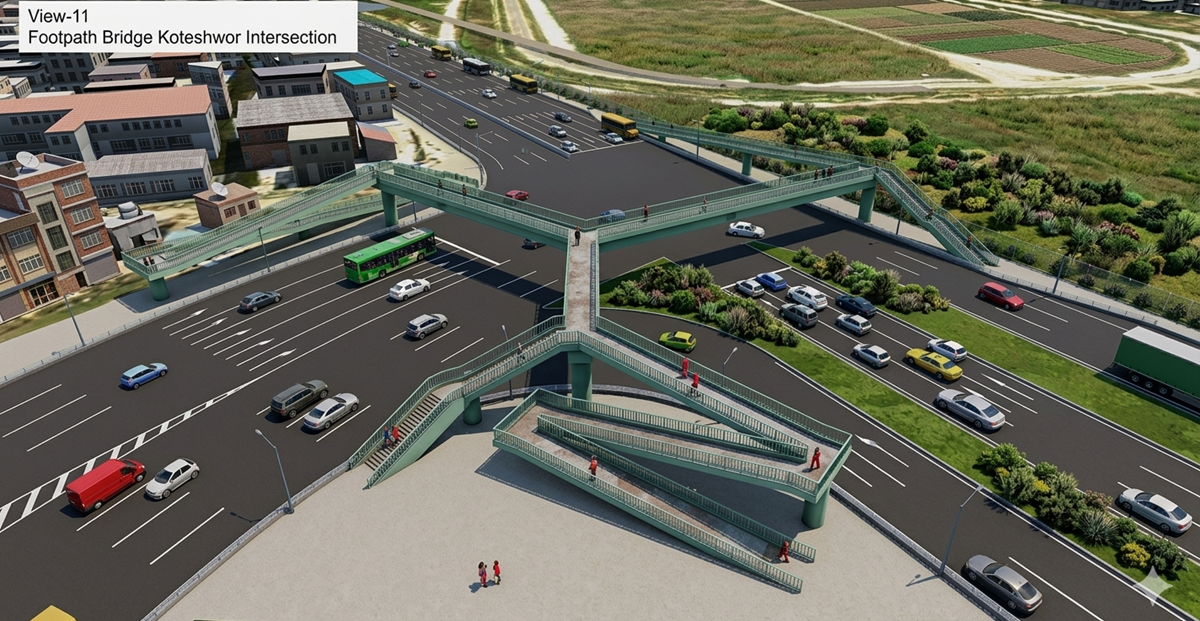

Kathmandu: The highly anticipated “Koteshwor Flyover and Underpass” project, envisioned as the definitive solution to the chronic traffic congestion at Koteshwor intersection, has come to a grinding halt. Despite being a top priority for urban mobility, the project has been delayed indefinitely due to a combination of administrative red tape, compensation disputes, and a significant lack of coordination between government agencies. While the global tender for the project was expected to be announced this month, the process is now paralyzed, leaving the future of this ambitious infrastructure development in limbo.
Technical and financial backing for the project comes from the Japan International Cooperation Agency (JICA), which has pledged a loan of approximately Rs 32 billion. The Department of Roads was in the final stages of selecting international consultants for the Detailed Project Report (DPR), design, and tender assistance. However, the process hit a wall when the Civil Aviation Authority of Nepal (CAAN) raised concerns over land occupancy at Tribhuvan International Airport (TIA) and demanded heavy compensation. This “game-changer” project now faces an uncertain timeline as two government bodies under the same administration fail to reach a common ground.
The most complex component of the project is a 600-meter-long underpass designed to run beneath the airport. CAAN has been reluctant to hand over the required land, arguing that it needs the space for its own parallel taxiway construction and future airport expansions. In a move that highlights the dysfunction within the bureaucracy, CAAN is demanding between 2 and 3 billion rupees in compensation from the Department of Roads. This internal “bargaining” for state-owned land has not only inflated potential costs but has also created a scenario where the government is essentially moving money from one pocket to another while stalling public progress.
Adding to the complexity is a lack of institutional continuity following a leadership change at CAAN. The previous technical team, which had been involved in extensive discussions with JICA and the Department of Roads, has been transferred. The new leadership and technical staff claim to be entirely unaware of the project’s technical details, safety protocols, and prior agreements. According to Gyanendra Kalauni, a Senior Divisional Engineer at the Department of Roads, they are effectively back at square one, having to re-brief the new CAAN officials on every technical aspect from scratch.
CAAN officials, including spokesperson Gyanendra Bhul, maintain that while discussions have occurred, formal paperwork has not yet progressed. CAAN insists that any decision regarding the underground tunnel can only be made after a comprehensive study that ensures airport security and future expansion plans are not compromised. This lack of high-level ministerial coordination means that the DPR and tender process cannot move forward until the Ministry of Physical Infrastructure and the Ministry of Culture, Tourism, and Civil Aviation intervene to resolve the stalemate.
The financial stakes are high, as the loan agreement with Japan was formalized last year with extremely favourable terms, including a 10-year grace period and a mere 0.2 per cent annual interest rate. Beyond the airport land, the project is also hampered by the long-standing land dispute at Tinkune. JICA’s study suggests that if the Tinkune land can be acquired, the project could use the “TK-3” model, which would reduce construction costs by 17 per cent and shorten the construction period from 64 months to 46 months. Without a breakthrough in land acquisition at Tinkune and the airport, the flyover remains a distant dream.
Technical challenges further complicate the project, particularly the “Obstacle Limitation Surface” (OLS) standards required for structures near international airports. The height, design, and lighting of the flyover must strictly adhere to International Civil Aviation Organization (ICAO) guidelines to ensure aircraft safety during takeoff and landing. Furthermore, construction near the runway may be restricted to just four hours a day to avoid disrupting flight schedules, a constraint that would significantly increase both the duration and the cost of the project unless a compromise for a six-hour window can be reached.
For the residents of Kathmandu, the Koteshwor-Jadibuti section is a vital lifeline, serving as the primary gateway for vehicles coming from eastern Nepal. The daily traffic jams at this junction result in massive losses in fuel, time, and economic productivity. While the preliminary environmental reports are complete and the funding is secured, the Koteshwor Flyover remains suspended in a web of administrative inertia. Until there is a decisive “breakthrough” in inter-agency cooperation, one of the capital’s most critical infrastructure projects will continue to exist only on paper.

Comment Here