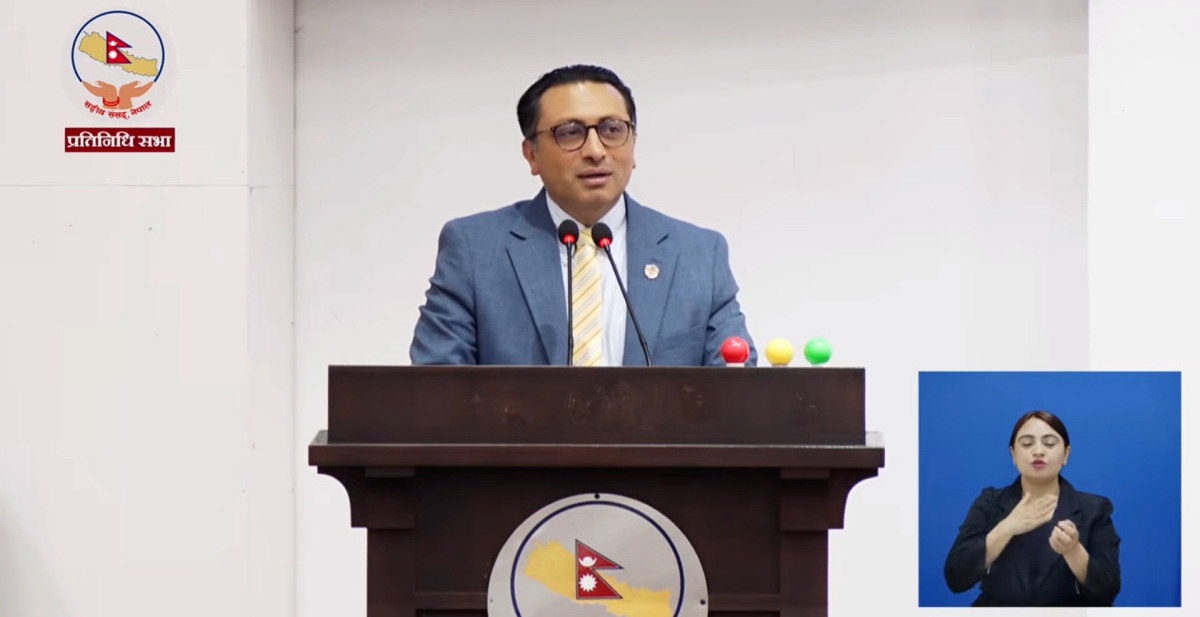

Kathmandu: Finance Minister Dr Swornim Wagle has floated a significant proposal to establish an “Authority against Economic Crimes,” a specialized and powerful body modelled after the Commission for the Investigation of Abuse of Authority (CIAA).
Speaking during a session of the House of Representatives on Thursday, the Minister emphasized the need for a dedicated institution capable of investigating and prosecuting a broad spectrum of financial offences, rather than focusing solely on money laundering. He urged lawmakers and stakeholders to initiate a serious discussion about creating this specialised entity to streamline the nation’s fight against economic malpractice.
Highlighting the inefficiencies in the current framework, Minister Wagle pointed out that the responsibility for investigating economic crimes and money laundering is currently scattered across thirteen different agencies. This fragmented setup, governed by more than fifty different acts, often leads to a cumbersome and disjointed process.
The Minister argued that consolidating these overlapping roles into a single, integrated authority would significantly enhance the effectiveness of investigations and ensure a more cohesive response to complex financial crimes that currently escape rigorous oversight due to jurisdictional confusion.
The Minister also clarified the administrative positioning of the Department of Money Laundering Investigation, noting that it currently operates under the jurisdiction of the Ministry of Finance. He addressed common misconceptions that the department still falls under the Prime Minister’s Office or that its duties could simply be absorbed by the existing anti-corruption watchdog, the CIAA.
Reflecting on past challenges, he noted that the department faced significant hurdles in complaint collection and processing while under the Prime Minister’s Office, issues that the current administration is actively working to rectify through structural reforms.
Under the existing legal architecture, the Department of Money Laundering Investigation conducts a preliminary inquiry upon receiving a complaint before forwarding it to one of the many specialized agencies responsible for the primary offence.
Dr Wagle described this procedure as overly complicated and dispersed, as these agencies often operate under disparate legal mandates. By proposing the “Economic Crimes Authority,” the Minister aims to eliminate the current ambiguity in performance and jurisdiction, providing a centralized and powerful platform to tackle the evolving landscape of economic crimes in Nepal with greater precision and authority.

Comment Here