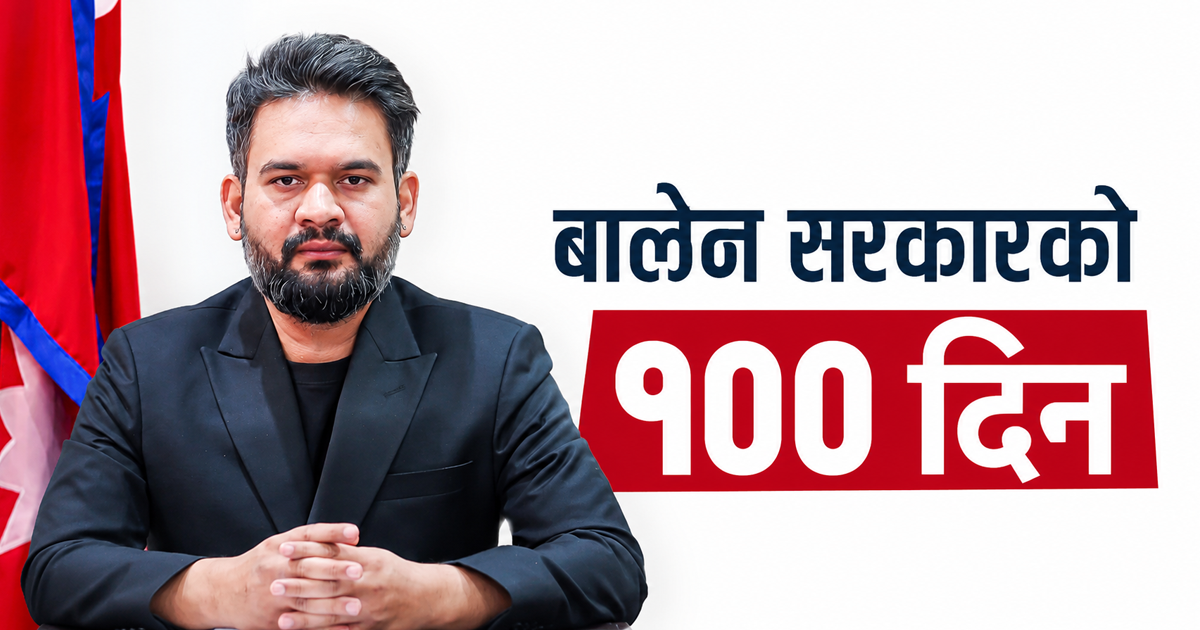

Kathmandu: The completion of the first hundred days of the government led by Balendra Shah, which assumed office on March 26, marks a significant milestone in Nepal’s volatile political and economic landscape.
This period, often referred to as the “honeymoon phase,” has been characterized by a mixture of cautious optimism, strategic silence, and a growing list of demands from the nation’s private sector. As the administration navigates the complexities of governance, the primary representatives of Nepal’s industry and commerce have begun to offer their initial assessments.
Their collective voice suggests that while the government has successfully initiated a much-needed departure from traditional, stagnant policy-making, the road to a full-scale economic recovery remains fraught with systemic hurdles and a lingering atmosphere of psychological unease among the business community.
In the eyes of the private sector, the first hundred days represent a potential turning point, a foundational period for policy reform that many hope will lead to a more predictable and business-friendly environment. Representatives from the nation’s leading business organizations have generally refrained from harsh public criticism, partly because of the inherent necessity to maintain a collaborative relationship with the state, and partly because the early signs of reform have been genuinely encouraging. These leaders view the initial steps not as a completed victory, but as a hopeful signal that the government is willing to listen to the grievances of those who drive the country’s productivity and employment.
One of the most significant highlights of this period has been the government’s fiscal intervention through the national budget. The administration’s decision to reduce certain tax rates and, more importantly, to double the personal income tax exemption limit from 500,000 to 1,000,000 rupees has been hailed as a masterstroke for boosting domestic demand and providing relief to the middle class. Furthermore, the proactive approach toward amending the Public Procurement Act has sent a strong message to the construction and infrastructure sectors. These legislative and fiscal shifts are seen as the “entry points” to a deeper structural transformation that the private sector has advocated for decades.
However, beneath this veneer of optimism lies a series of profound concerns that threaten to undermine the government’s reformist agenda. Businessmen point to a pervasive climate of fear and uncertainty that has emerged under the banner of “Good Governance.” While the private sector theoretically supports the crackdown on corruption and financial irregularities, there is a growing sentiment that the current approach is overly punitive and lacks due process.
The fear of being targeted by retroactive investigations or being entangled in complex money laundering probes has created a chilling effect on new investments. Industry leaders argue that unless the government shifts its perspective from viewing every businessman with suspicion to seeing them as legitimate partners in nation-building, the current reforms will fail to yield their intended results.
Surakrushna Vaidya, the Senior Vice President of the Federation of Nepalese Chambers of Commerce and Industry (FNCCI), offers a balanced perspective on the administration’s early performance. He notes that the FNCCI has been closely monitoring the government’s trajectory, focusing on three core pillars: good governance, economic prosperity, and the acceleration of capital expenditure. From the FNCCI’s standpoint, the government’s attempt to centralize these goals in its primary agenda is a positive development. The reduction in excise duties and the effort to lower customs tariffs in certain sectors are seen as vital steps toward making Nepali products more competitive and reducing the cost of doing business.
Vaidya emphasizes that the increase in the income tax threshold is a clear indicator of the government’s intent to create a more equitable economic environment. However, he warns against expecting “miracles” within a mere hundred days. The true value of this period, according to Vaidya, lies in the direction it has set for the future. He acknowledges that the focus on good governance is necessary, but he expresses concern over the atmosphere of “terror” that has inadvertently been created. He argues that while controversial files from the past should certainly be investigated, the entire business community should not be held hostage to a narrative of criminality.
The FNCCI’s senior leadership believes that good governance must be applied universally—not just to the private sector, but also to the bureaucracy and the political class. Vaidya points out that entrepreneurs who take significant financial risks by taking out loans and investing in the country’s future should be encouraged rather than intimidated. He suggests that the government should focus on closing legal loopholes and providing clear, stable policy guidelines. Only when the rules of the game are transparent and fair can the state effectively hold wrongdoers accountable without stifling the “animal spirits” of the broader economy.
One of the most pressing technical challenges identified by the FNCCI is the significant disparity in customs rates between Nepal and India. This gap has fueled a shadow economy characterized by illegal cross-border smuggling and under-billing, which puts legitimate, tax-paying businesses at a severe disadvantage. Vaidya urges the government to harmonize customs rates with those of India to ensure that goods enter the country through legal channels. Such a move would not only protect honest businessmen but also significantly boost the state’s revenue by bringing informal trade into the formal net.
Addressing rumours that the government has become inaccessible to the private sector, Vaidya clarifies that the FNCCI remains in constant dialogue with key decision-makers, including the Finance Minister, the Governor of the Central Bank, and the Industry Minister. Whether it is addressing the specific grievances of the tea industry or broader sectoral difficulties, he maintains that the government has been willing to provide time and space for consultation. This ongoing collaboration, he believes, is the only way to ensure that policy clarity translates into actual economic momentum.
From the perspective of the infrastructure and construction industry, the sentiment is similarly dualistic. Shivahari Ghimire, General Secretary of the Federation of Contractors’ Associations of Nepal (FCAN), views the first hundred days as a period of significant policy breakthrough. He praises the government for tackling “policy knots” that had remained tangled for nearly twenty years. The swift amendment and parliamentary approval of the Public Procurement Act is highlighted as a landmark achievement. Of particular importance to contractors is the government’s willingness to experiment with “average bidding,” a move intended to curb the rampant and unhealthy competition of “low bidding” that has historically led to poor-quality infrastructure and abandoned projects.
As the Balendra Shah government moves beyond its first hundred days, the message from the private sector is clear: policy reform is a good start, but implementation and empathy are what will ultimately determine success
Ghimire also points to improvements in the budget allocation process. By ensuring that projects are only pushed forward after adequate funding is secured and by giving individual ministries the responsibility for budget distribution, the government has brought a degree of discipline to the payment process. The new policy of not awarding contracts until the site is fully cleared, combined with making project chiefs directly accountable for delays, is expected to significantly reduce the bureaucratic inertia that has plagued Nepal’s construction sector for generations. The introduction of the “Sunset Law” concept to resolve hurdles related to forest clearances and land compensation for large-scale projects is another reform that FCAN has welcomed with open arms.
Despite these legislative successes, the reality on the ground for many contractors remains dire. Ghimire points out that the infrastructure sector, which accounts for nearly ninety percent of the country’s capital expenditure and provides direct employment to over two million people, is currently facing an existential crisis. Approximately 1,500 projects across the nation are classified as “sick” or “ailing” due to technical delays and government-side negligence. Ghimire warns that if the government does not immediately decide to extend the deadlines for these projects based on realistic work schedules, over 1,500 construction firms face the imminent threat of being blacklisted. Such a mass blacklisting would not only destroy these businesses but would also deal a catastrophic blow to the national economy and the banking sector that supports them.
The issue of outstanding payments for completed work also remains a sore point. Furthermore, the government has yet to address the need for price adjustments in response to the sharp rise in the cost of construction materials in the global market. Ghimire notes that many contractors are on the verge of bankruptcy, facing immense financial and mental stress.
He argues that the government’s attitude toward the private sector must evolve. The current tendency of the authorities to “arrest first and listen later” has demoralized the industry. He calls for an end to the rhetoric that portrays contractors and businessmen as thieves or cheats, reminding the leadership that they are, in fact, the state’s true partners in development.
As the Balendra Shah government moves beyond its first hundred days, the message from the private sector is clear: policy reform is a good start, but implementation and empathy are what will ultimately determine success. The infrastructure sector is the engine of the economy; if it stalls, the impact will be felt by banks, financial institutions, and related industries. The government must move from a posture of control to a posture of facilitation.
By addressing the “sick” projects, ensuring timely payments, and fostering a culture of mutual respect and dialogue, the administration can turn its initial hundred days of hope into a lasting legacy of economic transformation. The private sector is ready to do its part, but it requires a government that views its success as a national victory rather than a cause for suspicion.

Comment Here