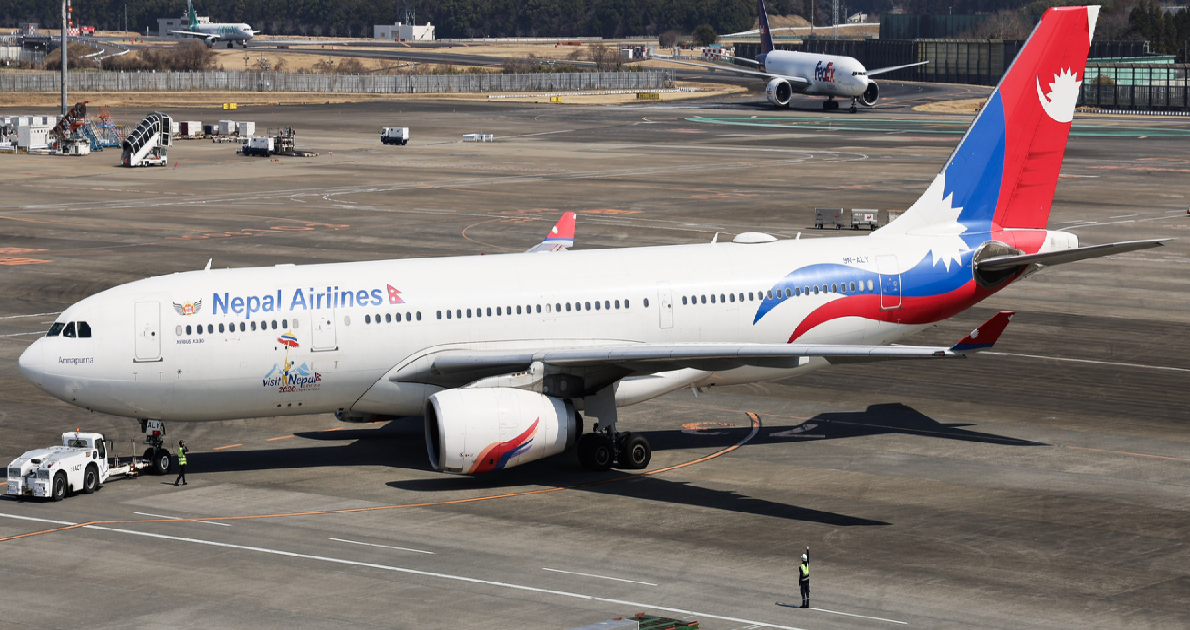

Kathmandu: Nepal Airlines Corporation (NAC) is set to send its wide-body Airbus A330-200 aircraft back to the same Italian maintenance provider that caused significant operational disruptions in the past, effectively disregarding the findings of a government-appointed investigative committee.
The national flag carrier’s aircraft, registered as 9N-ALY (Annapurna), is scheduled to depart for Italy on July 7 for an intensive C-check at Atitech SpA. According to the airline’s plan, the maintenance is expected to be completed within 20 days, after which the second wide-body aircraft, 9N-ALZ (Makalu), will follow on July 27 for its own scheduled repairs.
This decision has raised serious concerns within the aviation sector, as NAC’s history with the Italian firm is marked by extensive delays. Two years ago, when these same aircraft were sent to Atitech for a process intended to take 30 days, one vessel remained grounded for 80 days while the other was delayed for 83 days. In total, the fleet was rendered inactive for 163 days, leading to massive revenue losses. In response to these lapses, the Ministry of Culture, Tourism, and Civil Aviation had formed a committee led by Triratna Manandhar, a former Director General of the Civil Aviation Authority of Nepal (CAAN), which subsequently labelled the previous procurement process as flawed and non-transparent.
The Manandhar committee had specifically pointed out that the contract with Atitech bypassed essential transparency and competitive bidding requirements mandated by the Public Procurement Act and NAC’s own financial bylaws. Despite the committee’s recommendation to adopt a more rigorous and lawful selection process, NAC has opted to return to the same firm without publicly clarifying whether any corrective measures have been implemented. The airline has even faced criticism for failing to cooperate with the initial investigation and for not seeking compensation from the Italian company for the previous delays that crippled its international flight schedules.
NAC’s technical spokesperson, Devendra Pun, defended the move by stating that the maintenance is being conducted by an institution approved by the regulatory body. He claimed that the airline has secured a commitment from the firm to avoid past delays. Interestingly, Pun also noted that while the airline is aware of media reports concerning the government’s investigative findings, NAC has never officially received the formal report from the ministry. Consequently, the airline maintains that it is unaware of any specific directives or legal obstacles that would prevent it from continuing its partnership with the Italian facility.
The situation is further complicated by a lack of coordination between the ministry and the regulator. CAAN’s information officer, Gyanendra Bhul, stated that the authority has no formal knowledge of the ministry’s investigative report, even though such findings are crucial for regulatory oversight. Meanwhile, Ministry spokesperson Jayanarayan Acharya categorized NAC as an autonomous body, suggesting that the airline is responsible for its own operational decisions, including where and when to repair its fleet. He added that while the ministry conducted the study, the responsibility for acting upon the report lies with the relevant departments.
As the wide-body fleet prepares to head back to Italy, NAC has already begun scaling back its flight frequencies to accommodate the reduced capacity. While the airline hopes to resume full-scale operations upon the aircraft’s return, the decision to rely on a provider with a history of missed deadlines remains a significant gamble. With the previous board failing to secure damages for past losses or fix internal procurement loopholes, the upcoming maintenance cycle will serve as a critical test of whether the flag carrier has truly learned from its past mistakes or is simply repeating a costly cycle of mismanagement.

Comment Here