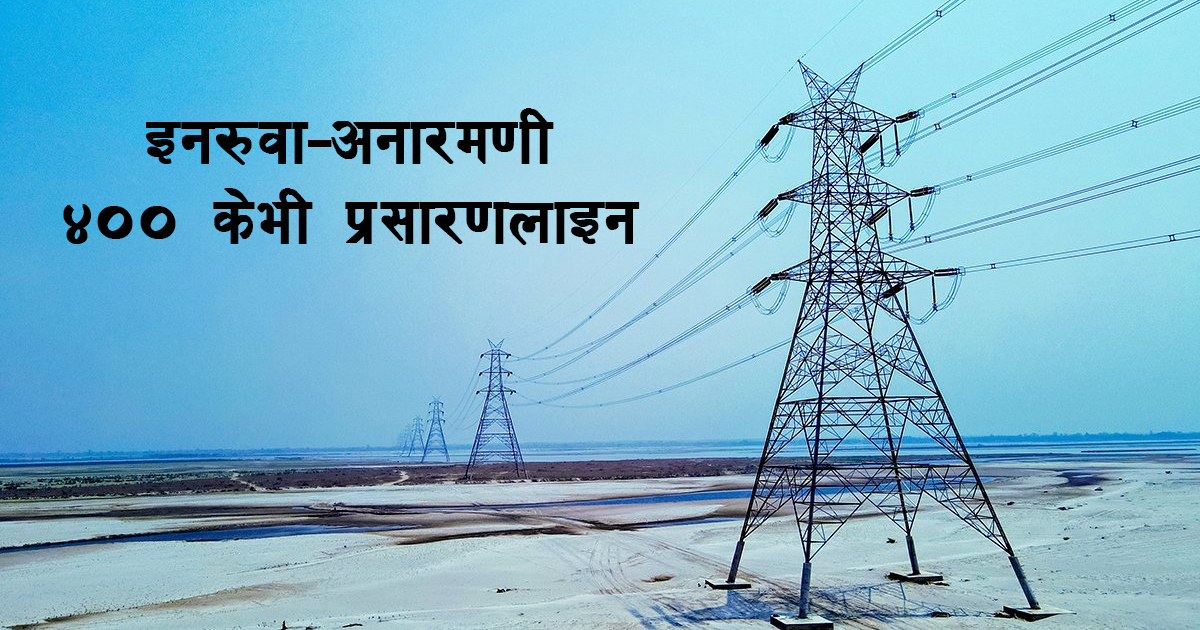

Kathmandu: The Inaruwa-Anarmani transmission line project is currently facing significant delays due to difficulties securing the necessary investment. Despite being a crucial 400 kV project spearheaded by the Nepal Electricity Authority (NEA), the lack of financial closure has left its future in doubt.
Sources indicate that the NEA’s focus on other major cross-border transmission initiatives has inadvertently pushed this specific project down the priority list, resulting in a sluggish pace of development.
This development comes at a time when the government is aiming for a long-term goal of exporting 15,000 megawatts of electricity by 2035. While bilateral agreements and joint ventures have accelerated work on the New Purnia and Dododhara-Bareilly lines, which are considered vital electricity hubs for trade with India, the Inaruwa-Anarmani project remains largely overshadowed, waiting for a dedicated funding source.
Structurally, the project has made significant administrative progress; the environmental study has been approved, a transmission license has been issued, and internal technical evaluations are complete. However, these milestones have not yet translated into physical progress on the ground because the required budget has yet to be managed.
To bridge this financial gap, the government and the NEA are currently in negotiations with both India’s Exim Bank and the Nepal Infrastructure Bank. The project strategy is to move forward with whichever institution ensures funding first, emphasizing the urgency of securing a reliable financial partner to get the construction back on track.
Even as the search for investment continues, preparatory work is underway with the initiation of land acquisition for a 400/132 kV substation in Anarmani, Jhapa. Preliminary estimates suggest that roughly 18 to 20 bighas of land will be required to accommodate the substation, which will also link to the existing 132 kV line from Ilam. Currently, the acquisition process is in its early stages, and officials report that there are no major local complications regarding compensation at this time.
The strategic weight of this project cannot be overstated for Nepal’s regional electricity trade. Once completed, it will serve as a vital conduit for exporting power generated in the eastern region to the Siliguri hub in India and onwards to the burgeoning energy market in Bangladesh.
The location in the Jhapa district is particularly significant because Anarmani sits in a geographically sensitive area near the borders of West Bengal and Bangladesh. This proximity makes the transmission line a key asset for funnelling electricity from major eastern corridors, such as the Arun, Tamor, and Kabeli rivers, directly into international markets through the Indian grid.
Beyond international trade, the project is expected to resolve domestic energy issues by stabilizing voltage and ending frequent power tripping in the Jhapa, Morang, and Ilam districts.
Ultimately, the successful completion of this line is viewed as a cornerstone for achieving the national target of exporting 10,000 megawatts to India and 5,000 megawatts to Bangladesh over the next decade.

Comment Here