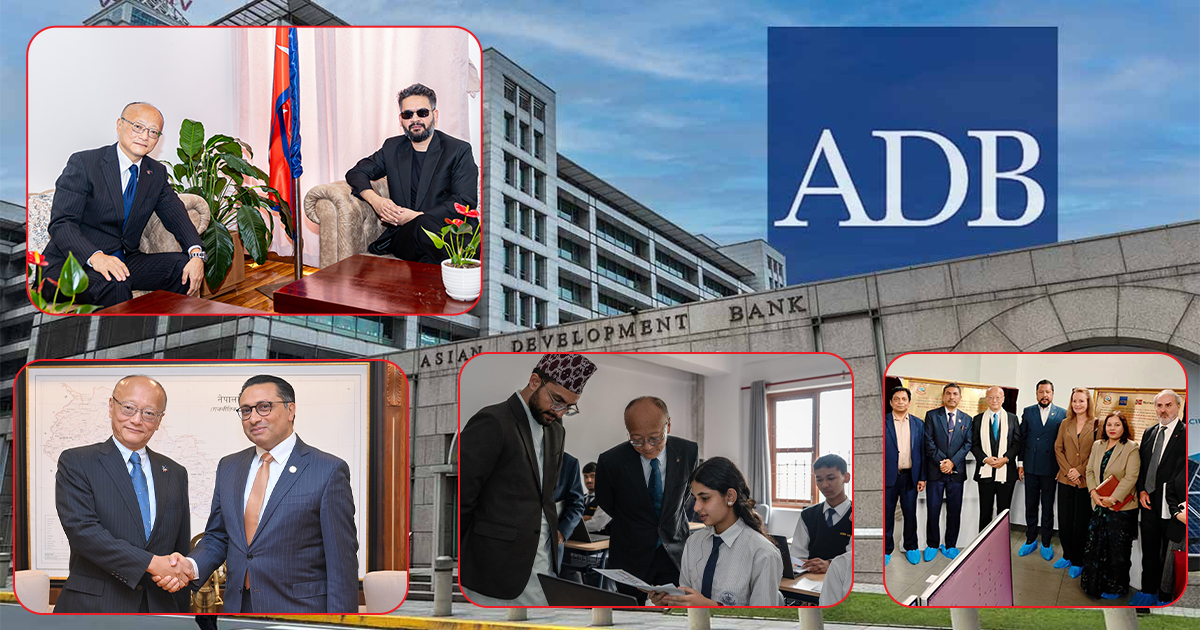

Kathmandu: To mark the 60th anniversary of the partnership between the Asian Development Bank (ADB) and Nepal, ADB President Masato Kanda has committed substantial investment to bolster the country’s economic transformation, job creation, and investment climate.
During his official visit to Kathmandu, President Kanda met with Prime Minister Balendra Shah and announced that ADB’s total assistance to Nepal is projected to reach US$ 2.4 billion (approximately Rs 320 billion) by the year 2029.
Speaking during the meeting, President Kanda emphasized that Nepal is currently at a decisive crossroads with a unique opportunity to build a dynamic and resilient economy. He noted that as Nepal’s largest multilateral development partner, the ADB is actively expanding its support with a primary focus on delivering tangible results for the people, including more jobs, stronger businesses, and improved livelihoods for local communities.
As part of this visit, the ADB signed two loan agreements with Nepal totalling US$ 165 million. These funds are designated to provide reliable and safe drinking water and sanitation services to over 850,000 people. Additionally, $50 million will be allocated to support policy reforms aimed at modernizing and digitalizing cross-border trade, which is expected to reduce business costs and enhance the competitiveness of Nepalese products in the global market.
President Kanda joined Minister for Energy, Water Resources, and Irrigation Biraj Bhakta Shrestha and the Norwegian Ambassador to Nepal, Dagny Mjos, to virtually inaugurate two substations built to strengthen Kathmandu’s electricity supply. He also visited a school reconstructed following the 2015 earthquake alongside Minister for Education and Sports Sasmit Pokhrel.
The school features modern science and technology facilities, and notably, the ADB has launched a pilot project there to integrate Artificial Intelligence into the learning process, aiming to equip both teachers and students with skills for a changing labour market.
In a meeting with Finance Minister Swarnim Wagle, President Kanda discussed improving Nepal’s business environment, mobilizing investment, and aligning with the government’s priorities for growth and resilience. He also held discussions with prominent private sector leaders to better understand the current opportunities and challenges facing investment in Nepal.
Under the ADB’s “Country Partnership Strategy 2025–2029,” the bank aims to provide up to US$ 660 million in annual loans to Nepal. Future priorities will centre on job creation, private sector development, sustainable infrastructure, and public service delivery. Significant emphasis will also be placed on the empowerment of women and marginalized groups, as well as digital transformation and climate adaptation. To maximize impact, the ADB plans to mobilize additional resources through co-financing and innovative financial instruments such as green bonds and local currency bonds.
During a 30-minute discussion with Prime Minister Balendra Shah, both parties reaffirmed their commitment to cooperation. Prime Minister Shah expressed confidence that Nepal is poised for a new era of development driven by good governance and transparency. Their conversation touched on advancing hydropower and tourism as the backbones of the Nepalese economy, while also collaborating on digitalization and tourism-related road infrastructure.
President Kanda concluded by reiterating that the ADB would remain a long-term, active partner in Nepal’s journey toward economic prosperity. He praised Nepal’s immense economic potential and its strong mandate for change, particularly noting that the country’s young leadership and commitment to reform are truly inspiring.
Established in 1966, the ADB currently comprises 69 member nations, 50 of which are from the Asia-Pacific region. For the past six decades, the bank has maintained a strategic partnership with Nepal to foster sustainable and inclusive growth.

Comment Here