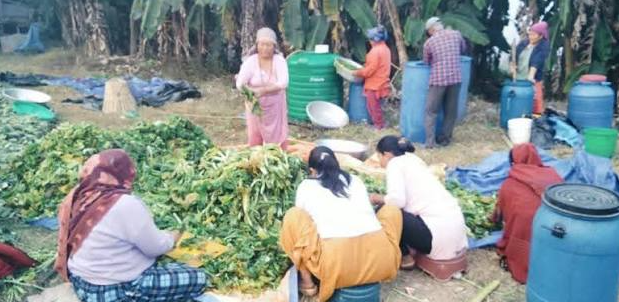

Hetauda: Until a few years ago, the daily life of 38-year-old Shriya Gurung from Ghalegaun, Hetauda Sub-Metropolitan City-12, was much like that of most rural Nepali women. Her days were spent from early morning on household chores, taking care of the family, livestock, and farm work. Even after working all day, she didn’t have any income in her own name.
Her family was solely dependent on her husband’s farming income to meet the family expenses. Shriya was always worried about how to manage the education expenses for their daughter, extra household costs, and growing financial responsibilities.
“I didn’t earn even a single rupee. I was really worried about the future, but I saw no other means of earning. I wanted to do something in the village, but I had no idea how to start,” Shriya says, recalling her past situation.
For her, ‘gundruk’ (the fermented and dried leafy vegetable) made every year in the village was just an ordinary homemade dish. No one had thought that it could be turned into a business, going beyond the traditional way of preserving vegetables for consumption in winter. Shriya had never imagined that this very gundruk could actually change her life.
“We never thought we could become entrepreneurs just by selling gundruk, the fermented and dried leafy greens,” she said. “
According to her, it was Green Foundation Nepal that inspired this dream, and Hetauda Sub-Metropolitan City created the environment to turn that dream into reality.
The skill-based training, initial financial support, and business operation advice provided by Hetauda Sub-Metropolitan City through the enterprise that Green Foundation Nepal started with training and material handover changed Shriya’s mind.
After that, she teamed up with other women from the village and established the Kanchanjangha Agriculture Cooperative and Micro Enterprise. This venture had a humble beginning. The women involved in this enterprise rented 15 katthas of land at a rate of 1,500 rupees per kattha per year.
“We grew mustard greens and from that, started producing organic gundruk. But as challenging as starting production was, finding a market turned out to be even harder. In the first year, there was no shortage of effort in the fields. The yield was good. But the market didn’t open its doors,” Shriya shared about their initial struggle.
Their enterprise could not get a license from the Department of Food Technology and Quality Control Office, so their production couldn’t reach the market. Millions of rupees worth of dried leafy vegetables were dumped in the warehouse. With no sales, worries about losing the investment and uncertainty about the future caused many sleepless nights.
“We worked so hard to produce the gundruk, but not being able to sell it was really disheartening. I was afraid all our effort would go to waste. But we didn’t give up,” Shriya recalls.
That same patience eventually paid off. With the facilitation of Hetauda Sub-Metropolitan City, the product got a government license from the Food Technology and Quality Control Office. Once it got government recognition, people started trusting the product more in the market. Businesspeople began reaching out on their own. Orders started increasing, and the path to sales opened up.
“Before, we were worried that nothing would sell. Now, the concern is whether production will meet the demand,” Shriya said with exuberance. Right now, the group is super busy not just fulfilling this year’s production but also keeping up with the demand for the coming year.
The group, which had 11 members in the beginning, now has 20 members. The cultivation of mustard greens has been expanded to 30 katthas of land now. A plan has been set to expand this cultivation to 50 khattas of land in the near future.
The group has also set a target to provide direct employment to more than 50 local women in the coming days, following the increase in production. Gundruk produced here is exported to Makawanpur, Sindhuli and Kathmandu for sale.
Shreya shared that they have now been working hard to fulfil the demand for gundruk. The group produces organic gundruk for six months and different types of pickles in the remaining six months.
Activities for processing, packaging and marketing of pickles are being carried out with the technical support of one organization. The group produces around 300 kilogrammes of pickles and has been selling at Rs 1,000 per kg. It makes a turnover of around 300,000 within a single production cycle.
Similarly, the market of gundruk has also been expanded gradually. Gundruk produced by the group is sold at Rs 800 per kilogram. The group has also started receiving demands for gundruk from other districts, too.
Organic gundruk is not simply the traditional menu of the Nepali kitchen; it is rich in nutritional value. It contains fibre, iron and calcium. With the increasing attraction of consumers towards chemical-free and organic food in recent periods, the demand for organic gundruk has also increased. This very change has led to the marketing of traditional foods produced by rural women.
The changes in Shriya’s life are not merely financial; her self-confidence, social identity and decision-making capacity have also boosted. She, who had to depend on her husband’s income for household expenses, has become able to run her family, invest in her daughter’s education and lead other women of the group from her income.
The business started from around Rs 100,000 in Hetauda sub-metropolis, and Rs 80,000 of cooperatives have now set an example of financial transformation of rural women. The women have created employment in their own villages by transforming gundruk limited within the house, as a business which has helped increase the price of local agro products, as well as connected women’s labour with direct income.
Many housewives of Hetauda sub-metropolis are becoming self-dependent by running small and cottage enterprises. Some of them have been producing organic gundruk, while others have turned pickle, handicraft, turmeric powder, and other local products into a business. This has become successful in increasing women’s income generation as well as connecting local resources, skills, and traditional knowledge with monetary value.
Shriya, who was worried about her family’s future in the past, has now become the source of inspiration for other women.
Her story is not only the success of a gundruk industry, but it is also an example of how, by combining opportunity, skill, support of local governments and women’s self-confidence, it is possible to live a dignified life and make a sustainable income even remaining in villages.

Comment Here