
With over 15 years of experience leading growth across global mobility and technology sectors, Mark Tolley, the APAC Regional Director for inDrive, provides a deep dive into the insights driving inDrive’s evolution. From the psychological importance of passenger empowerment and fair-choice pricing to navigating Nepal’s new fiscal regulations, Tolley outlines how inDrive is balancing affordability with a premium customer experience. He also shares his vision for the future of urban mobility in Kathmandu, touching on AI integration, safety innovations, and the potential of the super-app ecosystem in the Asia-Pacific region. Robin Paudel, Clickmandu Senior Correspondent, sat down with Tolley to discuss the ride-hailing giant’s latest ‘Passenger 360’ campaign in Nepal.
inDrive recently launched the Passenger 360 campaign in Nepal. What insights about passenger behaviour and expectations led to the development of this campaign?
Our latest 360-degree campaign is rooted in extensive consumer research. By engaging directly with passengers, we identified that their expectations extend far beyond basic transportation. They are seeking a premium experience defined by shorter wait times and total journey visibility. Most importantly, users demand confidence in the platform they choose. While value for money remains a critical factor, it is not the sole driver of brand loyalty. Consequently, we have built this campaign around the ‘full package’, providing passengers with the choice, control, and reliability they deserve.
You have researched the market of the Asia Pacific, including Nepal. How have passengers’ expectations evolved when it comes to urban mobility and ride-hailing services?
Affordability is a fundamental yet subjective requirement. Our model of mutually negotiated fares addresses this by accommodating varying financial capacities and providing inclusive access to our services. However, cost is only one element of the value proposition; consumers also demand safety and convenience. By integrating these priorities, we create a synergistic effect that ensures a seamless end-to-end experience for the passenger.
You said that customer experience and affordability matter most with ride-hailing. Which comes first, customer experience or affordability?
Affordability and user experience must advance in parallel. This is essential because even if a service is exceptionally affordable, a suboptimal experience will inevitably cause the customer’s perception of value to diminish significantly. While a passenger may initially appreciate a lower price point, if the quality of the journey is not commensurate with that price or fails to exceed those expectations, the brand faces a significant challenge in maintaining long-term customer retention.
Our core proposition, ‘choose your ride, choose your fare,’ is therefore supported by a high-quality experience built upon the substantial time, effort, and energy we invest into our driver onboarding and professional training programmes. We have successfully implemented these operational standards over the past 12 to 24 months in Nepal, achieving significant progress in service delivery. A key component of this was a specific campaign dedicated to professional manners and mental health awareness, which focused heavily on educating drivers regarding appropriate conduct and empathetic interaction with their passengers to ensure a consistently professional environment.
These efforts directly contribute to a more enhanced and professional passenger experience. Therefore, I would not prioritize one element over the other at this time; both affordability and experience must serve as the fundamental and equal pillars of our customer value proposition moving forward to ensure continued success.
The Passenger 360 campaign focuses on the idea of a ‘smart and safe ride.’ From inDrive’s perspective, what does a smart mobility experience look like for today’s commuter?
Safety consists of two primary components: digital in-app features and external operational standards. Within our application, we are continuously developing safety protocols, including ‘Share your ride,’ the SOS button, and trusted contacts; we have also recently introduced audio recording. Additionally, all rides are fully insured, which provides passengers with necessary peace of mind regarding their security. However, safety is not restricted to digital tools; it also encompasses the environment outside the app, specifically concerning our drivers. We are actively investing in driver welfare because we believe that enhanced wellbeing for drivers leads directly to a better experience for our customers. Therefore, it is essential to focus on both technological and human factors simultaneously. Over the past 12 to 24 months, we have dedicated a significant amount of time, energy, effort, and resources to successfully executing these initiatives here in the Nepal market.
One of the key messages of the campaign is giving passengers more control over their journeys. Why is passenger empowerment becoming increasingly important in urban mobility?
Passengers make choices that align with their specific needs, utilizing a freedom of choice that allows them to make decisions based on their unique circumstances and environment. Providing this level of empowerment to passengers significantly enhances their overall journey. If an application functions as a rigid service where the only option is to ‘take it or leave it,’ it misses the substantial opportunity to accommodate passengers whose choice is based on their personal needs and desires.
Central to this is the flexibility of mutually agreeing upon a fare with the driver and the ability to select a driver based on individual criteria. For instance, a passenger might prioritize personal safety by choosing a five-star-rated driver. Alternatively, those focused on price may select a driver who is further away but fits within their specific budget. On the other hand, a passenger can choose a driver who is only two minutes away, regardless of whether that option is more expensive. The benefit of this model is that no algorithm mandates a higher price based on proximity or distance; instead, pricing is determined by real-world conditions.
Granting both the driver and the passenger this opportunity for empowerment is essential. This remains a key message of our platform, as we believe that empowerment is a fundamental driver of customer retention.
In light of the Government of Nepal’s recent decision to impose a 5 per cent VAT and a 1 per cent TDS on ride-hailing services, how do you evaluate the sustainability of this sector? Given that ride-hailing platforms like inDrive have become vital for both public mobility and job creation, will these fiscal measures act as a significant deterrent for service providers and users, or are they a necessary step toward formalizing the gig economy?
To clarify the current discourse, the fundamental issue is not whether ride-hailing companies should be subject to taxation. It is widely accepted that they should, as these contributions ultimately support the broader economic ecosystem. The central question, however, is whether the emerging regulatory framework accurately reflects the practical realities faced by drivers, passengers, and the platform providers. As new legislation is expected soon, we are maintaining constant dialogue with regulators to ensure these nuances are addressed.
We must remain mindful that any implementation of Value Added Tax (VAT) carries a financial burden that must be borne by a specific party. While the final consumer often pays, the responsibility could fall upon the driver, the rider, the platform, or be shared among all stakeholders. The right balance must be struck, especially given the global cost-of-living crisis from which Nepal is not immune. Any resulting increase in costs could negatively impact the financial stability of both drivers and passengers.
A slight increase in fares may put services beyond the reach of many riders, while the imposition of Tax Deducted at Source (TDS) on drivers would directly reduce their take-home earnings. Furthermore, if platforms are required to absorb these additional costs, the funding must be diverted from other essential investments. Consequently, we advocate for a balanced approach to the implementation of VAT and other taxes to ensure the sustainability of the entire sector.
By bringing ride-hailing platforms like inDrive into the tax net for the first time, has the Government of Nepal finally provided the regulatory certainty needed for the sector to grow? How significantly does this formal recognition change the business landscape for investors and operators who previously feared crackdowns?
As an organization, inDrive is fully compliant, maintaining all necessary licenses and working through established partnerships. We collaborate closely with regulators globally, particularly in South and Southeast Asia, where regulatory frameworks are in a state of constant evolution. It is important to recognize that the ride-hailing sector is still in its infancy; while our business is thirteen years old, the industry remains young compared to traditional flag-down taxi services, which have operated for decades.
Because the regulatory landscape is constantly shifting, our objective is to work alongside regulators and governments to shape policies in the most meaningful way. We remain open to ongoing dialogue, leveraging extensive insights from global markets and frequent consultations with authorities across Asia.
As Nepal’s regulatory environment continues to evolve, we must ensure that over the coming weeks, months, and years, it is shaped positively. A well-constructed framework will allow drivers to achieve maximum earnings, enable us to reach more passengers, and allow platforms to invest sustainably in the market, all of which contribute to the growth of the broader economy.
Let us go back to the Passenger 360 campaign. The message ‘Agree on your fare, only here’ is central to the campaign. What makes this approach particularly relevant in today’s mobility landscape?
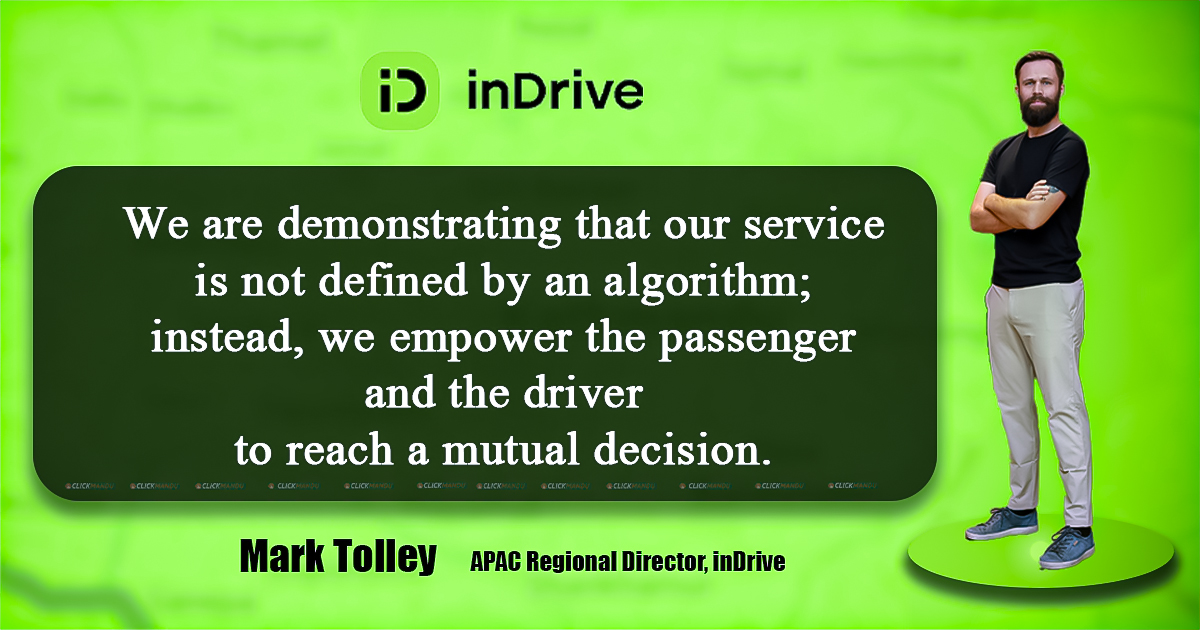
As previously discussed, passengers prioritize freedom of choice and the desire for inclusion rather than receiving rigid directives. Personalization and participation are the fundamental principles behind our ‘Agree on your fare, only here’ campaign. We are demonstrating that our service is not defined by an algorithm; instead, we empower the passenger and the driver to reach a mutual decision. Communicating this message of choice and autonomy is a vital priority that we must effectively convey to our audience to ensure our brand’s core values are understood.
Kathmandu continues to face increasing traffic congestion and changing commuter needs. What mobility trends are you observing in markets like Nepal, and how is inDrive responding to them?
Traffic congestion is a significant challenge across several markets. Based on our interactions with passengers, it is clear that time efficiency is their most valued priority. Consequently, our response centres on increasing service speed while offering greater flexibility, availability, and choice.
This approach reflects InDrive’s founding mission to challenge injustice and uphold the freedom of choice. We have remained committed to these principles, innovating within our core focus to address urban mobility issues and congestion. Our strategy involves supporting existing infrastructure, particularly in markets where public transportation, such as trains, buses, monorails, or underground systems, is insufficient. In these regions, we aim to provide critical first-mile and last-mile connectivity.
This is achieved through our core value proposition of freedom of choice. The combination of these strategies has been executed successfully in Nepal and other international markets as we work to resolve the ‘time-value-money’ challenges faced by our users.
What opportunities do you see in the mobility markets like Nepal?
Several key priorities define our future strategy. First, we must expand transportation options for passengers by offering a wider variety of vehicle types, including two-wheelers, four-wheelers, and premium tiers such as Executive and Comfort classes. Continually developing this level of flexibility and choice remains a primary objective.
Beyond vehicle variety, our strategy involves two additional pillars. The first focuses on technology and artificial intelligence, specifically regarding continuous application improvements. By integrating more AI-driven features, we can empower passengers to make more informed and personalized decisions. The second pillar involves constructing a comprehensive ecosystem tailored to the specific needs of Nepali consumers. This necessitates the development of a ‘super-app’ model-a robust ecosystem that provides passengers with access to groceries, courier services, rides, and insurance within a single, unified platform.
While there is a vast range of potential services, we must identify what is most relevant to each specific city to build an effective local ecosystem. The transition toward a super-app is a strategic priority for our organization, as we recognize a tremendous opportunity for such an integrated platform within the Nepali market.
Looking ahead, what opportunities do you see for Nepal’s mobility sector, and what should the future of safer, smarter, and more passenger-centric urban mobility look like?
Ultimately, the future of the industry depends on sustained investment in technology that empowers passengers with authentic choice, which inherently strengthens the entire service ecosystem. Over the next several years, we will focus on the consistent development and technological enhancement of our application to ensure it improves month after month and year after year.
Future success will lie with organizations that direct their energy toward two critical areas. First, within the application, we must invest in technology to ensure all features are strictly functional and relevant rather than superficial. Second, we must look outside the application to improve the holistic passenger experience. This objective is rooted in the quality of the drivers we onboard, the depth of training and investment we provide them, and the overall standard of vehicle quality and maintenance. A dual focus on both technological precision and operational excellence is required to provide passengers with true, lasting value.

Comment Here