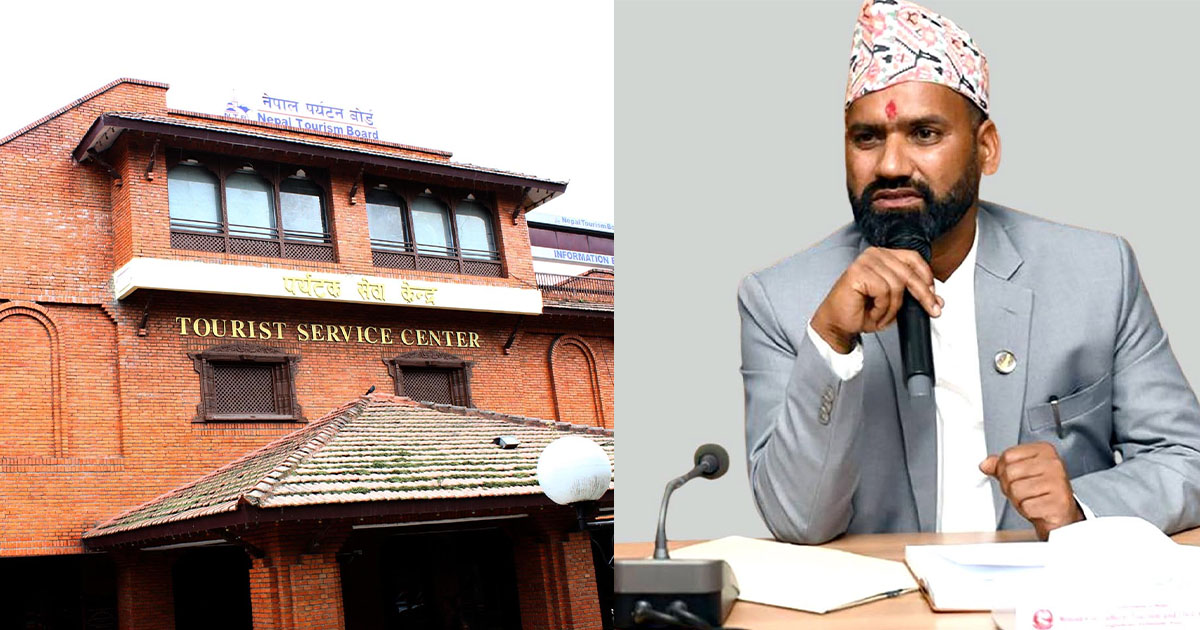

Kathmandu: The Nepal Tourism Board (NTB), the country’s premier agency responsible for international and domestic tourism promotion, has faced a complete halt in its strategic activities due to significant interference from the Ministry of Culture, Tourism, and Civil Aviation.
As the deadline for the upcoming fiscal year 2026/27 approaches, the institution finds itself in a state of administrative paralysis, unable to initiate even the most basic preliminary processes for its annual budget. This crisis is a direct consequence of the Tourism Minister’s failure to fulfil his responsibility of appointing board members on time, leaving the organization’s leadership structure hollow and its promotional mandate frozen.
Operating under a unique Public-Private Partnership (PPP) model, the NTB is governed by an eleven-member board of directors. This structure traditionally includes five ex officio government officials and six representatives from the private sector, including the Chief Executive Officer (CEO).
According to the Board’s governing statutes, the Tourism Minister is responsible for appointing the private sector representatives based on recommendations from a specialized selection committee. However, more than two months have passed since the board became dysfunctional, and the Ministry has yet to finalize the necessary appointments, causing an unprecedented bottleneck that threatens the future of Nepal’s tourism marketing.
The leadership crisis was triggered by a government ordinance aimed at revoking various political appointments across state institutions. Following a formal notice published in the Nepal Gazette on May 1, the CEO and the five private sector board members were relieved of their duties. This mass exit left the board without a quorum and stripped it of the private-sector expertise essential for its decision-making process.
Tourism Minister Khadak Raj Paudel (Ganes) initially formed a recommendation committee to fill these roles, but the process was immediately marred by controversy and allegations of bias, leading to the committee’s dissolution and subsequent reconstitution under the leadership of the Director General of the Department of Tourism, Ram Krishna Lamichhane.
The most pressing consequence of this ongoing vacancy is the looming budget disaster for the next fiscal year. According to the Nepal Tourism Board Act of 1997 and the associated Financial and Procurement Regulations of 2015, the institution is legally mandated to approve its annual budget and programs by July 9 (Asar 25). The regulations specifically require the formation of a Budget Formulation Sub-Committee, which must be led and represented by the private sector board members. Because the board currently lacks these representatives, the sub-committee cannot be legally constituted, making it procedurally impossible to pass a budget or plan any promotional activities for the coming year.
Under the current circumstances, the Tourism Board has been unable to hold a board meeting for over two months. Without these meetings, no decisions involving significant financial commitments or long-term strategic value can be ratified. The Board is currently restricted to performing only basic, day-to-day administrative tasks. Santosh Pant, the Board’s Information Officer, noted that while the various departments are continuing their internal preparations, the lack of a governing body has effectively blocked all major initiatives. Previously, a sub-committee led by private sector representative Rajendra Bahadur Lama was overseeing budget preparations, but that committee became defunct the moment the board was dissolved, leaving all planning in a state of limbo.
The absence of a CEO has further exacerbated the organizational struggle. While the heads of the board’s five departments have been granted the authority to manage affairs through collective leadership, this “management by committee” approach has proven insufficient for the high-level marketing and international diplomacy required to sustain Nepal’s tourism sector. Historically, the NTB has frequently suffered from delays in CEO appointments, and the current situation reflects a recurring pattern of political indecision that continues to hinder the professional growth and international competitiveness of the industry.
Mukunda Prasad Niraula, the Tourism Secretary and Chairman of the NTB Board, acknowledged the delays but suggested that the situation would soon be resolved. He attributed the recent hiatus to the disputes surrounding the initial nomination process, which necessitated the formation of a new selection committee. According to Niraula, the government is now moving forward based on the suggestions of the newly formed committee, and the appointment of board members is expected to happen imminently. Once the board is reconstituted, Niraula stated that the priority would be to fast-track the appointment of a new CEO and the approval of the annual budget to restore the Board’s full operational capacity.
The ongoing stagnation at the Nepal Tourism Board serves as a stark reminder of the vulnerabilities inherent in the PPP model when it is subjected to political whims and ministerial overreach. For a nation where tourism is a vital pillar of the economy and a major source of foreign exchange, the paralysis of its primary promotional agency during the peak budget planning season is a significant setback.
Stakeholders across the tourism industry have expressed concern that if the leadership vacuum is not filled immediately, Nepal risks losing its momentum in the global travel market at a time when international competition for tourists is fiercer than ever. Until the Ministry prioritizes institutional stability over political manoeuvring, the NTB’s ability to showcase Nepal to the world remains compromised.

Comment Here