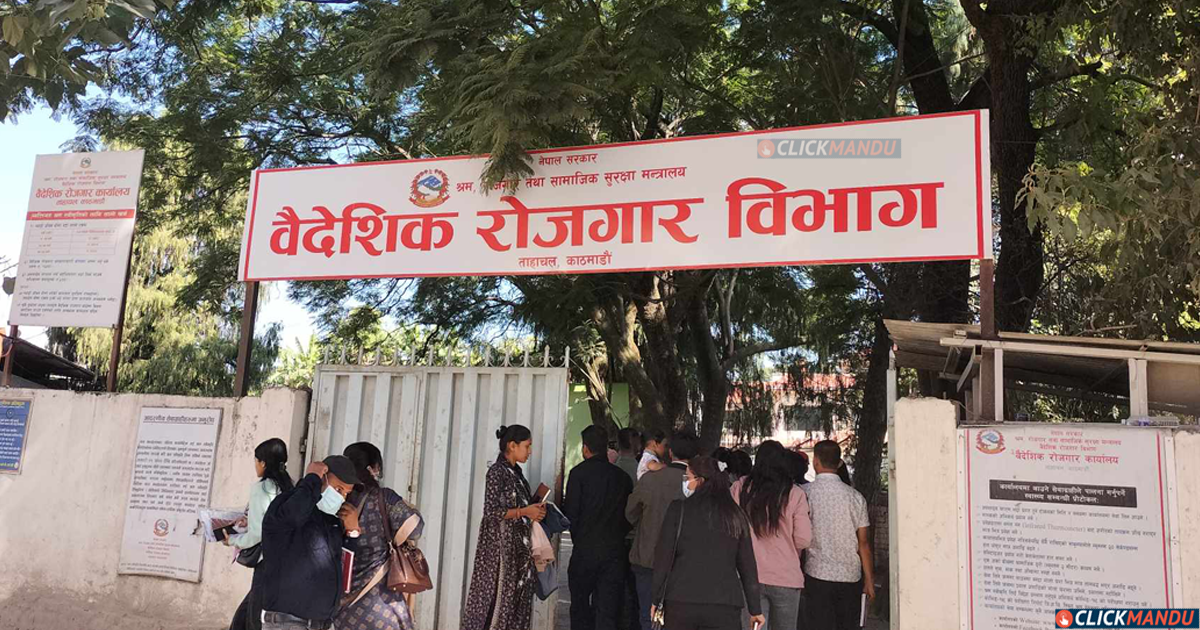

Kathmandu: The Department of Foreign Employment has taken disciplinary action against 159 manpower agencies found to have sent Nepali migrant workers abroad via Indian airports without obtaining the necessary prior approval. Citing a violation of Section 22 of the Foreign Employment Act, 2064, the Department officially issued warnings to these companies as a first-time penalty for bypassing legal protocols.
This move follows a rigorous monitoring period conducted between mid-March 2025 and mid-June 2026 (Chaitra 2082 to Jestha 2083 B.S.), during which the Department analyzed the flight records of workers who had received labour permits. Of the 1,117 licensed recruitment agencies currently operating in Nepal, only 678 complied with the request to submit their flight data. A detailed review of these submissions revealed that 159 agencies had utilized Indian transit for labour migration without the Department’s explicit permission.
In addition to those caught using unauthorized routes, the Department issued warnings to more than 434 manpower companies that failed to provide any flight details at all, marking a violation of Section 37 of the Act. These companies have been directed to submit the missing information immediately. For those showing repeated negligence toward laws and directives, the Department imposed a fine of Rs 50,000 each on eight specific agencies: Grand Suite Job, Mass Human Resource, Noon Resource, Apex HR Consultancy, Tesla Overseas, Sunaguwa International, Allied International Manpower, and Anjali Overseas Service.
Among these, three were fined for the unauthorized use of Indian airports, while five were penalized for their total failure to report data.
The Foreign Employment Act mandates that all workers departing for foreign employment must use domestic airports. If an exceptional situation arises requiring the use of a foreign airport, recruitment agencies must secure formal authorization from the Department beforehand.
Authorities emphasize that when agencies bypass local airports without oversight, it severely undermines the government’s ability to maintain accurate records, ensure the safety of citizens, and manage effective monitoring systems.
The Department’s crackdown was triggered by a surge in complaints regarding the unauthorized use of Indian transit, leading to a formal notice issued in July 2026 (Ashar 2083 B.S.) to verify these activities. Moving forward, the Department has cautioned all recruitment professionals that strict adherence to the law is non-negotiable and that any future repetitions of these unauthorized practices will lead to even more severe legal consequences.

Comment Here