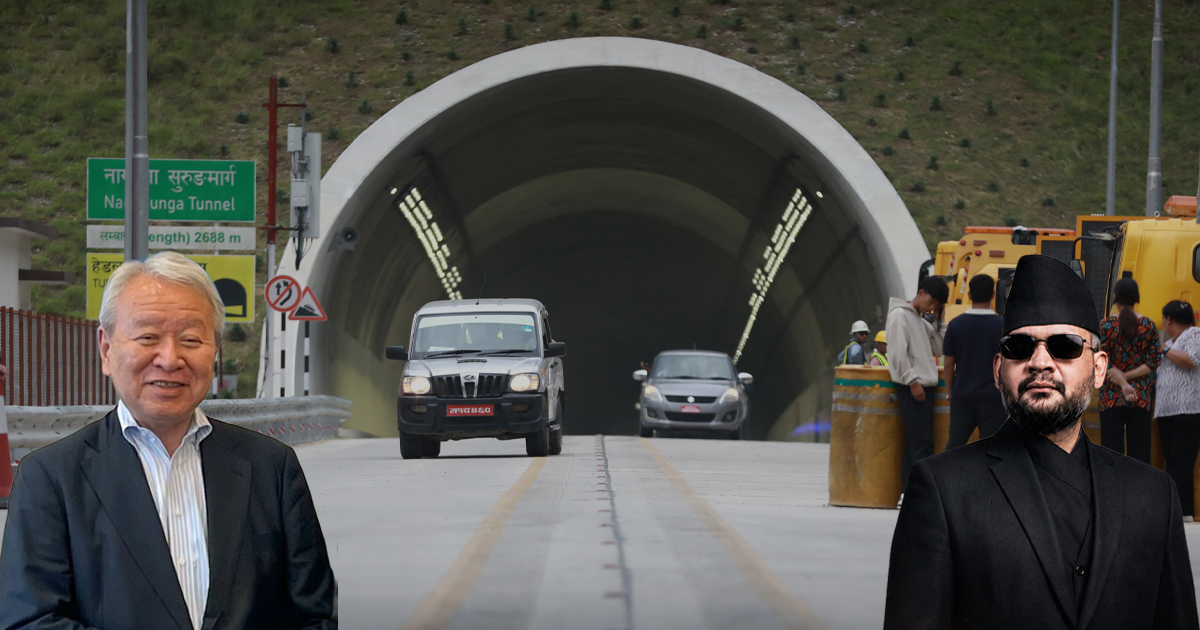

Kathmandu: The construction of the Nagdhunga-Sisnekhola tunnel, a high-priority National Pride Project connecting Kathmandu and Dhading, has entered its final stretch, with the government making extensive preparations for a formal inauguration.
According to project officials, the official opening is tentatively scheduled for July 26, provided no unforeseen technical or logistical hurdles arise in the coming weeks. High-level coordination is currently underway to ensure that the ceremony reflects the strategic importance of this infrastructure, which marks Nepal’s first modern roadway tunnel. The project office has indicated that while the date is set, they remain flexible should any minor adjustments be necessary to ensure a seamless debut.
To mark this significant achievement, the government has extended a special invitation to Dr Akihito Tanaka, the President of the Japan International Cooperation Agency (JICA), which provided the essential financial and technical support for the project. Diplomatic channels have already been activated, with Japanese Ambassador Mitsuteru Toru recently discussing the potential visit with Foreign Minister Shishir Khanal.
On the domestic front, the project is preparing to host Prime Minister Balendra Shah as the chief guest, alongside Infrastructure Development Minister Sunil Lamsal, who has already confirmed his participation. The ceremony is expected to begin mid-morning, signalling a new era for Nepal’s transportation sector.
Following the ceremonial ribbon-cutting, the tunnel will not immediately open to unrestricted traffic. Instead, the project has designated a three-month “trial opening period” to rigorously monitor technical performance and security protocols. This phase is crucial for identifying any latent engineering issues or safety concerns before the tunnel is fully integrated into the national highway system.
Project engineers, led by Senior Divisional Engineer Sanjay Panthi, explained that full-scale operations will only commence in the fourth month, contingent upon the successful completion of this testing phase. During this time, the Road Board of Nepal will determine whether toll fees will be waived or implemented, though recent indications suggest that a fee structure will likely be in place from the start.
In terms of physical infrastructure, the project is virtually complete. While all internal civil works within the tunnel are finished, some external tasks, such as landslide mitigation near the western portal and the installation of additional anchors, are in their final stages. Landslide prevention measures are reportedly 80 percent complete. On the human resource front, while 70 percent of the required operational staff is already mobilized, the project still needs to recruit the remaining 30 percent, focusing on specialized roles that require specific experience.
To manage daily operations, the Department of Roads has appointed a Nepali-Chinese joint venture, Yusin-ART, under a five-year contract worth approximately 1.1 billion rupees.
The operational framework for the tunnel is remarkably complex, requiring a dedicated team of 150 personnel. This team, led by a tunnel maintenance chief, includes 64 security officers, 54 toll booth operators, 14 traffic monitors, and several specialized technicians for civil and structural maintenance. The tunnel system itself consists of two parallel passages: a 2.68-kilometre main tunnel for vehicular traffic and a 2.55-kilometer evacuation tunnel designed for emergency rescues.
The main tunnel features three lanes, two lanes for traffic entering Kathmandu and one for exiting vehicles, with seven cross-passages connecting it to the emergency tunnel. These safety features are designed to facilitate rapid evacuation in the event of accidents or vehicle breakdowns.
From a macroeconomic perspective, the Nagdhunga tunnel is expected to become the backbone of the Nepali economy. A comprehensive study by JICA suggests that the tunnel will drastically reduce trade costs, save fuel, and enhance travel safety
Safety remains the paramount concern for the government, leading to strict regulations regarding tunnel access. According to the recently approved Nagdhunga-Sisnekhola Tunnel Transport Operation Directive, pedestrians, bicycles, motorcycles, and three-wheelers are strictly prohibited from entering the facility. Furthermore, vehicles carrying hazardous materials such as fuel, cooking gas, or explosives are barred to prevent catastrophic accidents within the enclosed space. Oversized vehicles exceeding 18 meters in length or certain height and width limits are also restricted. To maintain a smooth flow of traffic, a speed limit of 40 kilometres per hour has been established for all authorized vehicles.
From a macroeconomic perspective, the Nagdhunga tunnel is expected to become the backbone of the Nepali economy. A comprehensive study by JICA suggests that the tunnel will drastically reduce trade costs, save fuel, and enhance travel safety. As the primary gateway for goods arriving from both India and China, the Nagdhunga pass has long been a bottleneck. The tunnel is projected to reduce the 30-minute climb into Kathmandu to just seven minutes, while the exit journey will drop from 20 minutes to six minutes. These efficiencies are expected to save the country roughly 2.45 billion rupees annually through reduced vehicle operating costs and time savings, providing a significant boost to national productivity.
The financial scope of the project has evolved, with the final cost estimated at 24.5 billion rupees. This includes 16 billion for construction, 6 billion for land compensation, and an additional 2.5 billion due to price escalations. The budget increase was attributed to design modifications necessitated by technical requirements and delays caused by the COVID-19 pandemic and local disputes over house damages and water management. Financing was secured through a mix of Nepal government funds and highly concessional loans from Japan. JICA provided loans at interest rates as low as 0.01 percent with a 40-year repayment period, though later supplementary loans carried slightly higher rates of 1.15 percent.
Despite being in a trial phase, the Road Board of Nepal has clarified that toll fees will be mandatory for all users from day one. Executive Director Ganesh Bahadur KC emphasized that all technical preparations for digital and manual toll collection are complete. The government has already published the fee structure in the National Gazette, with rates varying by vehicle type and direction of travel.
For example, light vehicles like cars and vans entering Kathmandu will pay 65 rupees, while those exiting will pay 60 rupees. Heavy vehicles such as multi-axle trucks will face higher fees, reaching up to 600 rupees for entry. The Board plans to use the initial period to encourage vehicle owners to transition toward digital payment systems to ensure efficiency.
With an annual operating cost estimated at 300 million rupees, the project’s sustainability will depend on efficient toll management and strict adherence to safety guidelines. As Shrawan 11 approaches, all eyes are on this portal, which promises to transform the way people and goods move into the heart of the country, solidifying Nepal’s path toward modernized connectivity.

Comment Here