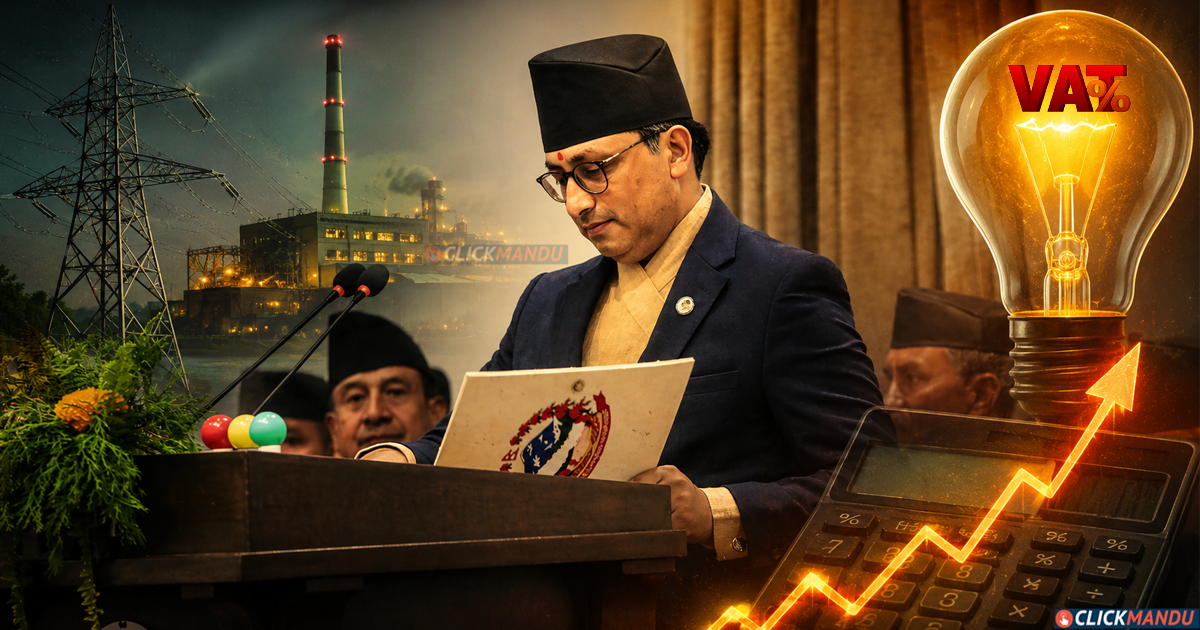

Biratnagar: Industrialists and business leaders from eastern Nepal have formally petitioned the government to retract the newly imposed Value Added Tax (VAT) on electricity, arguing that such a move is essential to protect the country’s manufacturing sector.
The Industry Association Morang (IAM) submitted a formal appeal to Finance Minister Swornim Wagle, asserting that electricity is a fundamental input for domestic production. They warned that the additional tax burden would inflate production costs, stifle cash flow, and cripple the competitive edge of local industries in both domestic and international markets.
In his letter, IAM President Nand Kishore Rathi highlighted a significant policy shift in the Finance Act of 2026/27, which ended decades of VAT exemptions on energy. Under the new regulations, households consuming over 50 units face a 5 per cent tax, while industrial and non-domestic consumers are hit with a full 13 per cent VAT on their entire bills.
Rathi argued that this tax directly contradicts the government’s own long-term strategy to increase domestic hydropower consumption and reduce the nation’s dependence on imported fuels, ultimately creating an environment that is hostile to industrialization.
The association expressed deep concern over the immediate liquidity crisis this tax creates for manufacturers. While VAT is theoretically a refundable or adjustable tax, the practical reality in Nepal involves a notoriously slow and complex refund process. Industrialists essentially provide an interest-free loan to the state while they themselves pay high interest on bank loans used to cover that same frozen working capital.
For high-energy sectors like the steel industry, the association estimated that a single large-scale unit could see more than 210 million rupees of its capital locked up annually, making daily operations increasingly difficult and pushing some businesses toward the brink of closure.
Furthermore, the IAM pointed out that the tax would be particularly devastating for exporters and small-scale enterprises. Exporters, who have zero-rated output, must rely entirely on the inefficient refund system, effectively turning the VAT into a permanent production cost that makes Nepalese goods less competitive abroad.
Similarly, small and cottage industries that fall below the VAT registration threshold cannot claim any tax credits, resulting in a direct and permanent 13 per cent hike in their operational expenses. This inequality exacerbates the challenges already faced by smaller players in the market.
The appeal concluded by warning of the broader inflationary impact on the general public. Since electricity is a primary component of almost all goods and services, the tax will inevitably lead to higher retail prices, further burdening citizens who are already struggling with a high cost of living.
At a time when the industrial sector is navigating high financial costs and stringent credit regulations, the association urged the government to reconsider this fiscal policy to prevent widespread financial distress and ensure the predictability and stability required for a healthy investment climate.

Comment Here