
Kathmandu: New data released Thursday by the Human Rights Measurement Initiative (HRMI), an independent NGO, show that Nepal has yet to fully realise and safeguard economic, social, civil and political rights for all people.
The data highlight persistent gaps in access to basic needs, opportunities, and equal exercise of rights and freedoms in the country.
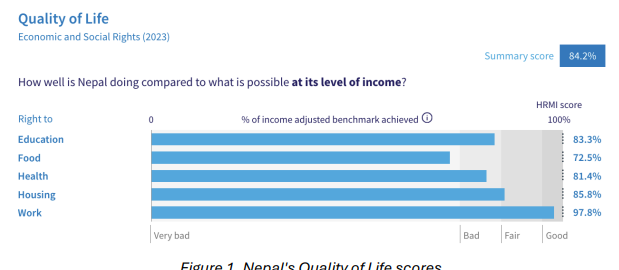
Nepal’s Quality of Life score of 84.2 per cent indicates that the State is underperforming in fulfilling the economic and social rights of its people, including the rights to education, work, health, housing, and food. These scores suggest that, given its current level of resources, the government could achieve a lot more in fulfilling each of these five rights.
Through HRMI’s annual survey, human rights experts from Nepal identified several groups who were at a greater risk of being left behind in the meaningful enjoyment of their economic and social rights. These included people living in rural and mountainous areas as well as those from Madhesh, Karnali, and Sudurpashchim provinces; people from disadvantaged socio-economic backgrounds; persons with disabilities; women and girls; and people from the Dalit and Janjati communities, with many facing intersecting forms of disadvantage and exclusion.
Nepal’s summary score of 6.0 out of 10 for empowerment rights indicates continuing challenges in ensuring full protection of civil liberties–the rights to assembly, opinion, political participation, and religion and belief. According to human rights experts, those
who are particularly at risk of rights violations are women and girls; LGBTQIA+ people; protestors; people from particular socio-cultural backgrounds or castes, especially people from Dalit, Janjati, and Muslim communities and other marginalised groups.
Notably, Nepal’s performance on these empowerment rights has trended downward, particularly for the freedom of opinion and expression, while score for freedom of religion and belief has remained roughly stagnant.
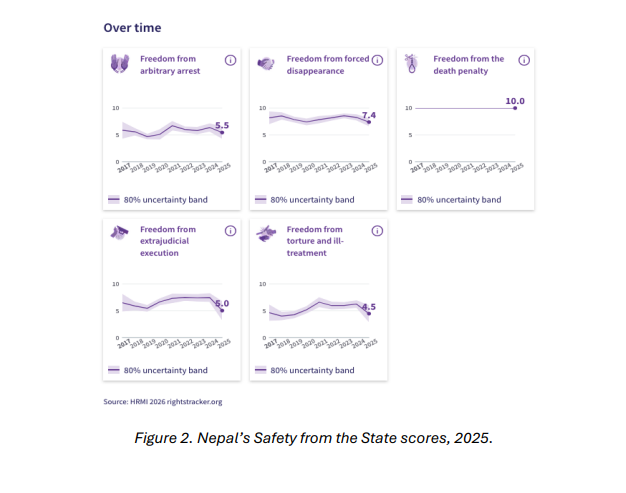
Nepal’s score of 6.2 out of 10 on the five ‘Safety from the State’ rights suggests that there are still a considerable number of people who are at risk of violations of their physical integrity rights. Human rights experts identified people from Adivasi Janjati communities; protesters, particularly the GenZ protestors; and those suspected of political violence, among others, as being at risk of being subject to arbitrary arrest, extrajudicial execution, and torture in 2025.
Much like HRMI’s empowerment rights data, Nepal’s Safety from the State rights scores reveal a concerning pattern of decline across physical integrity rights since 2023, and, more broadly, have shown little to no improvement since 2017.
These findings are broadly consistent with the Amnesty International reporting that the law enforcement used unlawful lethal and less-lethal force during protests. Reports of extrajudicial killings and ill-treatment remain a concern, and Nepal’s National Human
Rights Commission recorded 14 complaints under the UN Convention against Torture in 2025.
‘Nepal has made important commitments to uphold and protect human rights, both domestically and at the international level,’ said HRMI’s Global Engagement Lead, Aditi Patil.
‘The new data highlight the need for renewed efforts to ensure that these commitments are translated into tangible improvements in people’s lives, particularly for those who continue to face discrimination, exclusion, or barriers to exercising their rights.’

Comment Here