
Kathmandu: At a time when the economy is reeling from a deep slowdown and business morale is at an all-time low, expectations were high that the current government would provide much-needed relief.
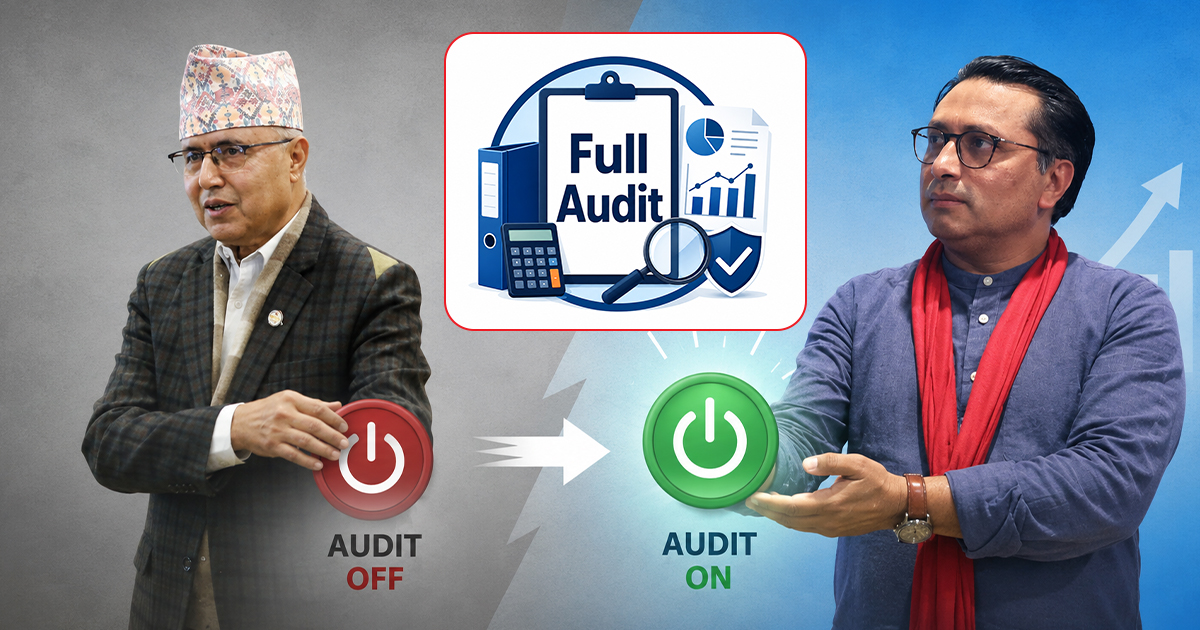
However, in a move that contradicts these hopes, Finance Minister Dr. Swarnim Waglé has reportedly unleashed the “stick” of full tax audits on the business community. Despite being part of a government that rose to power on the back of the “Gen Z” movement with promises to incentivize the private sector, the administration appears to have reverted to aggressive tax-collection tactics after failing to meet its revenue targets.
Under the direct instructions of Dr Waglé, the Inland Revenue Department has recently issued a circular to its subordinate tax offices to settle pending audit files and initiate new proceedings immediately. While the government frames this as a routine effort to clear backlogs, entrepreneurs view it as a calculated manoeuvre to harass businesses and extort commissions. Sources indicate that the Finance Minister has prioritized these audits under the guise of controlling revenue leakage, but the private sector sees this as a resurgence of a predatory system. Businesses complain that tax officers often use full audits to scavenge for minor technical errors, impose disproportionate fines, and then demand illicit kickbacks to “settle” the files.
The business community, which initially hoped for a two-thirds majority government led by the Rashtriya Swatantra Party (RSP), is now deeply concerned. They feel betrayed by a Finance Minister who brands himself as a pro-private sector economist but is accused of reviving a culture of administrative intimidation. One entrepreneur lamented that tax officers entering offices and warehouses for audits often results in psychological stress and blatant bargaining for significant sums of money, questioning the difference between this and institutionalized extortion.
This aggressive stance marks a significant departure from the policies of former Interim Finance Minister Rameshwor Khanal. During his tenure, Khanal had moved to halt indiscriminate full audits, arguing that they did not significantly contribute to the treasury but instead increased business costs and bred corruption within the tax administration. He had advocated for a selective, risk-based audit system and was working toward a “faceless” online structure to eliminate the need for physical interaction and illicit transactions. By abandoning this reformist path without a clear alternative, Dr Waglé has effectively granted tax officials the autonomy to act arbitrarily.
While full audits are traditionally mandatory for large-scale businesses with annual turnovers exceeding 500 million rupees, there are growing signs that medium-sized enterprises are now also being targeted. Business associations emphasize that the audit process is so cumbersome that it forces entrepreneurs to spend more time on bureaucratic hurdles and frequenting tax offices than on actual production or trade. Allegations of collusion between tax officials and certain auditors have surfaced, leading to claims that even honest taxpayers are being treated with suspicion and hostility.
Although Dr. Waglé has spoken about eventually implementing international best practices like “faceless” audits, his immediate actions tell a different story. The disconnect between the government’s rhetoric of boosting investment and the reality of administrative “tax terror” is threatening to further damage the investment climate. Critics argue that while the state certainly needs revenue to function, the Minister’s current approach of penalizing a demoralized business class rather than incentivizing it will prove counterproductive in the long run.
Ultimately, the outcry from the business community highlights a systemic flaw in the tax administration. While the theoretical goal of full audits, ensuring transparency and preventing leakage, is legitimate, the execution remains plagued by abuse. As tax offices prioritize comprehensive investigations into economic transactions, VAT, and stock details, the private sector continues to call for a streamlined, transparent system that fosters economic discipline without resorting to administrative harassment or the seeking of additional illicit gains.

Comment Here