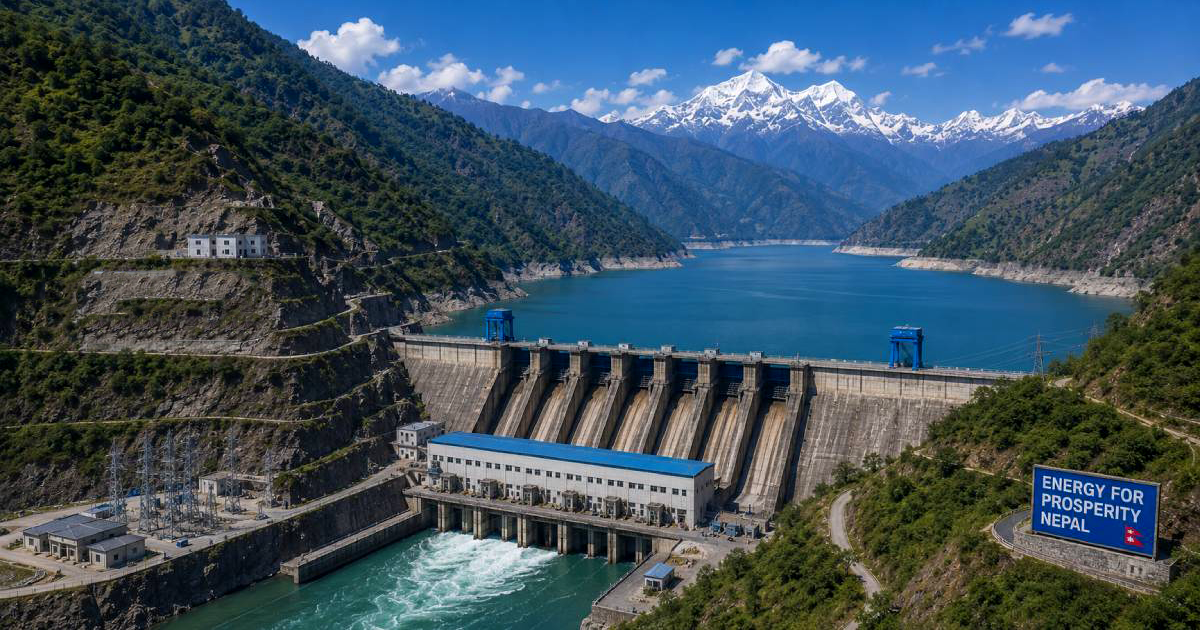

Kathmandu: Stakeholders in Nepal’s energy sector are warning that the multi-billion-dollar investments made by private developers are increasingly at risk due to persistent policy inconsistency, a sluggish administrative framework, and a complex geopolitical landscape.
While the country’s hydroelectric potential remains vast, experts argue that without a stable and supportive government presence, the sector cannot serve as the intended engine of national economic growth. During a recent “Energy Policy Dialogue” jointly organized by Urja Khabar and Martin Chautari, Dr Govinda Raj Pokharel, the former Vice-Chair of the National Planning Commission, emphasized that Nepal’s unique geography and water resources are its greatest assets.
He noted that with neighbours like China and India—home to nearly three billion people—attaining rapid economic growth, Nepal must leverage its strategic position to turn its natural advantages into sustained economic prosperity.
One of the most significant shifts discussed was the government’s 2022 directive allowing hydroelectric projects to be designed under a “Q20” framework rather than the stricter “Q40” standard. This change has fundamentally altered the sector’s outlook, as experts now agree that Nepal’s total technical potential could soar to 150,000 MW, compared to the previous estimate of roughly 32,680 MW. Beyond sheer capacity, the financial incentives are clear: Q20 projects offer a faster return on investment, averaging 6.5 years compared to 8.6 years for Q40 designs.
This technical evolution positions Nepal to potentially become South Asia’s “green energy hub,” provided the government remains consistent in its long-term planning regarding internal consumption and external exports.
Nepal successfully transitioned into a net power exporter between 2022 and 2024, achieving a record export revenue of 17.47 billion rupees in 2025. While the Nepal Electricity Authority (NEA) enjoys healthy margins by purchasing power from domestic private producers at fixed rates and selling it to India at market prices, the road ahead is fraught with geopolitical challenges.
India’s cross-border electricity trade guidelines explicitly favour projects without Chinese investment or contractors, forcing Nepal to navigate a delicate diplomatic tightrope to ensure its surplus energy finds a market. Dr Pokharel warned that ad-hoc energy diplomacy, a relic of the past, will no longer suffice in this increasingly polarized regional environment.
A central grievance among private producers is the NEA’s monopoly over transmission and distribution as the sole buyer in the market. Despite independent power producers initiating over 90 per cent of local projects and controlling nearly 80 per cent of total production capacity, they are barred from selling directly to local industries or engaging in international trade. Participants at the dialogue called for urgent reforms to dismantle these regulatory barriers, resume stalled Power Purchase Agreements (PPAs), and streamline the cumbersome administrative processes that continue to hinder project implementation.
Although Nepal’s installed capacity has surpassed 4,200 MW, the country continues to suffer from frequent outages in rural and industrial areas due to an antiquated and fragile transmission grid. There is a glaring contradiction in national priorities, where political focus remains fixated on ambitious production targets while neglecting the critical grid infrastructure needed to deliver that power.
Furthermore, the sector is heavily reliant on Run-of-River (ROR) projects, which leads to winter shortages and a continued dependence on imported fossil fuels. Looming over all of this is the threat of climate change; experts estimate that an additional $2.6 billion in “climate adaptation premiums” will be required by 2050, potentially inflating capital costs by up to 12 per cent.
To address these multifaceted crises, former officials and entrepreneurs suggested a range of legislative and cultural shifts. Former Energy Secretary Dinesh Ghimire proposed activating high-level political mechanisms to resolve diplomatic hurdles that exceed the capacity of civil servants.
Meanwhile, Prabal Adhikari, a former official at the NEA, suggested that a proposed “Sunset Law” could prove instrumental in ensuring projects are completed within stipulated timelines and budgets. However, the ultimate challenge may be changing the adversarial mindset of the bureaucracy, which often views investors with suspicion.
Experts concluded that for Nepal to truly prosper, it must align its forestry, environmental, and land-use laws with the needs of the energy sector, while also considering tax exemptions on electricity to boost domestic consumption.

Comment Here