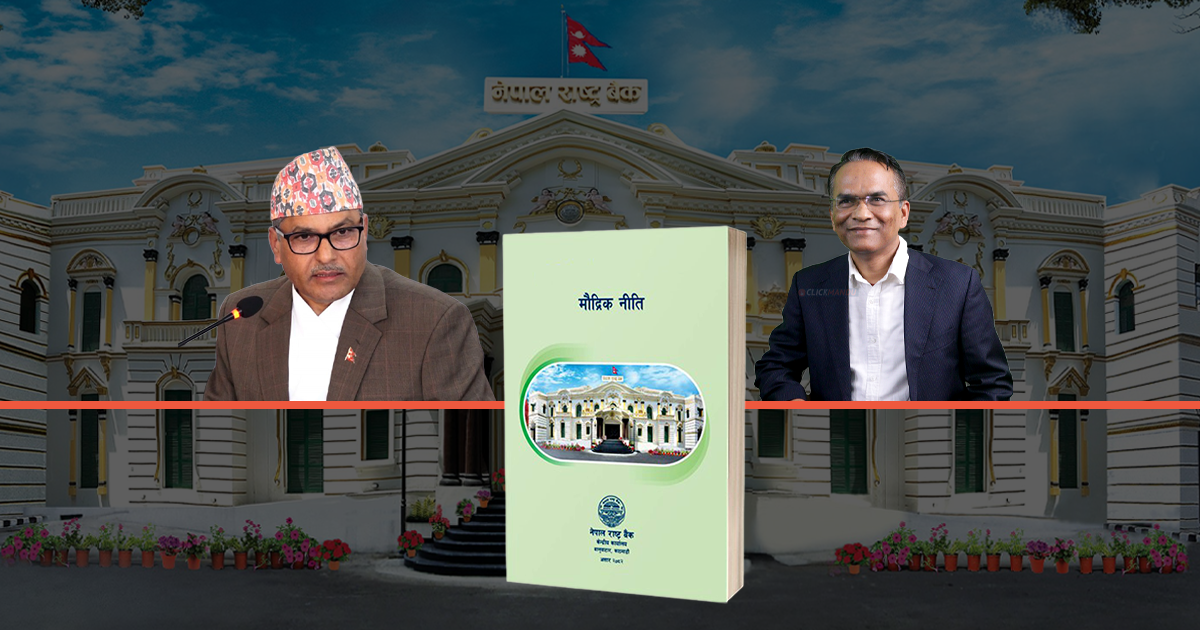

Kathmandu: In the hallowed halls of the Nepal Rastra Bank, the change of a Governor signifies far more than a mere administrative transition; it represents a fundamental shift in the nation’s monetary philosophy.
When Professor Dr Bishwonath Paudel assumed leadership as the 18th Governor on May 19, 2025, he inherited a paradoxical economy. While the external sector was robust with record-breaking foreign exchange reserves, the domestic economy was suffocating under profound stagnation.
Paudel faced a dual mandate: to provide immediate relief to a private sector battered by the restrictive policies of his predecessor and to channel massive idle liquidity into productive investment. Given his elite academic pedigree from prestigious American and Chinese universities and his experience as Vice-Chairman of the National Planning Commission, the market hailed his appointment as the arrival of a “Visionary Economist.” However, a granular analysis of his first year suggests that his primary focus has been “reversing the locks” installed by his predecessor, Maha Prasad Adhikari, rather than implementing a distinct, original blueprint.
As Dr Paudel prepares to unveil his second Monetary Policy, the expectations are significantly higher. While he has traditionally aimed to release the policy before the start of the new fiscal year, he technically has until the end of July. His first year was characterized by a concerted effort to shed the “Adhikari hangover.”
He systematically untied the knots Adhikari had tightened around margin-nature share loans, real estate credit, and working capital guidelines. Yet, despite these corrective measures, the economic engine remains cold. Banks are flush with cash—exceeding 1.1 trillion rupees in excess liquidity—but investor confidence remains at an all-time low. The central question now is whether Paudel’s second policy will transition him from a mere “policy fixer” to a visionary economist capable of structural transformation.
To understand Paudel’s current trajectory, one must look at the legacy of Maha Prasad Adhikari, whose tenure from 2020 to 2025 was a rollercoaster of crisis management. The post-COVID recovery and the subsequent external sector shock defined Adhikari’s leadership. Initially, he adopted an extremely loose stance to save the economy from the pandemic’s impact, expanding refinancing and subsidized credit to the point of “helicopter money.”
This led to private-sector credit growth of 27.3 per cent, inadvertently triggering an import surge and a historic depletion of foreign exchange reserves. To counter this, Adhikari pivoted to a “cautiously tight” stance in 2022, hiking policy rates to 8.5 per cent, imposing 100 per cent cash margins on imports, and strangling credit flow.
While he successfully saved the reserves—which now stand at a staggering US$ 24.19 billion, enough to cover 19 months of imports—the price was paid by the domestic market. Demand collapsed, and the economy entered a state of “induced lethargy” that persists today.
Governor Paudel’s entry in 2025 was marked by an “unlocking” strategy. With reserves at a comfortable high, he adopted a “flexibly cautious” stance in his first Monetary Policy for 2025/26. He positioned himself as a market-oriented leader, revising working capital guidelines to give businesses more breathing room and aggressively slashing interest rates.
He reduced the policy rate from 5 per cent to 4.25 per cent and lowered other corridor rates, pushing interest rates to historic lows. Furthermore, he scrapped the caps on share loans and reduced risk weights for real estate and construction to revitalize those sectors. He even increased the limit for first-time home loans to 30 million rupees. While these moves earned him a “populist” image among bankers and businessmen, they were essentially reactive measures designed to undo Adhikari’s rigidity. His own original expertise has yet to be fully reflected in the central bank’s policy instruments.
The stagnation in credit growth highlights the limitations of Paudel’s first-year approach. Despite record-low interest rates and loosened regulations, credit expansion reached only 3.6 per cent in the first half of the year against a target of 12 per cent. This suggests that the problem is no longer just the “locks” on credit, but a deeper lack of demand and confidence.
Analysts argue that simply being “the opposite of Adhikari” is not a vision. As a high-level economist with experience at the International Labour Organization, Paudel is expected to do more than just adjust interest rates like a traditional commercial banker. The market is looking for a policy that links credit flow directly to job creation, addresses the imbalance between bank profits and borrower distress, and directs stagnant capital into sectors with high value-added potential, such as information technology, hydropower, and cement.
Governor Paudel’s vision centres on the synchronization of fiscal and monetary policy. He has frequently advocated for the Finance Ministry to take the “driver’s seat,” with the central bank acting as a facilitator for government objectives
Expert opinions on Paudel’s performance are a mix of patience and pressure. Former Governor Dr Chiranjibi Nepal, known for his bold decision to hike bank capital requirements, suggests that Paudel must now take a daring step to leave a lasting mark on economic history.
While the first year may be excused as a learning phase, the upcoming policy must carry Paudel’s personal intellectual stamp.
Similarly, Dr Prakash Kumar Shrestha, a former executive director at the NRB, views the past year as a period of “rewinding” old mistakes, expressing hope that the new policy will feature original initiatives. However, former banker Parshuram Kunwar Chhetri offers a more sombre perspective, noting that the central bank’s mandate of price and external stability has largely been met, leaving little room for purely monetary solutions to what might be a structural fiscal problem.
Looking ahead, Governor Paudel’s vision centres on the synchronization of fiscal and monetary policy. He has frequently advocated for the Finance Ministry to take the “driver’s seat,” with the central bank acting as a facilitator for government objectives. He believes in less regulation but more effective supervision, moving away from micro-managing banks and toward ensuring credit quality and depositor safety. To truly succeed, his next policy must differentiate interest rates between productive and purely trading sectors, accelerate the piloting of the National Central Bank Digital Currency (CBDC), and foster fintech innovation to bring the informal economy into the formal fold.
The stakes for the 2026/27 Monetary Policy are immense. Dr Paudel must balance the Prime Minister’s desire for rapid development and good governance with the necessity of maintaining the central bank’s autonomy. He faces a government that has recently made aggressive administrative moves, yet he must remain a steady partner in driving the “Big Push” for the economy. Without deep internal deliberation among the various departments of the central bank, any major policy shift risks being incomplete.
As the market watches closely, the defining moment of Paudel’s career approaches: will he be remembered as the Governor who merely opened the doors his predecessor closed, or as the economist who built a new gateway for Nepal’s prosperity? The second Monetary Policy will be his answer.

Comment Here