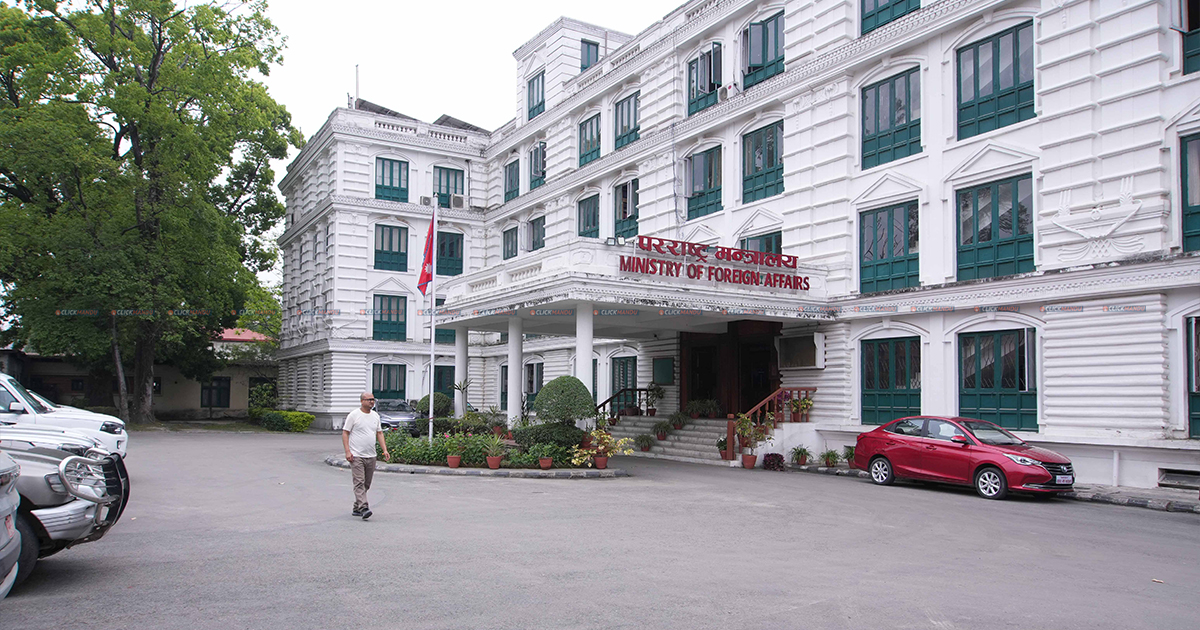

Kathmandu: The completion of the first hundred days of the government led by Balendra Shah marks a significant milestone in the evolution of Nepal’s foreign policy and administrative governance.
Since its inception, this administration has placed the ideals of good governance and streamlined service delivery at the very heart of its mandate. The Ministry of Foreign Affairs, as the primary vehicle for projecting Nepal’s interests onto the global stage, has undergone a notable shift during this period. The ministry’s progress report outlines a transition from traditional, often opaque diplomatic practices toward a more transparent, accountable, and technology-driven framework.
This era is characterized by an effort to make the ministry not just a centre for high-level political dialogue, but a proactive service provider for the millions of Nepalis living and working abroad. The administration maintains that these first hundred days have laid a robust foundation for a foreign policy that is both citizen-centric and strategically aligned with the nation’s long-term economic goals.
One of the most visible successes of the ministry’s hundred-day plan is the integration of cutting-edge technology into consular services. Recognizing the immense challenges faced by the Nepali diaspora in accessing government support, the ministry developed and launched the “MoFA Mitra” mobile application.
This digital platform serves as a virtual bridge, allowing citizens in distress to seek consular assistance, track their applications, and receive critical information in real-time. Complementing this digital push, the Department of Consular Services has successfully decentralized its online legal and consular consultation services. What was once a centralized process requiring a journey to the capital is now accessible across all districts and within five hundred and thirty-seven local government units. This expansion represents a significant step toward democratizing diplomatic services and ensuring that the state’s protective reach extends to the most remote corners of the country and the most vulnerable members of the migrant workforce.
The administration’s commitment to protecting the rights and dignity of its citizens abroad was put to a rigorous test during a major legal crisis in Portugal. Approximately two thousand Nepali residents in Portugal found themselves in a precarious situation when it was discovered that the consular verification seals on their original police character certificates had been forged.
This forgery threatened their ability to secure temporary residency permits, putting their livelihoods and legal status at risk. In a display of active diplomacy, Foreign Minister Shisir Khanal and Foreign Secretary Amrit Bahadur Rai engaged in direct, high-level negotiations with their Portuguese counterparts. These persistent diplomatic efforts eventually led to a resolution that validated the status of the affected citizens, demonstrating that the new administration is willing to deploy its top-tier diplomatic capital to resolve the practical grievances of the diaspora.
Beyond legal disputes, the ministry has shown remarkable agility in responding to human rights crises and criminal exploitations. In Southeast Asia, the rise of online “scam centres” has led to the trafficking and forced labour of many individuals, including Nepalis. During these hundred days, the ministry, in close coordination with various Nepali missions, successfully rescued and repatriated eight hundred and nineteen victims who had been trapped in these fraudulent operations.
Simultaneously, the government’s continuous diplomatic engagement with Gulf nations yielded significant humanitarian results. On April 14, the government of the United Arab Emirates granted pardons to one hundred and twenty-eight Nepali prisoners, followed by a similar gesture from the Saudi Arabian government, which pardoned thirty-three Nepali nationals on June 30. These successful negotiations for clemency underscore a strategic shift toward a diplomacy that prioritizes the welfare of the labour force as a central tenet of bilateral relations.
In the realm of neighbourhood diplomacy, the ministry has moved to resolve long-standing trade irritants through constructive dialogue. The export of Nepali tea to India, which had frequently faced non-tariff barriers and administrative hurdles, was a priority during this period. Through sustained communication between the Ministry of Foreign Affairs, the Nepali Embassy in New Delhi, and the Indian Ministry of External Affairs, several of these export bottlenecks were cleared. Furthermore, the ministry demonstrated its capacity for crisis management during the escalating tensions in West Asia.
By establishing a twenty-four-hour emergency response group within the ministry, the government was able to monitor the safety of a large number of Nepali citizens in the region. This proactive stance resulted in the safe return of one thousand and forty-seven individuals from conflict-prone areas, highlighting the ministry’s evolving role as a guardian of national security in a volatile global environment.
The reform of the passport distribution system remains another critical pillar of the ministry’s hundred-day achievements. A new, more efficient passport issuance system is scheduled to be fully operational by July 13, with preparations at the Department of Passports nearly complete. To ease the burden on citizens living in countries without a formal Nepali diplomatic presence, the ministry has introduced mobile passport collection and distribution services.
Furthermore, a landmark agreement was signed on July 2 with the Department of Postal Services to facilitate the delivery of passport services to districts and area administration offices. This collaboration, which came into immediate effect, aims to eliminate the need for citizens to travel long distances for passport applications, making the process more accessible and reducing the administrative congestion at central offices.
Under the leadership of Prime Minister Balendra Shah, the ministry has also redefined the protocol for high-level diplomatic engagement. On April 8 and again on May 26, the Prime Minister held collective courtesy meetings with ambassadors and heads of foreign missions based in Kathmandu. These gatherings, which included representatives from the European Union and various major powers, served as a platform for the administration to articulate its core foreign policy objectives directly to the international community.
By choosing collective interactions over fragmented individual meetings, the Prime Minister has sought to standardize diplomatic communication and ensure that Nepal’s message of sovereign equality and mutual respect is delivered consistently to all development partners.
Economic diplomacy has been elevated to a position of high priority in the government’s strategic agenda. The ministry is currently developing country-specific strategies designed to maximize bilateral economic cooperation and align foreign aid with the national goal of prosperity. This approach moves beyond traditional political rhetoric toward identifying specific areas of mutual benefit, such as investment promotion, tourism development, and information technology. By mobilizing Nepali missions abroad to conduct targeted economic diplomacy programs, the administration aims to utilize international relations as a catalyst for rapid socio-economic transformation. These strategies are being tailored to reflect the unique strengths and needs of each partner nation, ensuring that Nepal’s diplomatic outreach is both focused and results-oriented.
A significant strategic decision made during this period concerns Nepal’s graduation from the category of Least Developed Countries (LDCs). While the United Nations had previously scheduled Nepal for graduation on November 24, 2026, the Shah administration conducted a thorough review of the prevailing national and international economic and political landscapes.
Recognizing the need for a more stable economic foundation post-pandemic, Foreign Minister Khanal formally requested the Chairman of the UN Committee for Development Policy on May 13 to postpone the graduation until November 2029. This decision reflects a pragmatic approach to development, prioritizing long-term economic resilience over premature symbolic milestones. During the same period, the ministry also revitalized talks regarding the long-pending demands of former British Gurkhas, with Minister Khanal conducting virtual high-level discussions with UK Defence Secretary John Healey and other senior officials to ensure that the rights and grievances of the Gurkha community remain on the bilateral agenda.
On the multilateral stage, Nepal has successfully asserted its voice as a representative of landlocked developing nations. At the Ninth Indian Ocean Conference held in Mauritius on April 9, Minister Khanal articulated Nepal’s specific concerns regarding maritime access, regional connectivity, and the challenges of climate change. By emphasizing the need for inclusive and rule-based maritime governance, Nepal has positioned itself as an active proponent of regional cooperation.
Additionally, the ministry has successfully concluded several rounds of bilateral consultation mechanism meetings with countries such as Romania, Norway, Switzerland, Egypt, and Denmark. These interactions have been instrumental in securing labor agreements with thirteen different nations, ensuring that the migration of Nepali workers is conducted within a framework that is dignified, safe, and legally protected.
The promotion of Nepal’s “soft power” and cultural heritage has also seen remarkable progress. For the first time, following a proposal by Nepal, the United Nations officially declared April 15 as International Wellness Day. To mark the inaugural celebration, the ministry organized a “Wellness Hike” along the Hattiban-Champadevi trail, projecting an image of Nepal as a global centre for health and spiritual well-being.
In a major victory for cultural diplomacy, a historic agreement was signed on April 24 with the South Asia Institute at Heidelberg University in Germany for the repatriation of eight-hundred-year-old historical manuscripts. These efforts to reclaim national heritage and promote Nepal’s intellectual history, exemplified by the successful fifth edition of the Yadunath Khanal Lecture Series, are vital for elevating the nation’s international prestige and fostering a sense of national pride.
Finally, the ministry has taken unprecedented steps toward institutional meritocracy and diaspora engagement. For the first time in the history of Nepal’s foreign service, the ministry issued an open call for applications for ambassadorial positions, attracting nearly three thousand applicants. This move represents a departure from the traditional system of political patronage, seeking instead to tap into the vast pool of professional talent within the country.
Similarly, the ministry is prioritizing the revision of the Non-Resident Nepali (NRN) Act to better utilize the skills, capital, and networks of the global Nepali community for national development. To foster a new generation of diplomatic expertise, the ministry also launched its first-ever internship fellowship program through the Institute of Foreign Affairs, selecting twenty researchers from over twelve hundred applicants to conduct a study on economic diplomacy and diaspora affairs.
Through these multi-faceted initiatives, the Ministry of Foreign Affairs under the Balendra Shah government has demonstrated a clear intent to modernize Nepal’s international engagement, ensuring that diplomacy serves as a powerful engine for both national dignity and economic prosperity.

Comment Here