
Kathmandu: Nilgiri Khola Hydropower Company is projected to achieve a robust 20 percent annual growth in operating income, signalling a strong upward financial trajectory.
By the third quarter of the 2026 fiscal year, the company’s total operating income reached Rs 1.683 billion, while its operating profit margin showed significant improvement, climbing to 82 percent.
In 2025, the company recorded electricity sales totalling Rs 1.87 billion. The increased output from its 38 MW Nilgiri Khola-1 and 71 MW Nilgiri Khola-2 projects in the Myagdi district led to a substantial reduction in under-supply penalties, which dropped from Rs 232 million last year to Rs 152 million this year. This reduction in overhead costs has directly contributed to a marked improvement in the company’s net profit.
The company’s financial turnaround is evident in its net profit figures, which surged from a modest Rs 7 million in the 2025 fiscal year to Rs 416 million by the third quarter of the current fiscal year. Furthermore, the company’s total cash reserves have strengthened considerably, growing from Rs 509 million to Rs 795 million during this period.
Management attributes this production boost to heavy winter snowfall and favourable water flow during the first ten months of the 2026 fiscal year. During this timeframe, the Plant Load Factor (PLF) for Nilgiri Khola-1 rose to 73.56 per cent. In comparison, Nilgiri Khola-2 reached 69.62 per cent, representing significant growth compared to the previous year’s figures of 71.64 percent and 54.76 percent, respectively.
Despite these gains, the company’s capital structure remains heavily leveraged due to the substantial loans taken during project construction. As of mid-April 2025, the overall gearing ratio, the proportion of debt to equity, stood at 3.03 times. While this remains high, it shows a positive trend compared to the 3.79 times recorded in the previous year.
Moving forward, the company plans to enhance operational efficiency to eliminate penalties. Central to its long-term strategy is the issuance of an Initial Public Offering (IPO), with the proceeds earmarked for systematic debt reduction and financial restructuring.
Established in August 2012 and converted into a public limited company in September 2014, the firm is backed by prominent investors. Key individual promoters include Maheshwar Prakash Shrestha with a 31.57 percent stake and Prithvi Bahadur Pande with 15.10 percent. Beyond individual investment, established private equity firms such as Lotus Investment Fund and Himalayan Infrastructure Fund have made significant institutional commitments to the project.
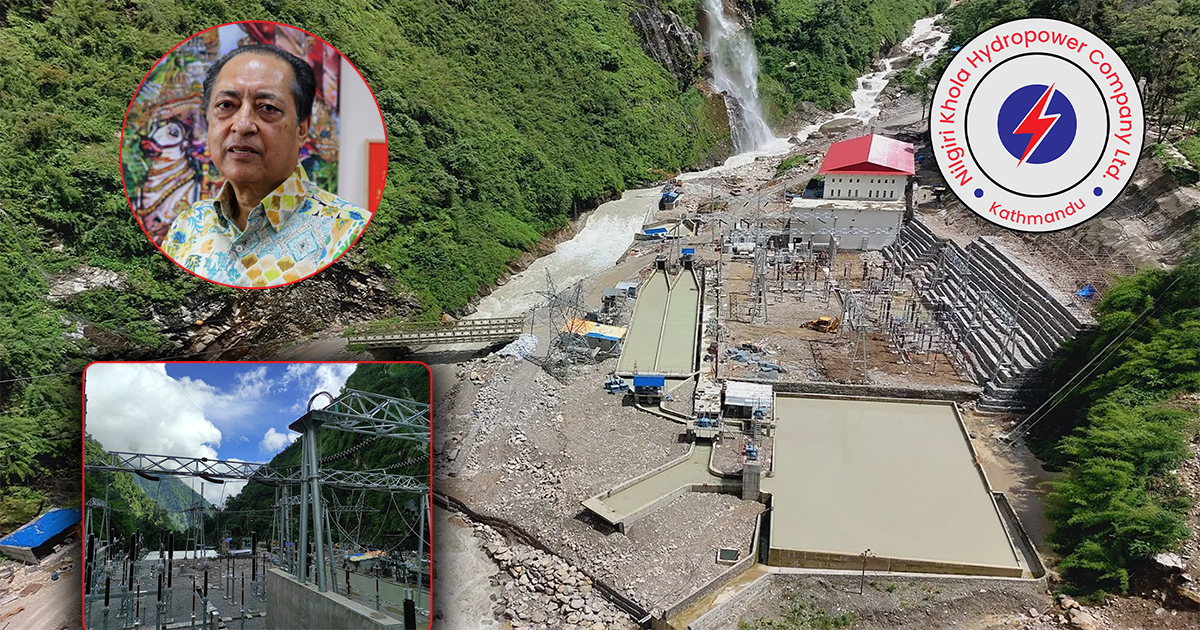
The company operates two major facilities in Myagdi that harness the Nilgiri River. The 38 MW Nilgiri Khola-1, which began commercial operations on August 5, 2024, utilizes a 150-square-kilometre catchment area. This is complemented by the 71 MW Nilgiri Khola-2 cascade project, which serves a 160-square-kilometre catchment area and began commercial production on April 6, 2024.
Both projects operate under 30-year Power Purchase Agreements (PPA) with the Nepal Electricity Authority. Nilgiri Khola-1 is contracted to supply 211.84 million units annually, while Nilgiri Khola-2 is slated for 387.17 million units. Notably, both plants were commissioned ahead of schedule; Nilgiri Khola-1 began production a week early, and Nilgiri Khola-2 started eight months ahead of its December 2024 deadline.
The electricity tariff is set at Rs 4.80 per unit during the wet season and Rs 8.40 per unit during the dry season. The agreements also include a provision for a 3 percent annual price escalation on the base tariff, applicable up to eight times over the contract duration.
As the company prepares for its IPO, the rating agency Infomerics has assigned it an issuer rating of Double B Plus (BB+). This rating reflects the significant improvements in both the financial and operational management of the two hydropower projects, affirming the company’s stabilizing position in the energy sector.

Comment Here