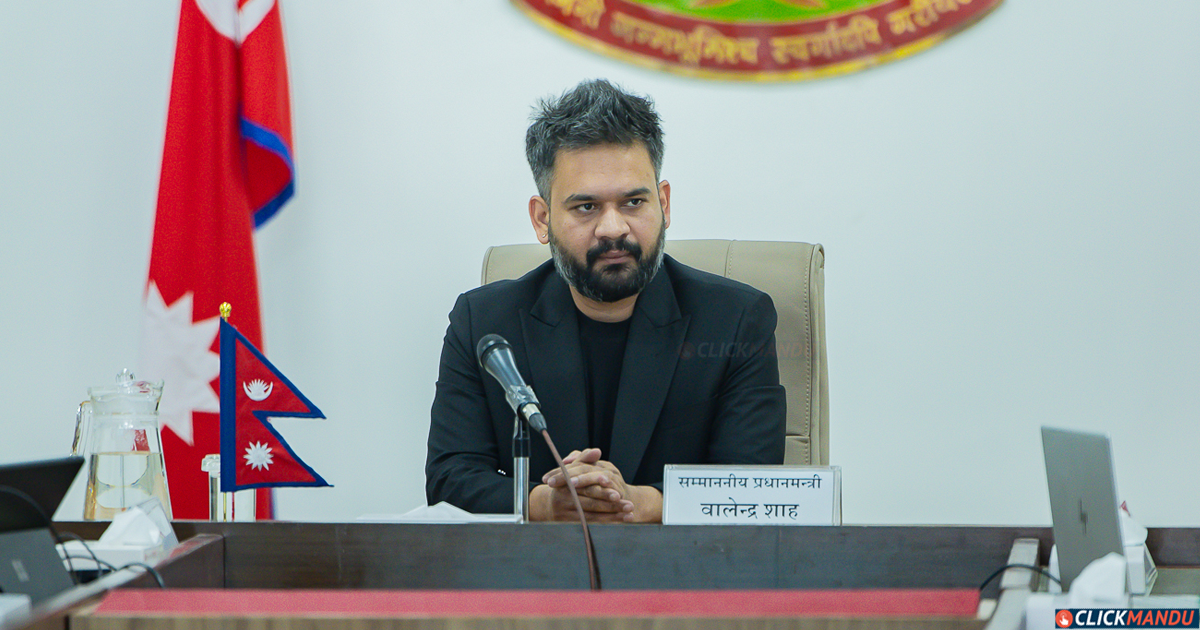

Kathmandu: Prime Minister Balendra Shah held his first formal meeting with representatives from the construction industry since taking office to address the systemic challenges hindering national development.
During the session on Thursday, the Prime Minister held in-depth discussions with a delegation from the Federation of Contractors’ Associations of Nepal on the multifaceted obstacles currently plaguing the infrastructure sector.
The high-level delegation, which included Federation President Nicholas Pandey, Senior Vice President Mukesh Panta, and General Secretary Shivahari Ghimire, presented a comprehensive eight-point memorandum. This document outlined the industry’s most pressing grievances and proposed strategic solutions to revitalise stalled projects nationwide.
General Secretary Ghimire noted that the Prime Minister maintained an inquisitive and proactive stance throughout the hour-long meeting, frequently posing counter-questions to better understand the ground realities. While signalling a willingness to address the contractors’ demands, the Prime Minister remained firm in his insistence on strict adherence to good governance, high-quality standards, and a zero-tolerance policy toward corruption in public works.
The contractors highlighted several critical bottlenecks, including the urgent need for price adjustments to counter inflation, the backlog of payments, and the status of “sick” or stagnant projects. The discussion also covered logistical hurdles such as right-of-way disputes, the scarcity of raw materials, the lack of designated crusher zones, and the failure of government departments to provide project-specific norms and technical specifications.
A significant portion of the meeting focused on the need for legislative reforms within the Public Procurement Act and regulations, as well as the acute shortage of skilled labour. A breakthrough was reached regarding project timelines, with an agreement in principle to grant deadline extensions for approximately 2,000 small and large-scale projects that have faced unprecedented delays.
The construction sector has been severely impacted by global market fluctuations since late February, when geopolitical tensions between the US and Iran contributed to a surge in raw material costs and supply chain disruptions. The Federation argued that these external factors made it impossible to complete projects within original budgets and timeframes, necessitating a more flexible government approach to extensions and cost-sharing.
Drawing on his professional background as an engineer, Prime Minister Shah demonstrated a sophisticated understanding of the technical complexities involved in field operations. He issued a strict directive for the mandatory presence of qualified engineers at every construction site to ensure technical integrity. He further warned that delays and financial irregularities would not be tolerated, urging contractors to report any instances of bureaucratic harassment or bribe solicitations directly to his office.
The Prime Minister committed to eliminating the burdensome requirement for contractors to navigate a maze of ministries and departments to resolve simple operational issues. He assured the industry that the government would take the lead in clearing administrative hurdles such as site access and forest permits, provided that the contractors focus entirely on efficient execution and fulfil their contractual obligations.
Addressing the industry’s demand for a price adjustment of approximately Rs 15 billion to offset recent inflationary pressures, the Prime Minister promised to bring the matter before the Ministry of Finance and the Cabinet. By acknowledging the extraordinary rise in costs since the recent global economic shifts, the government aims to stabilize the sector and ensure that vital infrastructure projects reach completion without further financial gridlock.

Comment Here