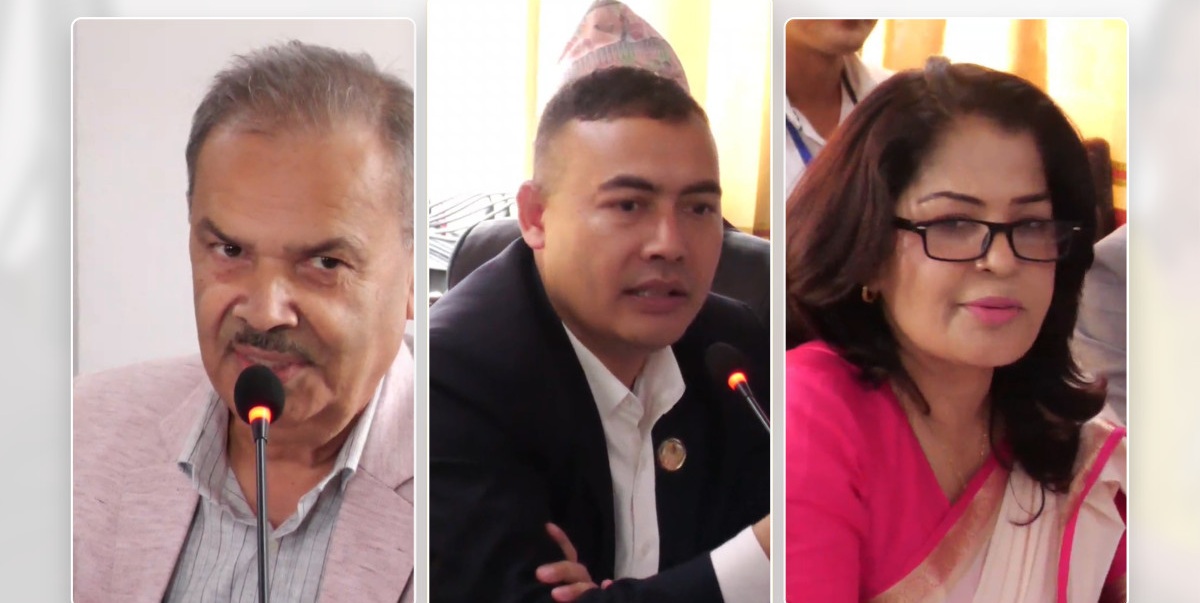

Kathmandu: The Finance Committee of Nepal’s House of Representatives has become a focal point for a significant legislative debate regarding the structural integrity and operational independence of the nation’s central bank.
As lawmakers deliberate on the proposed amendments to the Nepal Rastra Bank Act, 2058, the central point of contention has emerged as the presence of the Finance Secretary on the bank’s Board of Directors. Many members of the committee expressed deep-seated anxieties that the inclusion of a high-ranking government official in the central bank’s highest decision-making body could serve as a conduit for direct executive interference, potentially compromising the monetary authority’s ability to act in the best interest of the economy without political bias.
Leading the charge for a more insulated central bank, Rastriya Swatantra Party (RSP) lawmaker Lima Adhikari Acharya argued forcefully that the current structure needs a fundamental overhaul to bolster institutional autonomy. Acharya posited that if the central bank is to maintain its credibility and effectively manage monetary policy, the Finance Secretary should be removed from the board and relegated to the role of an invited member or a non-voting observer.
She warned that the current arrangement risks allowing the executive branch to exert undue pressure on the formulation of monetary policy, which should ideally be governed by economic data rather than electoral cycles or fiscal deficits. To further enhance transparency, she proposed the establishment of a dedicated ‘Monetary Policy Committee’ whose decisions and deliberations should be made public, ensuring that the bank remains accountable to the broader citizenry rather than just the government of the day.
The debate also touched upon the necessity of modernization and inclusivity within the bank’s leadership. Acharya advocated for mandatory female representation on the board, arguing that a diverse leadership team is essential for a contemporary financial regulator. Furthermore, she suggested that the recruitment pool for the position of Deputy Governor should be expanded to include qualified external experts, moving away from the traditional practice of promoting exclusively from within the bank’s internal bureaucracy.
On the controversial issue of the ‘cooling period,’ the duration a retired bank official must wait before taking up new appointments, she proposed reducing the timeframe from the suggested three years in the bill to two years. She also criticized existing provisions that disqualify bank CEOs or directors for five years due to minor technical errors, labelling such a blanket ban as anachronistic and calling for a legal distinction between administrative lapses and criminal negligence.
In stark contrast to these concerns, the Governor of Nepal Rastra Bank, Dr Biswonath Paudel, offered a pragmatic defence of the status quo regarding board composition. Based on his tenure, Paudel asserted that he had not experienced any sense of government interference due to the Finance Secretary’s presence. Instead, he argued that having a direct link to the Finance Ministry facilitates essential coordination between fiscal and monetary policies, which is particularly vital for a developing economy like Nepal’s.
While he acknowledged the debate over the cooling period, he emphasized that the state should prioritize merit and expertise, ensuring that the government can utilize the wisdom of seasoned professionals where appropriate without being hindered by excessive bureaucratic barriers. He also cautioned against expanding the board beyond its current seven-member structure, noting that a larger body would likely face logistical hurdles and risks in its decision-making processes.
Adding another layer to the RSP’s perspective, lawmaker Sushil Khadka noted that while operational autonomy is a non-negotiable requirement for the central bank, it remains a fundamental organ of the state that cannot operate in total isolation from the government’s strategic national vision. Khadka emphasized the need to inject “new blood”—younger, more tech-savvy professionals—into the bank’s workforce to navigate the complexities of the modern fintech era.
This sentiment was echoed in a different form by lawmaker Parshuram Tamang, who raised critical questions about the cost-benefit analysis of banking digitalization. Tamang pointed out that for a Least Developed Country (LDC) like Nepal, the high costs associated with digital transformation could have significant repercussions on the Gross Domestic Product. He specifically requested a clear roadmap from the central bank on how it intends to mitigate the systemic risks posed by the rise of cryptocurrencies and other unregulated digital assets.
Bringing a procedural perspective to the committee, CPN-UML lawmaker Dr Pushpa Raj Kadel advised the government to adopt a more holistic approach to financial sector reform. Kadel suggested that the amendments to the Nepal Rastra Bank Act should be discussed and processed alongside the Bank and Financial Institutions Act (BAFIA) and the Banking Offence and Punishment Act. He argued that since these pieces of legislation are deeply interconnected, debating them in silos could lead to legal contradictions and implementation bottlenecks in the future.
As the Finance Committee continues its deliberations, it is clear that the final shape of the amendment bill will have a profound impact on the future of Nepal’s financial governance, balancing the delicate scales between state coordination and the necessary independence of the monetary regulator.

Comment Here